The alpha, twice a week
That was 3 min.
Get the best new moments in your inbox every Wednesday and Saturday. It's free.
Check your inbox
We sent a link to your address. Click it to finish signing up. Not there in a minute? Look in spam.
or
Bloomberg Surveillance · 3 min · Nov 12, 2026
A 20% market drop could push GDP growth close to zero
 Anna Wong
 models a further 20% S&P 500 decline and estimates its effects on GDP, unemployment and inflation.
The episode’s best minutes
Full analysis- 38:21Huang changed how chipmakers sell and finance AI growthPro pick 3 min
- 29:37A 20% market drop could push GDP growth close to zero3 min
- 7:18Chipmakers could gain ground if Nvidia’s innovation slows3 min
- 3 more moments in the full episode
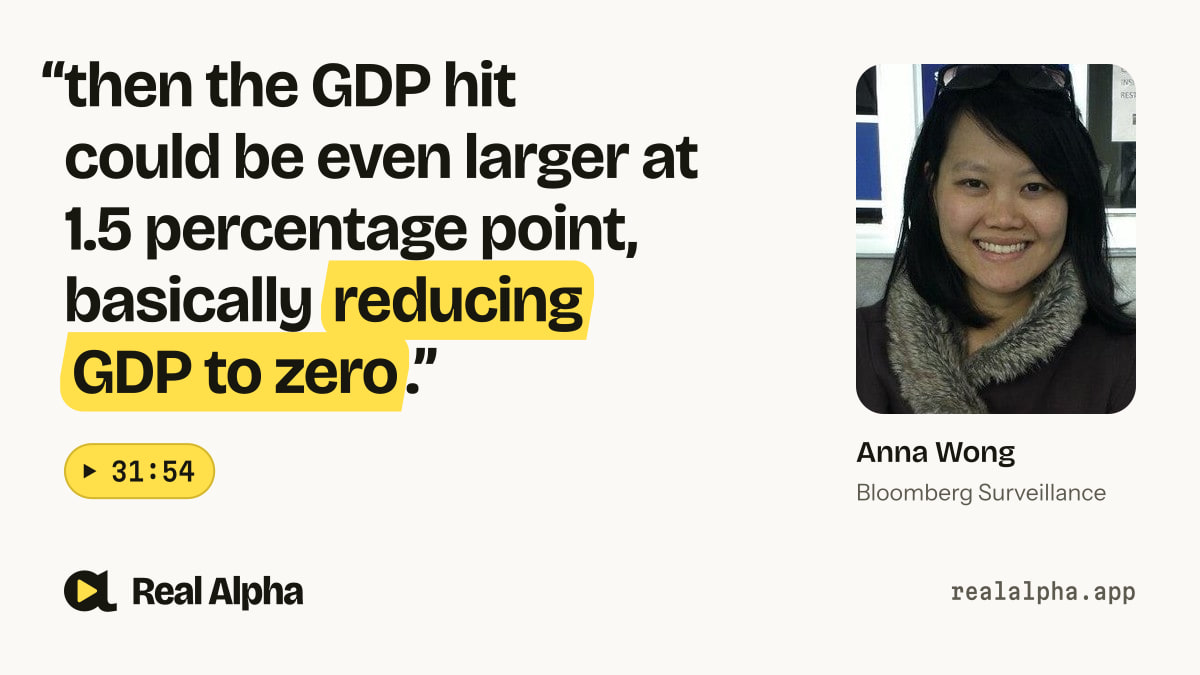
“then the GDP hit could be even larger at 1.5 percentage point, basically reducing GDP to zero.”
 Anna Wongat 31:54 · Bloomberg Surveillance
Takeaways
- A 20% S&P decline could subtract about 1 point from GDP.
- Unemployment could rise by roughly 0.5 percentage point.
- Without a Fed offset, the GDP hit could reach 1.5 points.
About this segment
Anna Wong models a further 20% S&P 500 decline and estimates its effects on GDP, unemployment and inflation. She says a lack of Fed rate cuts could make the economic hit larger.

Chief US Economist, Bloomberg Economics
Leads Bloomberg Economics' US analysis after roles at the Fed, White House Council of Economic Advisers and Treasury.
- TK
Tom Keene, Host
- PS
Paul Sweeney, Host
From “Jensen Huang Ousted by Nvidia Board as CEO | Bloomberg Surveillance”, Nov 12, 2026. Watch the full episode
Thanks. We'll look at and fix what's off.
Transcript
From the transcript Bloomberg Surveillance publishes with the episode.
- 29:40
Wong, the economic impact of this crisis at NVIDIA. Yes. One way to think about this is to ask ourselves, what if this NVIDIA shock becomes more of a given other impulse to this AI sell-off and leading to a broader equity correction? So if you simulate the shock in the Fed's Fervus general equilibrium model, so suppose that S & P 500 fall by another 20%. So we found that it will roughly subtract one percentage point. To GDP it will barely do anything to inflation because typically- equity price correction just do not- just not just equity but- any demand shock just do not really move the- dial on inflation.
- 30:35
Unemployment rate will rise by roughly point five percent. Point in the next year so that pushes. if the baseline is 4.2% on the street, then that could push it to 4.7%. And the mechanism of all this is primarily through the consumer wealth channel, right? So currently about 40% of household net worth is tied to equity and So when you have an equity correction like this, it could affect the GDP consumption through that channel. But I think the risk for this particular time that we are living in is that it could be a bigger impact because the Fed is not going to react. So even in the Fed's own model, it says the Fed should be– reducing rates by 50 pips. But right now, the Fed is thinking about or Chris Waller is talking about.
- 31:32
Raising rates by 50 pips. So it actually removed this very powerful offsetting channel against these drag on the economy. And so if the Fed, if the equity correction would not do anything to inflation and the Fed is on track to not hike, as the SEP says, or even hike by 80 bps, as the Warp or the future suggests, then the GDP hit could be even larger at 1.5 percentage point, basically reducing GDP to zero.
- 32:04
Have you ever heard Anna Wong this gloomy?