The alpha, twice a week
That was 6 min.
Get the best new moments in your inbox every Wednesday and Saturday. It's free.
Check your inbox
We sent a link to your address. Click it to finish signing up. Not there in a minute? Look in spam.
or
The Diary Of A CEO · 6 min · Nov 19, 2026
A billionaire wealth tax could fund major social programs
 Bernie Sanders
 proposes a 5% annual tax on billionaires and says it could raise about $400 billion a year.
The episode’s best minutes
Full analysis- 36:07AI threatens jobs, privacy and human control8 min
- 28:02A billionaire wealth tax could fund major social programsPro pick 6 min
- 50:35Media ownership shapes which issues get airtime4 min
- 4 more moments in the full episode
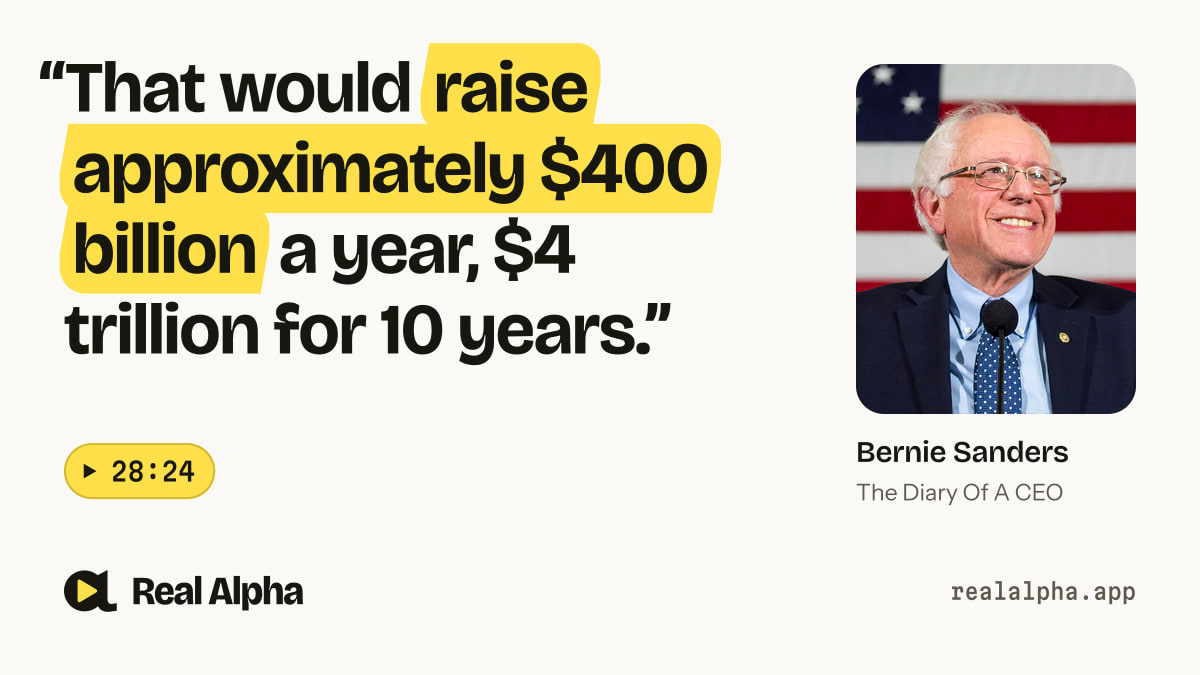
“That would raise approximately $400 billion a year, $4 trillion for 10 years.”
 Bernie Sandersat 28:24 · The Diary Of A CEO
Takeaways Pro pick
- Sanders estimates the tax would raise $400 billion annually.
- He says the money could fund childcare, housing and free college.
- He agrees tax-free loans against assets are a loophole lawmakers could close.
One of Pro's picks, open to you here. Try Pro free for 7 days
One of Pro's picks. The rest of the summary and the 3 takeaways are in Real Alpha Pro; the video, the quote and the transcript stay free.
Read it with Pro, 7 days freeAbout this segment
Bernie Sanders proposes a 5% annual tax on billionaires and says it could raise about $400 billion a year. The exchange also examines the challenge of taxing illiquid wealth and closing tax-free borrowing loopholes.

Bernie Sanders is an U.S. senator and independent.
Passed bipartisan VA health-care reform and has long championed working families, Medicare and narrowing wealth inequality.

Steven Bartlett, Host · Host, The Diary Of A CEO
From “Senator Bernie Sanders: Iran Wasn't Trump's Idea. Someone Else Pushed Him Into It!”, Nov 19, 2026. Watch the full episode
Thanks. We'll look at and fix what's off.
Transcript
From the transcript The Diary Of A CEO publishes with the episode.
- 28:05
Number two, at a time when the billionaire class is doing phenomenally well, it is appropriate that we impose upon them a wealth tax. Okay. Speak to me about this. Okay. Now, what that is, the bill that I've introduced is a 5% annual tax just on billionaires, about 2,000 individuals, not a whole lot of people. That would raise approximately $400 billion a year, $4 trillion for 10 years. Is that on income or assets?
- 28:34
Their wealth. So, all their assets? Yes, exactly. What they are worth at a given moment. And with that $400 billion, this is what we could do. Wipe out childhood poverty. We could have universal and free childcare. We could provide $3,000 stipend in the first year to every working class individual in the country under $150,000. We could make public colleges and universities tuition-free. We could build 7 million units of low-income and affordable housing.
- 29:06
So when you do that, it's a transfer of wealth from the people on top to working families. And we use that money to create an economy that works for workers and not the people on top. That's what you can do with that. One of the rebuttals I often hear with the idea of a wealth tax is when we think about startups, I was thinking about a bunch of my friends who have started a startup in the last two or three years.
- 29:30
And because there's been this huge boom in AI, their startup is now worth, honestly, in one case, $10 billion. I'm thinking about a guy called Noah who runs a brand called Instinct. And his company's just been valued at $10 billion. Now, under the proposal of a wealth tax, say the founder, I don't know, holds 95% of their value in equity, a 5% wealth tax would mean he was paying $500 million a year.
- 29:55
Noah doesn't have $500 million. He has, his salary might be, I mean, I don't know him personally, but his salary might be a couple hundred thousand dollars and he's never, his stock is- Well, also people, look, I could be wrong on this, but I think people like Bezos has a salary of $80,000 a year. Yeah. You know, because you don't want to pay taxes on your money. Look, the bottom line is- that the billionaire class is doing phenomenally well by working families struggle.
- 30:27
And that dynamic, they have got to be asked to pay their fair share of taxes because right now, many of these guys are paying an effective real tax rate lower than a truck driver or a nurse. And it does not make any sense to me. I think I really agree with that point. I think the mechanism is the tricky part, especially when people hop around different states, as we've seen in California recently, where there was a sniff of a wealth tax.
- 30:52
More than a sniff. Well, it looks like it's still progressing, right? It will end up with, I think, 47% of the vote after the billionaires spent over $300 million to defeat it. And a lot of them went to Florida. A lot of them have gone to Texas to get away from this wealth tax. Now, where are they going to go now? After Texas, after the elections, they have to leave Texas, I guess. But I guess the point I'm making is how this might kill innovation in private companies.
- 31:17
But Stephen, let's back that one up. Well, the guys, I was involved in this wealth tax in California. All right. Now, you would say, all right, what it was was a one-time wealth tax, okay? One time. And the money was going to go to provide health care to people who had lost their health care, okay? That was it. And you know what the billionaires said? They said, if you dare to pass this tax, we're going to leave the state of California.
- 31:44
Mm-hmm. Now, that's kind of ugly in a way. You could argue with me about economics, right? It wouldn't work. It's a bad idea. It could stifle innovation. Have that argument. It's like me putting a gun to your head, isn't it? Stephen, give me your wallet. I'll blow your brains out. If you guys pass this tax, we're out of here. You're going to lose your job. I think that's kind of the arrogance of...
- 32:06
that we are seeing from a ruling class today that thinks they are entitled to have it all. So you can work on the details of it. You make some good points. But at the end of the day, when so few have so much, it is appropriate that they start paying their fair share of taxes, and they are not doing that today. I find myself in this really weird position where- You're a billionaire. You don't want to pay more tax.
- 32:26
No, I'm very privileged to be wealthy. And at the same time, I think that there should be a mechanism where people like me shouldn't be able to hoard massive amounts of wealth while other people suffer. And so I think a lot about the mechanisms. I think about the trade-offs, because it's all trade-offs. I think if you did a 5% wealth tax against someone like my friend Noah, you'd basically kill his.
- 32:46
He does not have. I mean, when I was running my company for six years, that eventually became a public company. My peak salary was $150,000. I had loads of equity, which I was hoping at some point I might be able to sell to someone. But if you had taxed me, and you might have looked at my net worth and said, this guy's worth tens of millions, and you might have taxed me then, I would have been fucked.
- 33:05
The business would have been fucked. So that feels like it doesn't work. What I then figured out rich people do, which is a loophole, which when I started to get a little bit more money, someone whispered in my ear, was they said to me, they go, Stephen, do you know what you can do? you can take a tax-free loan against your equity. You pay no tax. That's right. So you take your equity, which is in this public company, and guess what?
- 33:26
This bank will give you 50% of it in cash, and you pay no tax. I thought, so why does anybody ever sell their equity if I can get a tax-free loan against it? And this is what the billionaires do. That's exactly right. That's what I mentioned with Bezos. Why don't you close that law? Yeah, well, we can. I mean, that's one of the things that we should be doing. Do you know what's funny? On that podcast, I just played for you.
- 33:47
They actually said that. They went, the thing that people should pass if they want to tax billionaires is stop us being able to take these tax-free loans on our assets. But the wealth tax thing, I think, is... I understand the principle of it, but the mechanism, I think, is counterintuitive. But you asked me about the things that we could do. The other thing I think that we can do