The alpha, twice a week
That was 3 min.
Get the best new moments in your inbox every Wednesday and Saturday. It's free.
Check your inbox
We sent a link to your address. Click it to finish signing up. Not there in a minute? Look in spam.
or
Bloomberg Businessweek · 3 min · Nov 4, 2026
A blue wave could leave defense spending below $1.5 trillion
Wayne Sanders says the $1.5 trillion defense plan is unlikely; with a blue wave, he expects $1.1–$1.15 trillion outside reconciliation.
In this episode
Full analysis- 1:05Polling limits make prediction markets less reliable7 min
- 17:28AI data center growth faces funding and infrastructure constraints3 min
- 28:53Record campaign spending has uncertain returns3 min
- 11:57AMD's Helios deployment will test its ability to take GPU share2 min
- 24:11US missile stockpiles cannot be replenished quickly2 min
- 21:41A blue wave could leave defense spending below $1.5 trillion3 min
- 32:12Crypto and AI spending followed different playbooks4 min
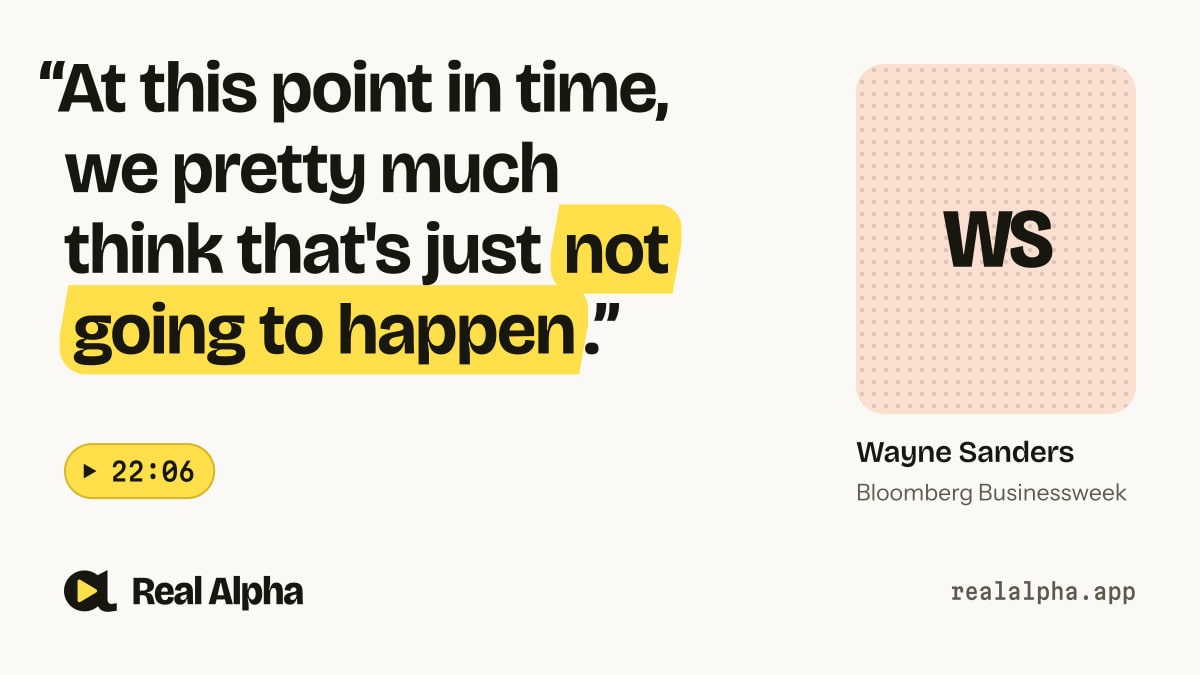
“At this point in time, we pretty much think that's just not going to happen.”
Takeaways
- Sanders expects $1.1–$1.15 trillion outside reconciliation if Democrats gain ground.
- Munitions and hypersonics were placed in the reconciliation bill.
- Some 200–300 companies could potentially be called to testify.
About this segment
Wayne Sanders says the $1.5 trillion defense plan is unlikely; with a blue wave, he expects $1.1–$1.15 trillion outside reconciliation. Munitions and hypersonics in that bill may need line-by-line negotiations.
Senior Defense Analyst, Bloomberg Intelligence
- CM
Carol Massar, Host

Tim Stenovec, Host · Co-host, Bloomberg
Interviewed leaders including Reed Hastings, Stephen Schwarzman and Mary Barra as a Bloomberg Businessweek co-host.
From “Midterms Notch Records on Early Voting, Ad Spending | Bloomberg Businessweek”, Nov 4, 2026. Watch the full episode
Thanks. We'll look at and fix what's off.
Transcript
From the transcript Bloomberg Businessweek publishes with the episode.
- 21:44
I want to start big and wide, some scope here. Are you watching any certain races in terms of how it might affect your world and the stuff that you write and cover?
- 21:55
I think really it's not so much about the races as it is going to be whether or not they're going to be tied into to the reconciliation bill side of the House versus the defense top line. So like you mentioned, one and a half trillion for the defense. At this point in time, we pretty much think that's just not going to happen. Really, anytime if there is a blue wave that comes in, you're going to start seeing the defense top line is probably going to be about 1.1, 1.15. And that's going to be the pieces outside of the reconciliation bill. The problem is that the Trump administration and the Pentagon put a lot of their high vulnerable things like munitions stockpile, as well as hypersonics and some of these others. They put these into the reconciliation bill, thinking that was going to be the leverage
- 22:39
to push it across the finish line. And so now that it's not in any type of this situation where you have Democrats coming in to provide additional pressure, you're going to have to see them go line by line, program by program in order to actually get this figured out.
- 22:54
Okay, so we often talk about the primes in the context of that $ 1. 1 to $ 1. 5 trillion. What about the insurgents, like a Palantir, for example, or an Anduril, for example, firms that have been closely aligned with this administration? Does their future shift at all if Democrats win the House and the Senate?
- 23:19
I think that there are certain programs. You know, this is a conversation I have with clients a lot. And the difference between the programs themselves that these companies are looking at versus the potential of the Musk slash, you know, Palmer Luckey, whether or not there are going to be some congressional investigations that are launched specifically against the companies that then could potentially slow things down.
- 23:41
Could Palmer Luckey be somebody? Sorry. Sorry, Wayne. Could could Palmer Luckey be somebody who's called to testify? He's the head of Anderle, the founder of Anderle.
- 23:50
Yeah, so I mean, they can be placed in specifically to do this. Nathan Dean, senior policy analyst, has a tracking mechanism specifically that's looking at this in terms of who are some of these companies. There's like 200 to 300 companies that could potentially be called. And so the ones on the defense side are mainly the ones that you'd be looking at that are closely aligned, such as like a SpaceX or an Anduril.