The alpha, twice a week
That was 2 min.
Get the best new moments in your inbox every Wednesday and Saturday. It's free.
Check your inbox
We sent a link to your address. Click it to finish signing up. Not there in a minute? Look in spam.
or
Bloomberg Law · 2 min · Nov 23, 2026
A CEO’s cover-up can outweigh the policy breach
Eric Talley says boards may forgive a policy violation when a CEO is candid and contrite.
The episode’s best minutes
Full analysis- 5:16The board faced competing risks after Trump intervened4 min
- 13:38A CEO’s cover-up can outweigh the policy breachPro pick 2 min
- 18:11Celebrity CEOs create governance risks when fortunes turnPro pick 2 min
- 2 more moments in the full episode
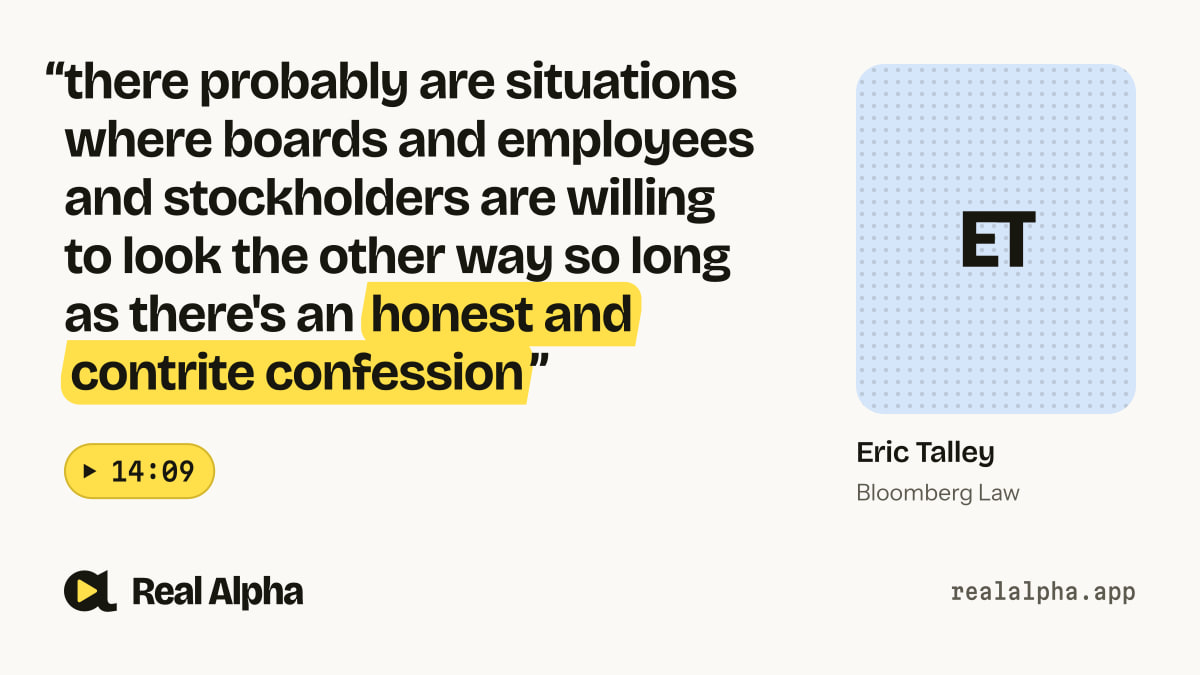
“there probably are situations where boards and employees and stockholders are willing to look the other way so long as there's an honest and contrite confession”
Takeaways Pro pick
- Power imbalances make supervisor-subordinate relationships risky.
- Candor can matter more than the underlying policy violation.
- The board’s loss of trust helped prompt Huang’s removal.
One of Pro's picks, open to you here. Try Pro free for 7 days
One of Pro's picks. The rest of the summary and the 3 takeaways are in Real Alpha Pro; the video, the quote and the transcript stay free.
Read it with Pro, 7 days freeAbout this segment
Eric Talley says boards may forgive a policy violation when a CEO is candid and contrite. Denials followed by an admission can do deeper damage to trust.
Eric Talley is a business law professor at Columbia Law School.
- JG
June Grasso, Host
From “Jensen Huang's Stunning Return to Nvidia | Bloomberg Law”, Nov 23, 2026. Watch the full episode
Thanks. We'll look at and fix what's off.
Transcript
From the transcript Bloomberg Law publishes with the episode.
- 13:40
And putting aside concerns about national security and allegations of a Chinese spy, he admittedly had an affair with a subordinate, and that's against company policy. And now he's going back to head the company.
- 13:54
Yeah, I think there are two dimensions of this, the substance of the company policy, and there are all kinds of power dynamics why that's just not a great idea. You know, we've learned the hard way that that's not a great policy to encourage those types of relationships with that type of a power dynamic. But above and beyond that, my sense is that there probably are situations where boards and employees and stockholders are willing to look the other way so long as there's an honest and contrite confession that, yeah, I screwed up, but I won't do it again. That's not initially what we got from Mr. Huang. We got denials followed by a culminating admission that, yes, I've been misleading you all along. And that in some ways is the more corrosive part of breaking a A company policy.
- 14:38
It's not the breaking of the policy. It's the, you know, endeavor to attempt to either, you know, wash it away or cover it up. In many ways, no one knows for sure. And that record may not come out for some time. But that was probably one of the key reasons why the board lost confidence in Mr. Wong. To begin with that induced them to put into place what is actually a pretty drastic move to completely remove a CEO and show him the door with a banker's box filled with his stapler and personal effects. And so in many respects, I think that that's essentially the boomerang that the board has been trying to navigate. over the last couple of weeks. I don't get the sense they're not acting specifically in bad faith, but we don't know for sure. But it really is one of these situations where once you come into possession of information that there
- 15:26
are some real yellow flags having not just to do with, you know, internal company policy, but, you know, federal, state law, international politics that could really have material effects on the company. you have to be pretty much on top of things full time. So while I don't expect a lot more action until after the Thanksgiving holidays, I also don't expect the board members of NVIDIA are going to have the most restful of Thanksgiving holidays. Yeah.