The alpha, twice a week
That was 6 min.
Get the best new moments in your inbox every Wednesday and Saturday. It's free.
Check your inbox
We sent a link to your address. Click it to finish signing up. Not there in a minute? Look in spam.
or
Relentless · 6 min · Nov 17, 2026
A company’s story makes its mission matter
 Josh Wolfe
 uses his childhood piggy bank to show how a personal story gives an object meaning.
The episode’s best minutes
Full analysis- 0:16Founders can turn old pain into lasting drive5 min
- 22:01A company’s story makes its mission matterPro pick 6 min
- 45:46Understate the odds and deliver beyond expectations6 min
- 5 more moments in the full episode
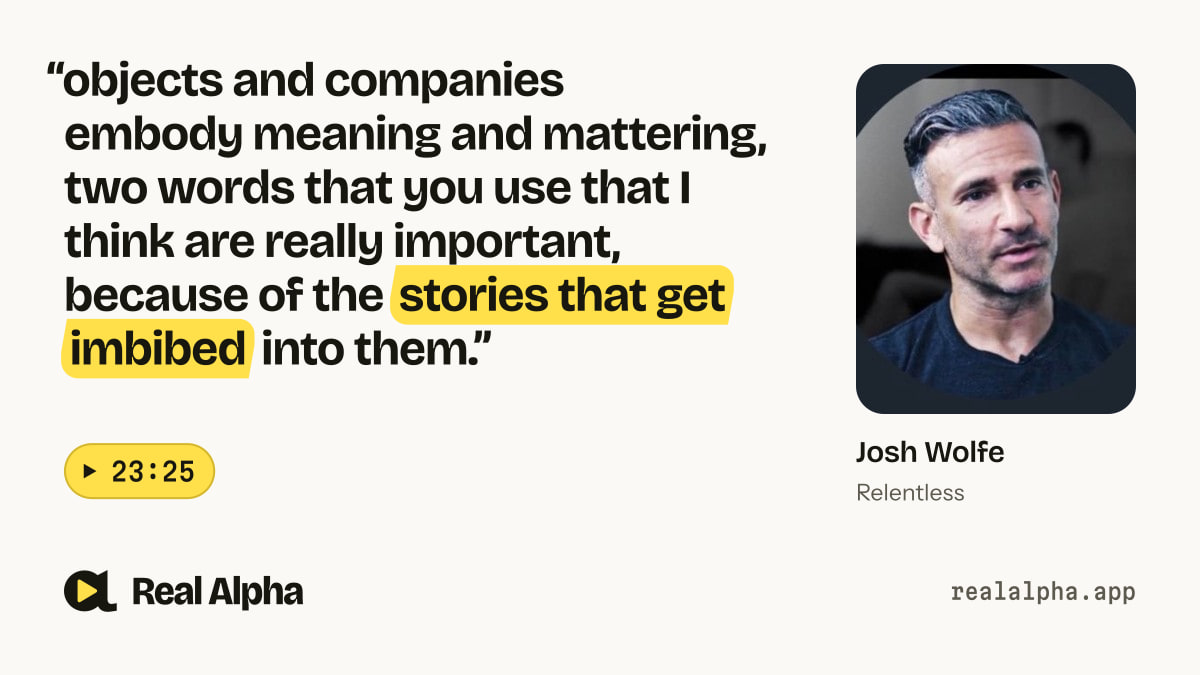
“objects and companies embody meaning and mattering, two words that you use that I think are really important, because of the stories that get imbibed into them.”
 Josh Wolfeat 23:25 · Relentless
Takeaways Pro pick
- A mission feels meaningful when its story is authentic.
- A scarce opportunity can make joining early attractive.
- Ask founders what genuinely drives them.
One of Pro's picks, open to you here. Try Pro free for 7 days
One of Pro's picks. The rest of the summary and the 3 takeaways are in Real Alpha Pro; the video, the quote and the transcript stay free.
Read it with Pro, 7 days freeAbout this segment
Josh Wolfe uses his childhood piggy bank to show how a personal story gives an object meaning. For companies, an authentic story helps people see why the work matters and imagine the status of joining early.

Josh Wolfe is co-founder and partner at Lux Capital.
Co-founded Lux Capital and backed category-defining companies across AI, automation, biotech, compute, defense and robotics.

Ti Morse, Host · Host, Relentless
Interviews hard-tech founders on Relentless; guests include Sam Altman, Brian Armstrong and Hadrian's Chris Power.
From “What drives the world's greatest founders | Josh Wolfe, Lux Capital”, Nov 17, 2026. Watch the full episode
Thanks. We'll look at and fix what's off.
Transcript
Transcribed by machine (Whisper) from the episode’s audio, so a word may be off here and there.
- 22:05
a mission that other people are really excited to believe in um can i get up for a second yeah all right i'm gonna show you all right so this this object what does that mean to you what does it mean to me is this like a uh dollar holder or something yeah like a piggy bank yeah uh it's a wooden piggy bank right it's an object it's meaningless to you um this is deeply meaningful to me this totem this object because it has a story in it and um my grandfather so my parents split when i was super young my mom and i moved from california where i was born at two moved in with my grandparents. We lived in a two-bedroom, one-bath apartment, and my grandfather delivered the Daily News at night. My grandma was a retired meter made.
- 22:48
My mom was a special ed public school teacher, and I was an holy child. And this was my first piggy bank, which was the Daily News piggy bank. It was wooden. It's got to be 40 years, 50 years old. And the only thing that's missing is the little plug on the bottom to prevent the change from going out. But this is where I first would store my little quarters and pennies and whatever that I would collect. And my grandfather gave me this. He would go out at night and he would deliver the newspaper. And my mother and I slept in one room. My grandmother slept in the other, and we had one bath. And that was my life until I was roughly 18 years old. But this object to me is deeply meaningful to anybody else that sees this object. They look at it and they're like, I don't really care. But I really think about the fact that objects and companies embody meaning
- 23:31
and mattering, two words that you use that I think are really important, because of the stories that get imbibed into them. And it's sort of like inception, but that to me is what makes something meaningful. When somebody is just like, yeah, I'm doing this app or whatever, you can feel if the founder has authenticity about what it is. Palmer and Andrew, he is obsessed with, I want to create weapon systems, not just like defense. He's not being cowardice, but I want to create weapon systems that advance.
- 24:00
to the warfighter and deter war, because we have such superior weapon systems, right? And somebody's like, yeah, I want to get behind that. Like, that feels meaningful. And it's also relatively singular, because there aren't a lot of companies that, at the time, were working on it. So those are two things. One is the scarcity of it. Two is the authenticity of a story. And three is the status that you can anticipate and speculate, just like you were speculating about buying a stock or buying something in a crypto market or making a bet on, you know, Poly or Polymarket or Calci, it's the same feeling of like, I'm speculating that I'm going to accrue more status if I do this thing. And people might not be totally honest about that. But five, six years ago, you were taking a risk to go and work at Andrel when it was less than 100 people. Today,
- 24:41
11,000 people. And today, it's a little less risky. And there's some founder out there that is starting to tell a story about something that sucks, some reason that they're going to go do it. And there might be less than 10 people. And then you're making the forecast, oh, yeah, I can see this company getting really big. And I can see this being really important. And I want to be there at ground zero. It is no different than the people that discover bands when everybody else is listening to pop music on the radio or back in the day on MTV, and you find the off the beaten path band that you know is going to be cool, not only because you like it, but because the status is going to accrue to you. Same thing with a fashion brand, same thing with a neighborhood in real estate. Like every domain has something where you can make the bet, the speculative bet
- 25:19
to go along something or someone because you think it's going to accrue status to you. And that often starts with a simple story. Like what is the story of this band? What is the story of this neighborhood? What is the story of this brand of clothes? What does it represent? What is the story of this company? What is it going to do? I have a allergic reaction to one kind of storytelling. When a founder comes in and says, I just want to change the world. And my first instinct is bullshit. I don't believe you. I believe people that are like, I want to prove people wrong because everybody said that this wouldn't be possible. Some technological achievement or everybody else is developing this, but I have a totally contrarian view and nobody believes me. And that's why we always like to say at Lux that we believe before others
- 25:57
understand. I love finding that. And it's no different to me transcending these boundaries between music or art or real estate or fashion or tech. It's finding that person that's like, got this crazy idea. Nobody else believes in them. We get the opportunity to believe in them. And it's out of going back to like the sins, greed and avarice, therein lie the virtues of progress that I think it's going to accrue capital and currency socially to me, that my status will increase because I was there in the founding days. And so I can be sort of intellectually honest or self-reflective about that, but that's where I think it starts. Storytelling has to be authentic because there's so many people that mirror stories that have been told to the point that they're cliched. But I've had so many people that come in and sometimes it's authentic and sometimes
- 26:45
it feels so forced, especially when you hear multiple times that somebody says, I really wanted to start this biotech company because I had an aunt who suffered from some, and I'm like, I don't know if I believe you. And maybe I'm too cynical in some of those instances. I can tell you from a sad number of people who become experts in a special or rare disease because their kid or a deeply close loved one suffers from it, they become the smartest in that space relative to anybody. And you know that that motivation is real. Like when people are like, yeah, I'm quitting my job to go do this thing. Like that is a true story. And so if you can find those things, which again, start with these intrinsic motivations, my co-founder, Peter Hebert at Lux, he is exceptional at understanding. He doesn't want to talk technical diligence. He
- 27:28
doesn't want to talk about your first year forecast. He doesn't want to talk about, he just wants to talk about like, why are you doing this? What's your motivation? And not in a challenging way, but like to just really understand what drives you. And 90% of the time he gets out of a meeting that I might not have been in. And he's like, i understand this guy or girl and and that to me when pete identifies the intrinsic motivations that are authentic and real about why somebody wants to do something it's typically we're going to invest and if it's bs and like they're like hand wavy or they're saying the things that you they think you want to hear it just it falls really flat and hollow. If you had to think about founders where in your experience