The alpha, twice a week
That was 5 min.
Get the best new moments in your inbox every Wednesday and Saturday. It's free.
Check your inbox
We sent a link to your address. Click it to finish signing up. Not there in a minute? Look in spam.
or
Big Take · 5 min · Nov 10, 2026
A Democratic Congress could test Trump’s power in court
 Noah Feldman
 expects disputes over unilateral action, spending and congressional oversight to reach the courts.
The episode’s best minutes
Full analysis- 2:52Democrats can regain court influence without packing itPro pick 5 min
- 10:12A Democratic Congress could test Trump’s power in court5 min
- 3 more moments in the full episode
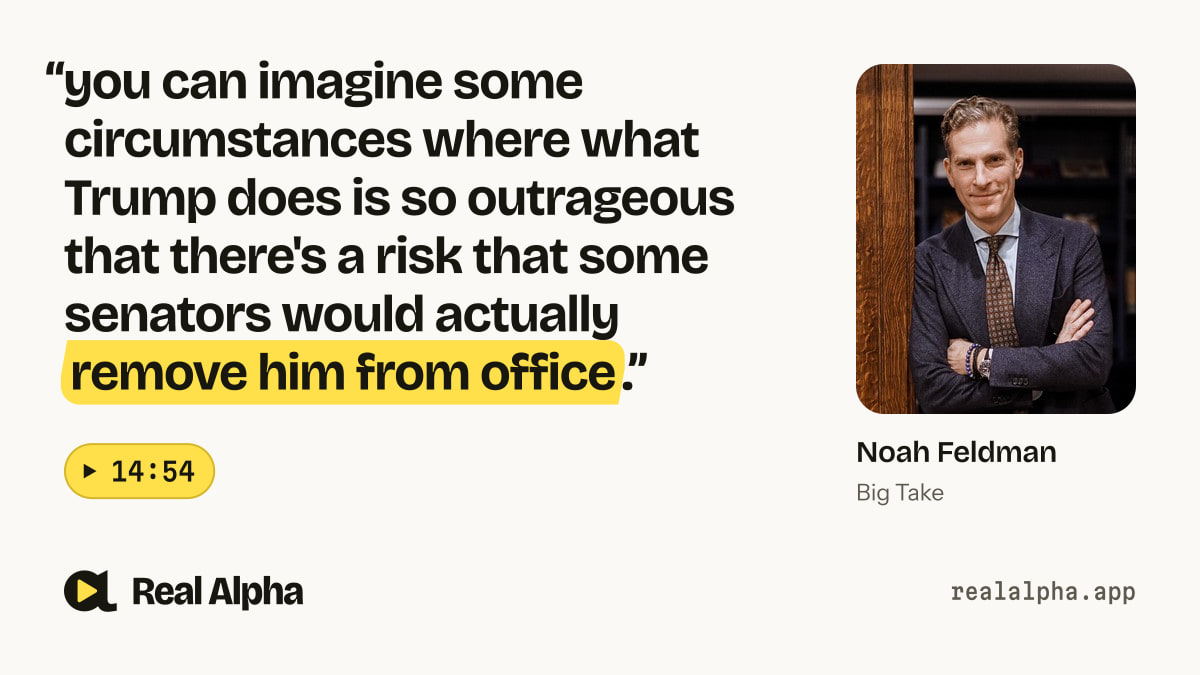
“you can imagine some circumstances where what Trump does is so outrageous that there's a risk that some senators would actually remove him from office.”
 Noah Feldmanat 14:54 · Big Take
Takeaways
- Congress can challenge unilateral actions by withholding funding.
- Subpoenas and executive privilege could spark court fights.
- A weakened hold over Republicans could change Trump’s impeachment risk.
About this segment
Noah Feldman expects disputes over unilateral action, spending and congressional oversight to reach the courts. He says Trump’s declining political power could make Senate conviction a risk in an extreme case.

Noah Feldman is a Harvard Law constitutional scholar and Bloomberg Opinion columnist.
Architected Facebook’s Oversight Board and advises technology companies on ethical decision-making, governance and AI.
- DG
David Gura, Host
From “Democrats Now Control the Future of the Supreme Court | Big Take”, Nov 10, 2026. Watch the full episode
Thanks. We'll look at and fix what's off.
Transcript
From the transcript Big Take publishes with the episode.
- 10:15
saw Democrats campaign on affordability and cost of living, but they also talked about oversight and this project to constrain Donald Trump in the final two years of his second term. Looking ahead, as you see the president, Democrats in Congress kind of locking horns here, what kind of fights do you expect will reach the Supreme Court?
- 10:33
I actually think there's a prospect for some pretty serious interbranch conflict between Congress and the president going to the Supreme Court. And I think it can take a few forms. One is we know that Donald Trump's preferred way of operating is not to rely on Congress, even when he had a majority in Congress back in his first term. And he likes to do things unilaterally. So he's going to keep on doing things unilaterally. And Congress is not going to take that sitting down. They're going to pass legislation that insists that he not do so. And they may, in fact, block spending for things that he wants. He can veto, of course, and they won't have the numbers to overturn the veto. But if it's a matter of not funding something, Congress will be able to say, hey, we didn't fund this, so you can't do it. And
- 11:19
Trump will do it anyway, almost inevitably. And that means a battle in the courts. And so I think we should expect some of that to happen. The other is in the direct form of oversight where Congress, both houses, subpoena Trump administration officials and demand that they.
- 11:35
Appear and bring documents and answer all kinds of questions. The Trump administration is going to try to roadblock that by saying, we have presidential privilege, we can't be called upon, or maybe in some cases just flat out refusing without a good theoretical justification. And what's going to happen then is that since realistically Congress is not going to send the sergeant at arms to go and grab up the secretary of war and bring him into a brig, what's going to actually happen is they're going to go to the courts and they're going to ask the courts to resolve this. And we had some of this in the first Trump administration. And the courts tried to be judicious about it. They gave some latitude to Congress, but they didn't give Congress indefinite latitude for what they could subpoena over.
- 12:17
And I think you could expect it to go back to the Supreme Court because it's really, in the end, in Trump's interests for it to go to the courts. He would rather have the headline be Trump and Congress fighting over power than Trump officials engage in corruption and this is what they. Said in testimony. On the oversight things, there's no way it's in his interests or that of his team's. to do anything other than fight back. And so I expect some serious constitutional conflict over the powers of Congress when it engages in oversight to happen over the next couple of years, probably starting up pretty quickly.
- 12:50
How do you think of the prospects of him obeying a court's decision? I think this is something that's kind of bubbled up here over the last many months. If a court were to tell him that something he did was illegal, he couldn't do it, would he abide by that ruling? How are you thinking about his willingness to comport himself to the rule of law in that way?
- 13:09
The way it's worked out so far in President Trump's second term is that the Trump administration has not officially ever said, we refuse to follow a court order. But instead, what they've done is just kind of negligently, and sometimes it appears intentionally, just not followed certain elements of certain court orders. They foot drag, they pretend they didn't know the order was in place. That happened a few times in the deportation cases. They push the envelope without quite saying, We believe that we shouldn't do it. And then they go to court and the judge orders them. And then eventually they come around to doing something sort of like what the court originally wanted. And it's a kind of almost a compromise formation.
- 13:50
It's not good. That's not the way things should work. But it has one benefit, which is at least the Trump administration hasn't precipitated the constitutional crisis that we'd have if the judiciary says do it and the president of the United States says, I'm not going to do it. Now, if he did that, He does have one thing on his side, which is that he was impeached twice and neither time did the Senate convict him. And so he may have confidence that that couldn't possibly happen a third time.
- 14:20
The wild card is that in those previous times, it was still possible to believe, and it was true, that Trump's political future was going to continue. And so if you were a Republican in the Senate who had to vote on conviction after impeachment, you had to be worried that that Trump would come for you and he would primary you and even if he might lose the seat, he would get you out of office. This time, it's possible that Trump's political power over the Republican Party will be perceived as meaningfully in decline after the disaster.
- 14:52
Of the blue wave. And if that happens, and it's a big if, you can imagine some circumstances where what Trump does is so outrageous that there's a risk that some senators would actually remove him from office.
- 15:03
And Trump is not going to want to risk that.