The alpha, twice a week
That was 4 min.
Get the best new moments in your inbox every Wednesday and Saturday. It's free.
Check your inbox
We sent a link to your address. Click it to finish signing up. Not there in a minute? Look in spam.
or
Big Take · 4 min · Nov 22, 2026
A genetic risk test can bring anxiety without a clear next step
 David Cameron
 contrasts an actionable BRCA2 test with the uncertainty of testing for Alzheimer’s risk.
The episode’s best minutes
Full analysis- 14:05A family mutation pointed to amyloid as an Alzheimer’s cause4 min
- 23:17A sudden change exposed a father’s Alzheimer’s declinePro pick 6 min
- 40:21A genetic risk test can bring anxiety without a clear next stepPro pick 4 min
- 3 more moments in the full episode
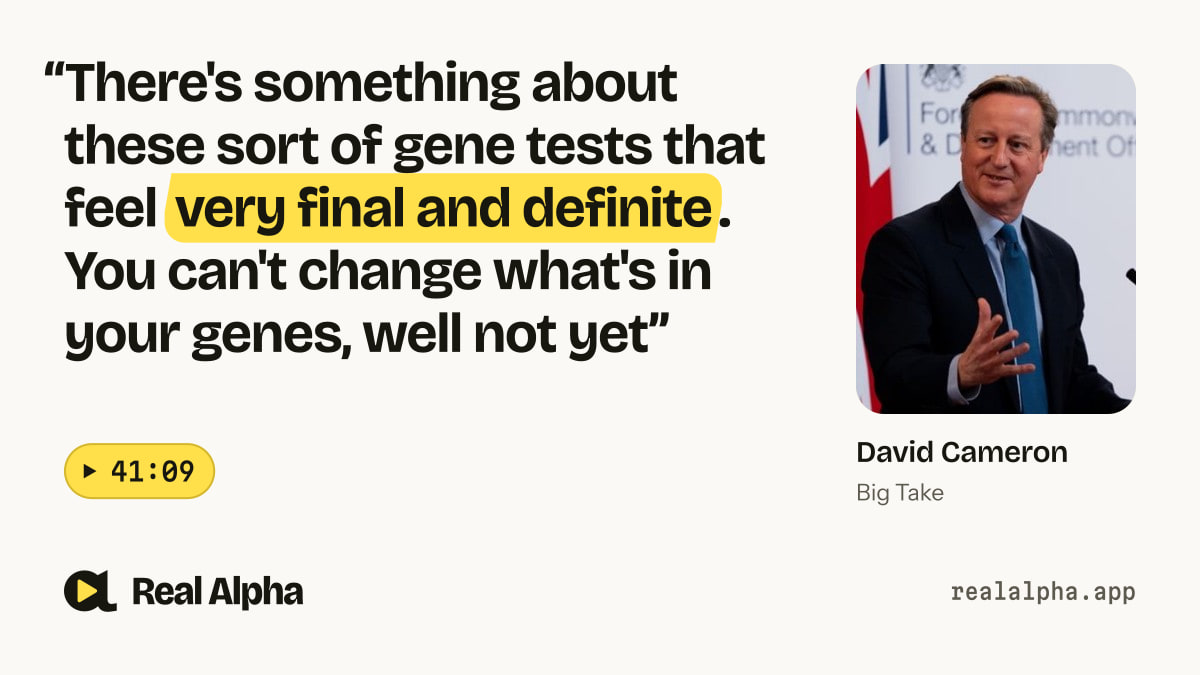
“There's something about these sort of gene tests that feel very final and definite. You can't change what's in your genes, well not yet”
 David Cameronat 41:09 · Big Take
Takeaways Pro pick
- Cameron took a BRCA2 test after cancer in his family.
- A negative result reassured him about his cancer treatment.
- He questions the value of an Alzheimer’s risk test without clear options.
One of Pro's picks, open to you here. Try Pro free for 7 days
One of Pro's picks. The rest of the summary and the 3 takeaways are in Real Alpha Pro; the video, the quote and the transcript stay free.
Read it with Pro, 7 days freeAbout this segment
David Cameron contrasts an actionable BRCA2 test with the uncertainty of testing for Alzheimer’s risk. When there’s no clear path to treatment, knowing a genetic risk may bring anxiety without changing what happens next.

David Cameron, Host
Former Prime Minister, United Kingdom
Made dementia research a political priority, helped double investment, and now champions the search for an Alzheimer’s cure.
From “Weekend Listen: How Close is a Cure for Alzheimer’s? | Big Take”, Nov 22, 2026. Watch the full episode
Thanks. We'll look at and fix what's off.
Transcript
From the transcript Big Take publishes with the episode.
- 40:24
that can tell you if you're at risk for developing diseases like cancer or Alzheimer's. Earlier this year, a doctor I'd never actually met contacted me. He'd seen in the newspapers that I had prostate cancer and that my brother had died of pancreatic cancer, and he told me there was a gene that linked the two. If I had it, it would mean my risk for getting pancreatic cancer would be doubled. He told me I should look into it.
- 41:10
I was hesitant at first. There's something about these sort of gene tests that feel very final and definite. You can't change what's in your genes, well not yet, and the burden of knowing something may be coming is actually quite scary. But with this gene in particular, there's a clear upside to knowing. If caught early, pancreatic cancer can be treated. So I decided to take that test. I went to the Royal Marsden Hospital in London and I had a blood sample taken. The doctor explained in some detail what we were looking for, whether my prostate cancer and the family history of breast and pancreatic cancer was due to a genetic alteration in the BRCA2 gene passing through my family. The test came back negative. Relief. It meant that no genetic alterations were found that could have caused my prostate cancer, which could be passed on to
- 42:04
my children. What's more, prostate cancers due to a genetic alteration in the BRCA2 gene are more aggressive. As this test was negative, I was reassured that there was a greater chance that the treatment I'd had for the prostate cancer would actually work. After going through that process, I'd been considering a similar test for Alzheimer's to test for a gene called APOE. Depending on the variant of the APOE gene you have, you can have a higher risk for Alzheimer's.
- 42:35
You can get a genetic test commercially with these companies who will do. It, Interestingly enough, Dr Hardy pointed out that many of the people who discover they have this gene find out accidentally. The one I remember is 23andMe. Yes.
- 42:53
And I remember getting a phone call. Somebody had taken a 23andMe test. They'd taken it because they thought they might have Hungarian ancestry. But when they'd taken the test, they had found that they had an APOE, and they were suddenly scared... that they were at risk of Alzheimer's disease, which they had not realised.
- 43:17
The genetic test for the Alzheimer's risk gene is much more fraught than the BRCA2 test. There aren't clear paths forward after you learn your genetic risk. And what's the point of finding out you're genetically predisposed to dementia if there's no cure? In this series, I'm on a quest to know how close we are to that ultimate goal. Along the way, I'll find out what's going on right now inside research labs that may change how we'll face this disease in the future. I'll also learn how early we can detect Alzheimer's, if there are secrets that AI can unlock, and what it will take to prevent the disease altogether. And as I discover more about the potential for a cure... I'll explore the question that's nagging at me.
- 44:08
Should I take the gene test? Because unlike with the pancreatic cancer test, finding out my genetic risk for Alzheimer's may only bring anxiety with the limited treatment options that we have today. But that might not be the case for long. And that's what I'm going to investigate. Next episode, how far are we from treatments that can stop dementia in its tracks?