The alpha, twice a week
That was 4 min.
Get the best new moments in your inbox every Wednesday and Saturday. It's free.
Check your inbox
We sent a link to your address. Click it to finish signing up. Not there in a minute? Look in spam.
or
Knuckle Up with Nakul · 4 min · Aug 4, 2026
A history book exposed what Google search could not do
 Will Bryk
Researching a book on civilization, Will Bryk found Google couldn't retrieve deep, cross-regional information.
The episode’s best minutes
Full analysis- 10:20A history book exposed what Google search could not do4 min
- 21:19Bryk relies on culture to coordinate instead of adding processPro pick 4 min
- 29:47Scaling a company is a problem of information flowPro pick 3 min
- 4 more moments in the full episode
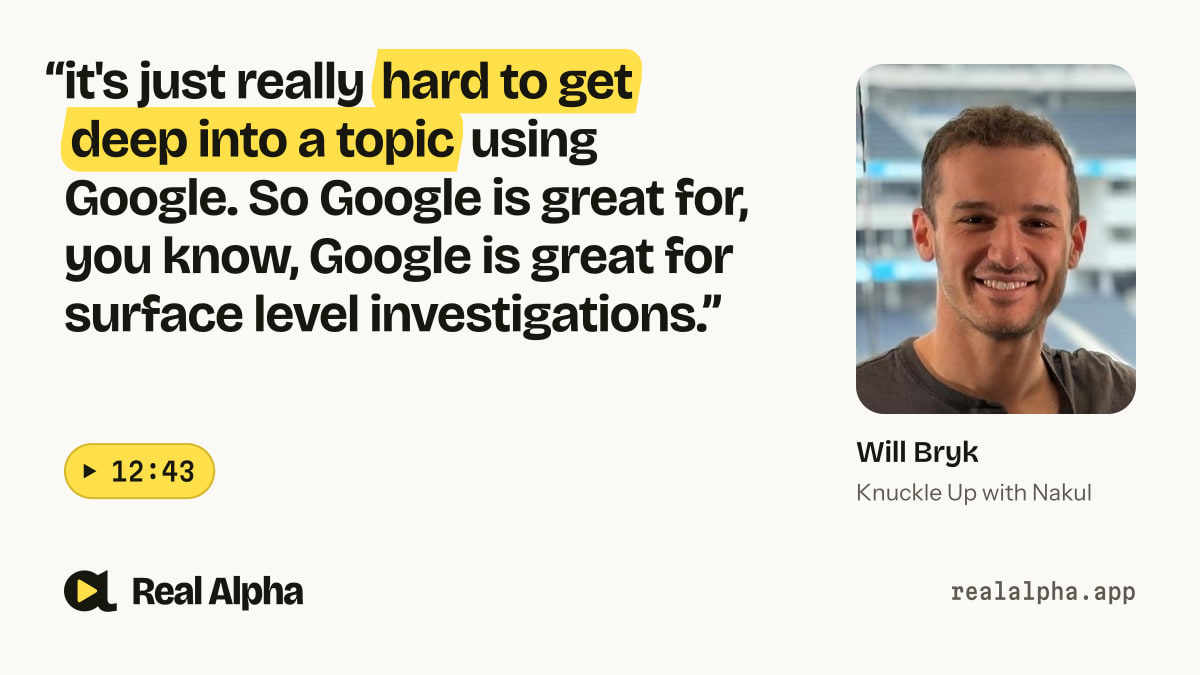
“it's just really hard to get deep into a topic using Google. So Google is great for, you know, Google is great for surface level investigations.”
 Will Brykat 12:43 · Knuckle Up with Nakul
Takeaways
- Google worked for quick lookups, not deep research.
- Bryk had been frustrated by information access since high school.
- GPT-3 made paragraph-based search seem feasible.
About this segment
Researching a book on civilization, Will Bryk found Google couldn't retrieve deep, cross-regional information. GPT-3 made a different kind of search engine seem possible, prompting Exa.

Will Bryk is cofounder and CEO of Exa.
Co-founded Exa, a search engine built for AI agents with its own index and ranking algorithms.

Nakul Mandan, Host · Host, Knuckle Up with Nakul
General partner at Audacious Ventures; his show goes deep with founder CEOs on how they build.
From “How a first-time CEO is taking on Google: No process, no NPC hires, and extreme shipping velocity”, Aug 4, 2026. Watch the full episode
Thanks. We'll look at and fix what's off.
Transcript
Transcribed by machine (Whisper) from the episode’s audio, so a word may be off here and there.
- 10:24
last job you were literally writing a book on the history of civilization and as part of it you came to the conclusion that the quality of information in the world is the most important thing for civilization and that kind of sparked or that was the genesis of XA right? That was definitely one of the big motivators. I think I've been thinking about ideas surrounding XA since like even high school. I remember in high school I was like I'm going to start a new type of news organization because like I have had this frustration and it continues to today where it feels like ridiculous that we, you know, can get to the moon and we split the atom.
- 10:58
And yet if I want to understand what's going on at the border right now, it's really hard to. Like that to me is just an error in humanity. Like when I was a kid, I thought this was like, we have a bunch of adults. Like why can't they like figure out how to like share information in a normal way? Like why is everything politicized? Like I always thought this was ridiculous and I don't accept it. Like I think that's just an error in our coordination structure.
- 11:18
Something's wrong here, right? And I think a lot comes back to our information tools. So if, for example, let's say there was some really well-funded news organization that didn't have bad incentives and just was fully devoted to the truth, and they were super well-funded, I think that would have a huge impact on the world. So that was kind of like the thing I was imagining back then. And then over the years, I've thought of different ideas.
- 11:36
Like me and my co-founder actually built a search engine in college together, like way before Exa, because we were just like frustrated that it's so hard to find high quality information. Again, that was like, we were upset at the state of our information tools. What kind of searching was that? That one, so AI wasn't that good yet. So it was more like crowdsourcing the best URLs, kind of like Reddit, but for everything.
- 11:55
And like really focused on like high quality URLs. I still think that'd be really cool. And it's like, basically. Using like the intelligence of humans to, with the right incentives, like just organize, here are the best URLs on this topic if I'm trying to start a company or learn about like physics or something. But then in 2021, when we started Exa, yeah, I was writing this book on the side and just like really just became obsessed with history and just like, I always thought you don't need to read fiction books because if you just read history books, it's like insane what is happening.
- 12:21
Like the deeper you go into any part of history, the crazier it is. It's just a fascinating story of humanity. I was writing this book because I felt like no book captured the excitement I had. And I thought maybe as a new, I was not an expert by any means, but I was just so excited. I was like, maybe I could capture this in a 300-page book. It had a really interesting structure. I was really excited about it.
- 12:38
But as I was writing the book, I was doing a lot of research because I had a cover of, you know, 5,000 years really fast because I didn't want to write this book for my whole life. So I was doing research really, really fast. And it's just really hard to get deep into a topic using Google. So Google is great for, you know, Google is great for surface level investigations. Okay, like, where is this Costco?
- 12:54
You know, what's the address? Stuff like that. But if you want to find like, you know, give me every article on medieval, what they ate in medieval times, like across different regions of the world, like you can't expect Google to do that, right? It's not meant for this like deep research. And so, yeah, just these were the ideas in the time. And then the critical reason we started, so it was like the technology became possible to build a new type of search engine.
- 13:16
This is like, this is a time when GB3 had recently come out. So GB3 was like this magical technology where you could type in a whole paragraph and it would fully understand all the words in your paragraph. And then Google at the time was like, you can't type in a paragraph to Google. You still can't. It just wouldn't understand anything more than a few keywords. And so like, what if you could take the technology of GB3 and put it into a search engine?
- 13:35
You could have perfect search. That would have a huge impact on our information ecosystem and hopefully solve some of these political problems that I noticed since high school. So it's a pretty mission-driven start of the company. How much of that now is your private fuel or you're looking for that in every person who joins?