The alpha, twice a week
That was 4 min.
Get the best new moments in your inbox every Wednesday and Saturday. It's free.
Check your inbox
We sent a link to your address. Click it to finish signing up. Not there in a minute? Look in spam.
or
The Peterman Pod · 4 min · Nov 9, 2026
A move into biology offered a second chance
 Venki Ramakrishnan
 left physics because he saw little future in his work, then moved toward a field undergoing a revolution.
The episode’s best minutes
Full analysis- 0:33Experiments remain the bottleneck in AI drug discovery6 min
- 10:30A move into biology offered a second chance4 min
- 15:02Choose problems that are important and feasible2 min
- 3 more moments in the full episode
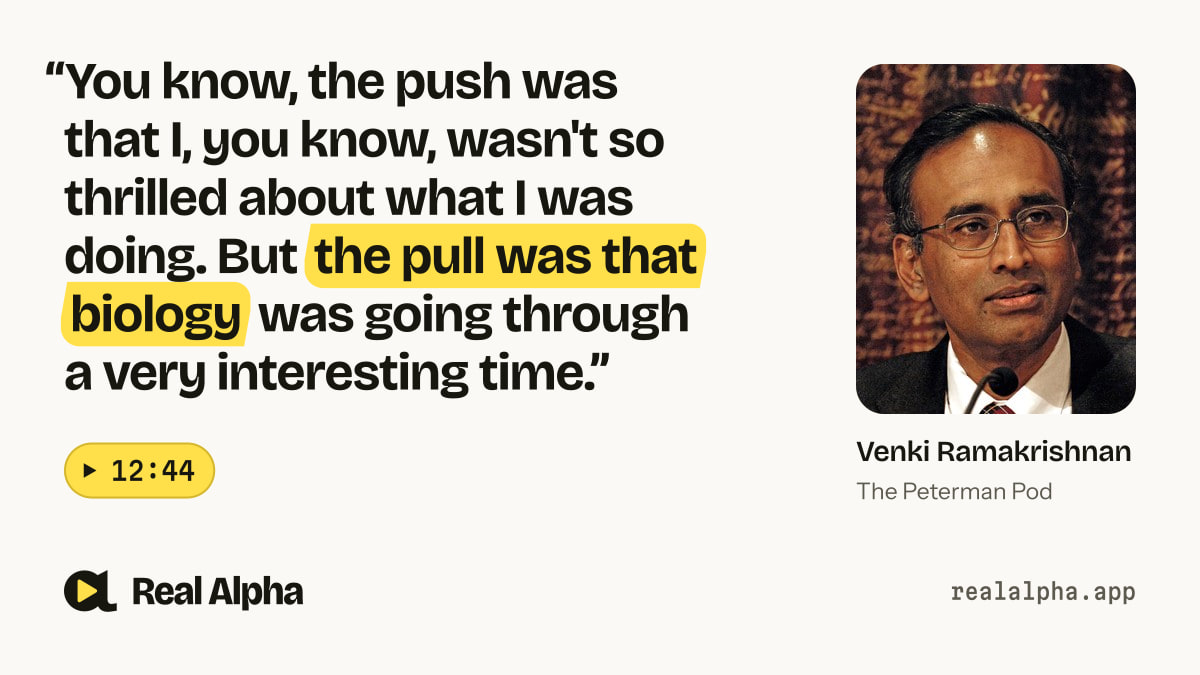
“You know, the push was that I, you know, wasn't so thrilled about what I was doing. But the pull was that biology was going through a very interesting time.”
 Venki Ramakrishnanat 12:44 · The Peterman Pod
Takeaways
- He saw his physics work as incremental and unpromising.
- Biology drew him because new tools were opening new questions.
- An article about ribosomes led to his long-term research focus.
About this segment
Venki Ramakrishnan left physics because he saw little future in his work, then moved toward a field undergoing a revolution. An article about ribosomes led to a research path that shaped his career.

Venki Ramakrishnan is a molecular biologist, Nobel laureate and Isomorphic Labs scientific adviser.
Determined the bacterial ribosome’s structure, advancing understanding of protein synthesis and how antibiotics inhibit it.

Ryan Peterman, Host · Host, The Peterman Pod
Went from new grad to staff engineer at Instagram in three years.
From “Nobel Prize Winner: AI’s Impact On Drug Discovery And Biology | Venki Ramakrishnan”, Nov 9, 2026. Watch the full episode
Thanks. We'll look at and fix what's off.
Transcript
Transcribed by machine (Whisper) from the episode’s audio, so a word may be off here and there.
- 10:33
look at things. You got a PhD in physics, and then at some point you did a hard pivot into biology. And I think a lot of people, whether because of sunk cost or some other reason, they might not have the confidence to pivot so hard. What gave you the confidence to switch? Oh, I don't know if it was confidence. There's both a push and a pull there. I just wasn't feeling very motivated about continuing my physics career.
- 11:07
I thought, you know, the problems I was working on were not that interesting. And I didn't see with my particular graduate training and PhD, I didn't see a real future for me in physics, to be honest. I thought if I stayed in physics, I'd probably end up in some second rate or even third rate position doing very, you know, incremental or boring stuff at all if at all and I thought that I was giving myself a second chance so it's not like it's not like I had this great confidence and saying oh I'm gonna go off and do this other great thing I just thought of it as you know I mean it's like punting in football you know I just It's like, okay.
- 12:00
I'll give myself a second chance. When you were in physics, you had this, I guess, research taste or the sense that continuing that research, those problems were not interesting or they were not... Yeah, they wouldn't go anywhere. You know, my thesis has maybe 20 citations after 50 years or something. So you can see probably nobody read it. And the thing, it had almost no impact. And the thing is that biology, when I made the switch, was really booming.
- 12:36
You know, all sorts of things were happening. It was like going through a revolution. And I thought, oh, this is, you know, this is where the action is. So that was the pull. You know, the push was that I, you know, wasn't so thrilled about what I was doing. But the pull was that biology was going through a very interesting time. And it's weird because that revolution hasn't stopped. You know, new things keep happening in biology that has really made it a very exciting place.
- 13:08
Because as new tools appear, you can crack aspects of very difficult problems that you couldn't before. Sort of you can get to the next level in difficult problems. So it turned out in hindsight to have been a good choice. And that was completely by accident. You know, I read an article in Scientific American when I was a grad student in La Jolla. And the article was written by these two professors at Yale, Peter Moore and Don Engelman.
- 13:39
It was about the ribosome, which is this large machine that reads our genes, genetic information, which basically resides on mRNA, which is a copy of DNA, of the gene on DNA. and uses that information to make proteins. So it's a very, very central molecule in the cell. It's one of the oldest molecules of life, probably predates DNA because before the ribosome, the cell wasn't making proteins in any systematic way.
- 14:10
So why would it need genes to encode proteins? So it's an incredibly ancient molecule that's still absolutely central to life. And by that time, I knew what a ribosome was because I'd gone to this graduate school after my PhD. As you pointed out, I pivoted. But in the pivot, I started graduate school all over again. In fact, the first year, I even took undergrad courses because I didn't really know anything.
- 14:40
And so I knew what a ribosome was, so I wrote to them, and they offered me a fellowship to go to Yale. and that was the start of my sort of ribosome career in 1978 and I sort of you know basically