The alpha, twice a week
That was 8 min.
Get the best new moments in your inbox every Wednesday and Saturday. It's free.
Check your inbox
We sent a link to your address. Click it to finish signing up. Not there in a minute? Look in spam.
or
Machine Learning Street Talk · 8 min · Nov 23, 2025
A new architecture must beat Transformers by a wide margin
 Llion Jones
 compares today’s Transformer tweaks with the incremental RNN research that preceded Transformers.
The episode’s best minutes
Full analysis- 8:00A new architecture must beat Transformers by a wide margin8 min
- 35:56CTM lets easy examples stop early and hard ones think longer8 min
- 1:00:35Variant Sudoku tests reasoning beyond familiar puzzle patternsPro pick 7 min
- 5 more moments in the full episode
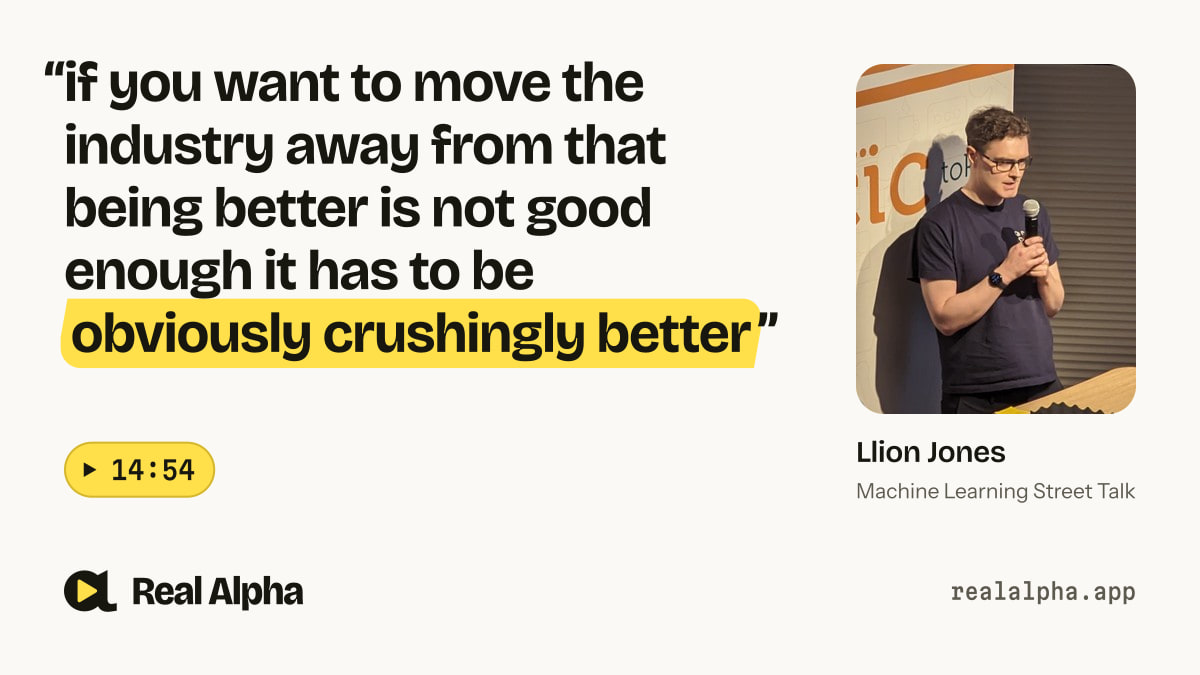
“if you want to move the industry away from that being better is not good enough it has to be obviously crushingly better”
 Llion Jonesat 14:54 · Machine Learning Street Talk
Takeaways
- RNN papers once competed over tiny gains in bits per character.
- Transformers made those incremental improvements irrelevant almost overnight.
- A new architecture needs a decisive advantage to dislodge the incumbent.
About this segment
Llion Jones compares today’s Transformer tweaks with the incremental RNN research that preceded Transformers. An alternative must be dramatically better to overcome the industry’s infrastructure and investment in the incumbent.

Co-founder & CTO, Sakana AI
Co-founded Sakana AI and co-authored Attention Is All You Need, which introduced the Transformer.
- TS
Tim Scarfe, Host · Host, Machine Learning Street Talk

Keith Duggar, Host · Co-host, Machine Learning Street Talk
From “He Co-Invented the Transformer. Now: Continuous Thought Machines [Llion Jones / Luke Darlow]”, Nov 23, 2025. Watch the full episode
Thanks. We'll look at and fix what's off.
Transcript
Transcribed by machine (Whisper) from the episode’s audio, so a word may be off here and there.
- 8:03
So, of course, the main technology before transformers was recurrent neural networks, right? And there was a similar feeling, right? When recurrent neural networks came in and we discovered this new sort of sequence-to-sequence learning, that was also a massive breakthrough, right? The translation quality went up massively, right? Right. Voice recognition quality went up massively. And there was a similar sort of feeling then of like, OK, yes, we've, you know, we found the technology and we just need to sort of perfect this technology.
- 8:41
And back then, even my favorite task was character level language modeling. Right. So every time a new RNN based character level language modeling paper came out, I got quite excited. right um i you know i'd want to like quickly read the paper like okay how did they you know how did they get the improvements but the papers were always these just these slight modifications on the same architecture right it was lstms and grus and maybe um initializing it with the identity matrix so that you could use the relu function or like maybe if you put the gate in a different place or if you if you layer them in a slightly different way or if you had gating going upwards as well as as sideways um and i remember one of my favorites was this uh like hierarchical lstm where it would actually decide to compute or not compute the different
- 9:37
layers and if you trained on wikipedia and you looked at the structure of when it was decided to compute and not compute it kind of looked like the structure of of the the sentences were actually being picked up by the model. And I used to love that sort of stuff, right? But the improvements were always like 1.26 bits per character, 1.25 bits per character, 1.24. That was the result. That was publishable, right?
- 10:06
That was exciting. But then after Transformer, the team that I went on to afterwards, we applied for the first time very deep Transformer models, decoder only transformer models to language modeling and we immediately got something like 1.1 uh right so so something that was so good that people actually come to our desk and politely tell us like i i think you you made it error like a calculation do you think it's nats not bits per character and we're like no no we you know it really is the the the correct the correct number What struck me later is that all of a sudden, all of that research, and to be clear, very good research, was suddenly made completely redundant.
- 10:55
All of those endless permutations to RNNs were suddenly seemingly a waste of time. we're kind of in the situation right now where a lot of the papers are just taking the same architecture and making these endless amount of different tweaks of like you know where to put the normalization layer and slightly different ways of training them and and we might be wasting the time in exactly the same way right like i personally don't think we're done right i don't think that this is the final architecture and we just need to keep scaling up there's some breakthrough that will occur at some point and then it will once again become obvious that we're kind of wasting a lot of time right now yeah so we are a victim of our own success and this basin of attraction there are so many basins of attraction sarah hooker spoke about the hardware lottery
- 11:48
and this is a kind of architecture lottery and it actually made me think of the agricultural revolution, which is that this kind of phase change happened. And all of the folks that had these skills that were so necessary, these diverse skills for living and surviving, they died out. And that's actually quite paradoxical because we need those skills to take the next step. And so we're now in this regime.
- 12:16
We've got the term foundation model. And the implication is that you can do anything with a foundation model. In the corporate world, we used to have data scientists. You know, there were ML engineers doing these architectural tweaks, even in, you know, midsize enterprise. And now we just have AI engineers who are just doing prompt engineering and so on. So you're saying that the fundamental skills that we need to be diverse, to think of new solutions and new architectures, they're dying out.
- 12:46
I think I'm going to disagree with that. I think the problem is we have plenty of very talented, very creative researchers out there, but they're not using their talents, right? For example, you know, if you're in academia, there's pressure to publish, right? And if there's pressure to publish, you think to yourself, okay, well, I have this really cool idea, but it might not work. it might be too weird right it might be difficult to get it accepted because i have to sort of like sell the idea more or i can just try this new position embedding right the problem is that the current environment both in academia and in companies are not actually giving people the freedom that they need to do the research that they probably want to do i mean there's also this interesting thing that even in spite of great new research i mean i was speaking to uh sepp
- 13:49
hot reicher and he's got all of these new architectural ideas and open ai aren't implementing them i mean google are doing this diffusion language model which is quite cool and i i'd like to know your opinion on why that is so there's a few philosophies floating around like this concept of a universal representation that there are universal patterns and the the transformer representations resemble those in the brain and it's rather led to this idea of well we don't need to use different architectures because if we just have more scale and more compute then all roads lead to Rome so why would we bother doing it any differently there's actually better right there is actually already architectures that have been shown in the research to work better than transformers okay but not better enough in order to move the entire industry
- 14:41
away from such an established architecture where you're familiar with it you know how to train it you know how it works you know how the internals work right you know how to fine-tune them you have all this software is already set up for training transformers fine-tuning transformers inference so if you want to move the industry away from that being better is not good enough it has to be obviously crushingly better transformers were that much better over RNNs okay transformers where you just applied it to a new problem and it just was so much faster to train and you just got such higher accuracy that you just had to move and I think the deep the deep learning revolution was also another example of that right where you had plenty of skeptics and people were pushing our neural networks even back then and people are going no
- 15:37
we think symbolic stuff will work better but then they demonstrated it as being so much better that you couldn't ignore it this fact makes finding the next thing even harder right that's the gravitational pull of always pulling you back to oh okay but a transform is good enough and yeah yeah, you made a cool little architecture over here that, yeah, it looks like. It's got better accuracy, but OpenAI over here just made it 10 times bigger and it beats that.
- 16:05
So let's just keep going.