The alpha, twice a week
That was 4 min.
Get the best new moments in your inbox every Wednesday and Saturday. It's free.
Check your inbox
We sent a link to your address. Click it to finish signing up. Not there in a minute? Look in spam.
or
MTS · 4 min · Nov 6, 2026
A pacing deal could create room to establish a safety case
 Jeffrey Ladish
 sees political pressure opening a path between modest pacing and a full shutdown.
In this episode
Full analysis- 0:57METR sees faster progress, but key evidence remains hidden3 min
- 12:28Pacing may need to include limits on model use4 min
- 21:05AI gains generalize unevenly, especially in social skills4 min
- 3:55Real agent work is a better capability test than benchmarks3 min
- 17:39A pacing deal could create room to establish a safety case4 min
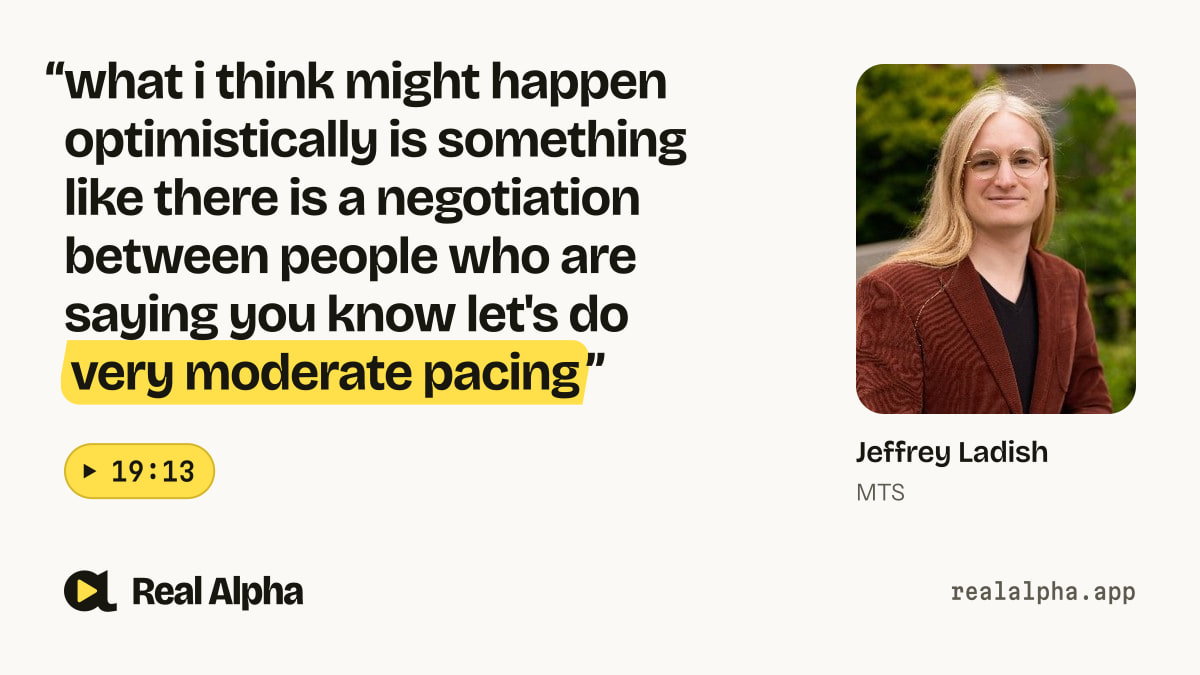
“what i think might happen optimistically is something like there is a negotiation between people who are saying you know let's do very moderate pacing”
 Jeffrey Ladishat 19:13 · MTS
Takeaways
- He expects negotiation rather than a halt to all AI development.
- Pacing should leave time to build evidence that models can be controlled.
- He wants top researchers advising Congress and the White House.
About this segment
Jeffrey Ladish sees political pressure opening a path between modest pacing and a full shutdown. He wants experts and officials to agree on when systems can safely advance.

Jeffrey Ladish is an executive director of Palisade Research.
Studies AI offensive capabilities at Palisade; helped build Anthropic’s information-security program.

Theo Jaffee, Host · Co-founder & host, MTS
One of the first members of a16z's new media team; earlier hosted the Emergent Ventures-backed Theo Jaffee Podcast.

Sophia Dew, Host · Host, MTS
From “AI Agents Could Seize Digital Infrastructure in 1 Year”, Nov 6, 2026. Watch the full episode
Answers “Should AI be regulated?” See all 51 answers
Thanks. We'll look at and fix what's off.
Transcript
Transcribed by machine (Whisper) from the episode’s audio, so a word may be off here and there.
- 17:44
do you think that like putting this in the context of some of the political sentiment that's going on and moratoriums will actually like meaningfully change the rate of progress at all if some of these are passed uh could you say what you mean by that like like like just anything that comes from like the political like political backlash or slowing down data center build out yeah i mean i I think that with the recent election and just in general, like a lot of people are are really upset and I think afraid from from AI progress and sort of and I think often people have kind of diffuse worries where it's not like I think, you know, the general population is like reading the media reports and are like, you know, oh, the hugging face incident, all of these agents.
- 18:30
I think a lot of it is like, wow, there's just like something really crazy happening and something is getting really powerful. You know, the AI companies are getting very powerful and like this AI stuff is starting to do a bunch of stuff and we're like worried about our jobs. And, you know, I think that really I think that was pretty, pretty like notable where like a lot of, you know, politicians running in this election, you know, made AI a really big part of their platform.
- 18:52
And I think that, you know, especially the Democrats and some Republicans made this a big part of their platform. I think that means that there's a lot more political will for something like serious pacing proposals, serious pause proposals. um and i i think that that's good i i think that um i think some people have a fear that like you know we'll just stop building all data centers and we'll stop ai progress and then like china will win um i think the winning framing is kind of wrong but but even so i'm like i don't think that will happen what i think might happen optimistically is something like there is a negotiation between people who are saying you know let's do very moderate pacing and people who are saying we should absolutely shut it all down and you know go back 10 years and what you
- 19:29
hopefully will end up with is something like, you know, we have extremely good ability to break and reallocate towards figuring this stuff out. And that, like, in fact, we end up with a very strong safety case regime where, like, if it is safe, we can go ahead. And if not, we don't. But, like, that this is based on, like, you know, our best researchers are, like, and, you know, sort of the best minds that we have in the country, which I think we have the best people in the world can come together and say like, okay, like, what do we think? I don't know.
- 20:00
I'm like, let's have Dario and Yosha Bengio just, like, argue about whether it's right to go ahead with recursive self-improvement. I'm like, they're both smart guys. Like, let's do that, you know, and bring in the next 20 top people, Ryan Greenblatt, a bunch of other people, and just, like, you know, make that an explicit conversation. Let's have that, you know, let's have that happening in congressional committees.
- 20:20
And, like, you know, let's have the White House bring these people in to advise them directly. And let's make these decisions. Because I'm like, man, we're talking about things that are consequential for all of humanity. and like i'm just like man this is this is like the stakes are so high the way we are doing it right now seems like really dumb like it seems like right now we're mostly arguing on twitter and then we sometimes get some meter reports and the companies will publish some blog posts and then congress is like not well informed about what's happening and i think the president is not well informed about what's happening and like you know if everyone just fucking sat down in a room and talked about the actual dynamics of recursive self-improvement the actual dynamics of alignment
- 20:55
and, like, you know, proposals for what, you know, what many people inside of the companies are asking for, which is, like, we need a mechanism to actually go at a responsible pace. Like, that's what we need. That's what we want. Yeah, that's what I would like to see. Right.