The alpha, twice a week
That was 4 min.
Get the best new moments in your inbox every Wednesday and Saturday. It's free.
Check your inbox
We sent a link to your address. Click it to finish signing up. Not there in a minute? Look in spam.
or
The Katie Miller Podcast · 4 min · Nov 19, 2026
A phone lets aspiring reporters build a reel without waiting for permission
 Brian Kilmeade
 contrasts his old audition-and-tape route with making work on a phone today.
The episode’s best minutes
Full analysis- 1:22A phone lets aspiring reporters build a reel without waiting for permissionPro pick 4 min
- 25:58Shays’ Rebellion helped create pressure for a new constitution4 min
- 11:04A 2:30 alarm gave Kilmeade time to be present with his childrenPro pick 5 min
- 3 more moments in the full episode
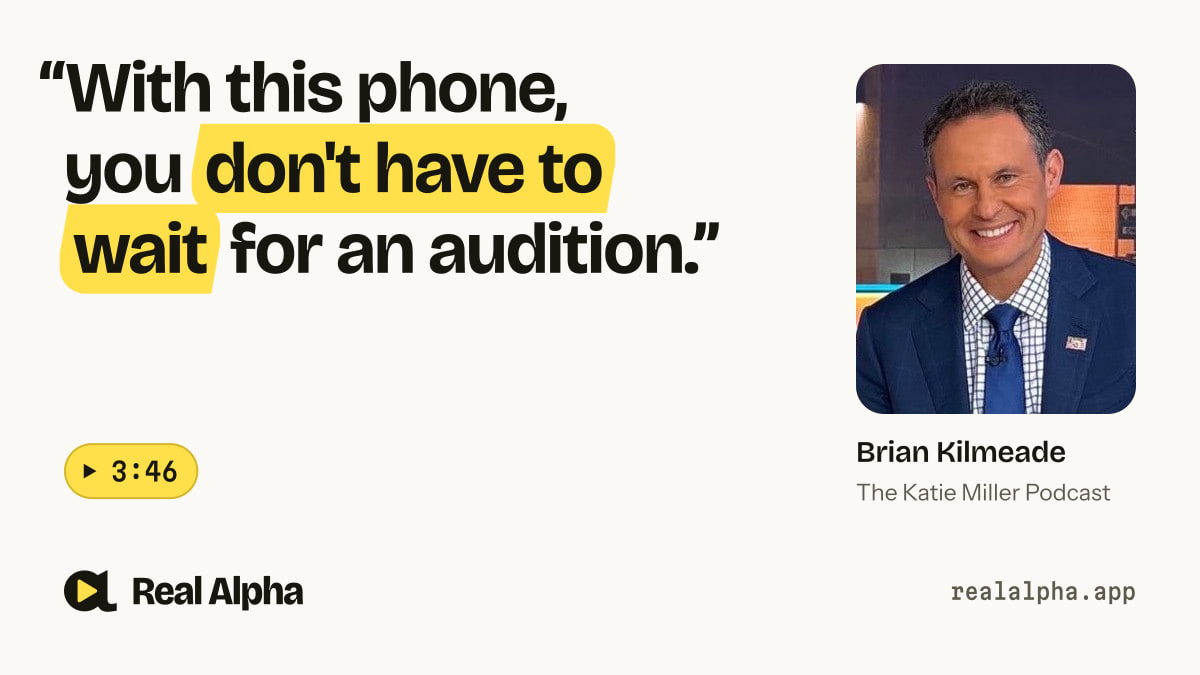
“With this phone, you don't have to wait for an audition.”
 Brian Kilmeadeat 3:46 · The Katie Miller Podcast
Takeaways Pro pick
- Make reporting or interview clips with the phone you already have.
- Build a tape before waiting for an audition or job opening.
- Show employers how you perform and how deeply you ask questions.
One of Pro's picks, open to you here. Try Pro free for 7 days
One of Pro's picks. The rest of the summary and the 3 takeaways are in Real Alpha Pro; the video, the quote and the transcript stay free.
Read it with Pro, 7 days freeAbout this segment
Brian Kilmeade contrasts his old audition-and-tape route with making work on a phone today. His rule: create clips that show how you handle a camera, topics and questions.

Brian Kilmeade is a Fox News host and author.
Co-hosts FOX & Friends, hosts One Nation, and wrote seven books, six of them New York Times bestsellers.
- KM
Katie Miller, Host
From “Kilmeade’s Rise at Fox News | KMP Ep.62”, Nov 19, 2026. Watch the full episode
Thanks. We'll look at and fix what's off.
Transcript
Transcribed by machine (Whisper) from the episode’s audio, so a word may be off here and there.
- 1:27
Let's go back for a second. When did you start doing TV and how did you get your start? I wanted to do it really probably since seventh grade. It's all I wanted to do. If I watched Carson, I watched Regis, I watched Letterman was my idol. I thought that was the best show I've ever seen. And you might not have seen it, Katie, but you should see the early episodes of Letterman. I mean, it was so different.
- 1:52
It was so cool. And it was just great. I mean, to have Carson follow Letterman, that's always made me always wanted to do it. I've always been obsessed with news. I was clipping headlines in sixth grade. So whether it's a space shuttle, test tube baby, you know, when a space shuttle explodes, a world championship. The first one I ever got was 1977, the Raiders win the Super Bowl. And I would just clip headlines because I just wanted to remember.
- 2:17
And I wanted to remember what happened. And I want to be able to go in four years from now. I remember the Yankees came back in 1977 from 18 and a half back and had to have a playoff to beat the Red Sox and end up winning the World Series. I go, I'm clipping every one of those. And so who gave you your first break on TV? My first break on TV, believe it or not, it wasn't TV, it was radio. And it was before All Sports Radio.
- 2:43
Do you ever listen to All Sports Radio? I did, yes, growing up. So before All Sports Radio was sports phones. So before that, you had to wait until the 6 o'clock news or the 5 o'clock news, whatever you had, to find out the scores and the previews and the 11 o'clock news at night. So they created this thing called Sports Phone, 9761313. And you would keep in touch with every single game on the fly every seven minutes, 40 hours a week, eight hours a shift.
- 3:04
And you do Detroit, Chicago, and New York for $12,000 a year. And it was really intense. It was like boot camp. So you go into these booths, and you have 57 or 59 seconds to get it done. And that was a big break. That's the first time I could write on my taxes, broadcaster. And that was huge. Do you think it's still possible for someone to get their start similar to how you did and then end up on Fox News today?
- 3:30
Very interesting. You know, I was talking to somebody who is a producer. And he says, I have these actors coming up to me all the time. And I'm saying, you know, I'm auditioning. I'm practicing. I'm taking classes. And they said, do you have a phone? He would say, do you have a phone? Yeah. Every day you should be shooting a movie should be writing a movie shooting moving with your friends or whatever With this phone, you don't have to wait for an audition. I feel the same way It's yeah, if you want and it's nothing if you want Be a reporter, and so cool, if you want to be the local reporter, you want to do stories in your town, you want to do stories nationally, internationally, go do it.
- 4:07
There's that traditional path. But along the way, you could be doing what Nick Shirley's doing. I mean, Nick Shirley with a phone is how cutting his teeth, doing things the Nick Shirley way and other people way. So it's raw, it's with a hoodie instead of a tie and a blazer. But he's getting experience. So he's not waiting for a news director to give him a call. What I did is make a tape, make copies, make a resume, and then you look up and try to find an ad.
- 4:33
Then you send out the tape, and then you follow up in two weeks. Then you send a thank you note, and you try to get the rejection letter, the acceptance letter, the phone call. I think what you're doing right now, for example, if there's a kid in Idaho who's 18 years old and wants to have a good tape to get into a college that they want, they could do a podcast with their friends. It doesn't have to be as good as Katie Miller's podcast, but you can begin to have tape.
- 4:58
I still think the fundamentals are there. If a news director or somebody wants to hire you, the first thing they want to see is what you look like on camera and how familiar you are, the topics, how deep you go in questions.