The alpha, twice a week
That was 2 min.
Get the best new moments in your inbox every Wednesday and Saturday. It's free.
Check your inbox
We sent a link to your address. Click it to finish signing up. Not there in a minute? Look in spam.
or
Lightcone · 2 min · Nov 8, 2024
A prior exit helped Altman finance OpenAI's first steps
 Sam Altman
 says his Loopt exit let him write OpenAI's early checks, which would have been hard to raise externally.
In this episode
Full analysis- 13:42OpenAI bet on deep learning and scale before the field agreedPro pick 6 min
- 26:13GPT-4 demand showed when models became commercially useful3 min
- 40:33Current models may enable innovation sooner than expected4 min
- 22:28Conviction should give way when the evidence arrives3 min
- 44:12AI gives startups an edge when they move faster than incumbents2 min
- 31:10A failed startup can still compress years of learning3 min
- 7:00Founder peers can raise your ambition more than school4 min
- 34:04A prior exit helped Altman finance OpenAI's first steps2 min
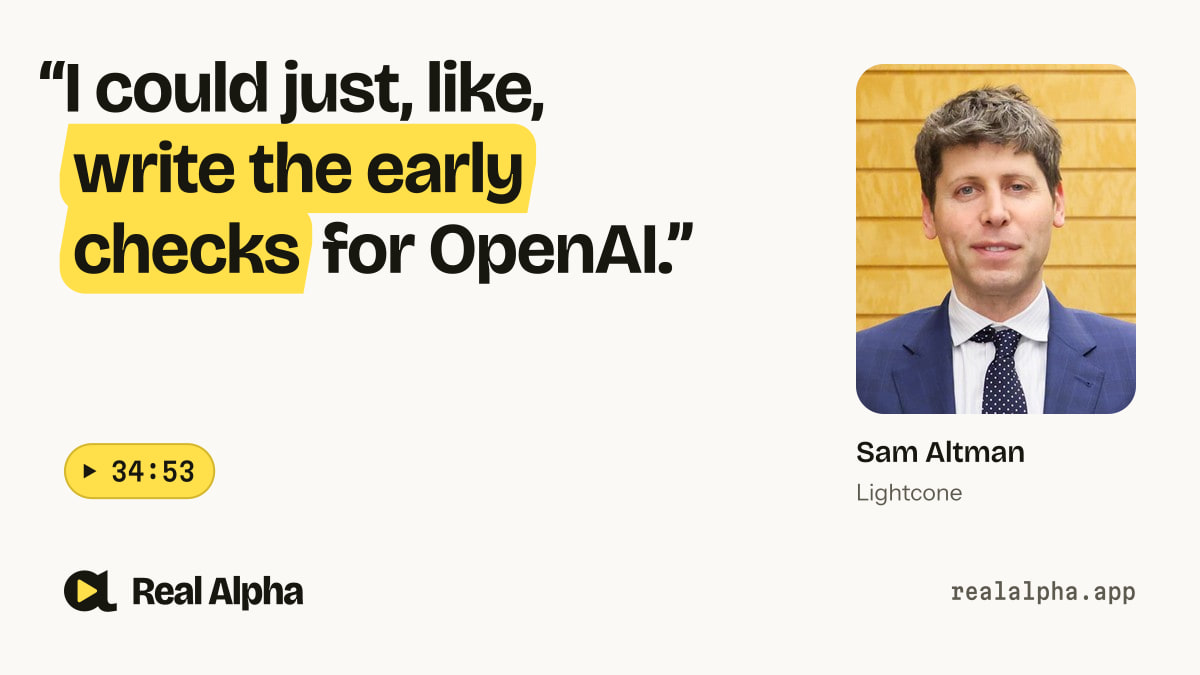
“I could just, like, write the early checks for OpenAI.”
 Sam Altmanat 34:53 · Lightcone
Takeaways
- His own capital helped fund OpenAI at the start.
- He says outside funding would have been hard to secure then.
- AI was the work he most wanted to pursue.
About this segment
Sam Altman says his Loopt exit let him write OpenAI's early checks, which would have been hard to raise externally. He also reflects that AI, not Loopt, was the work he most wanted to do.

Sam Altman is CEO of OpenAI.
Co-founded OpenAI and has led it since 2019, overseeing ChatGPT's launch; formerly president of Y Combinator.

Garry Tan, Host · President & CEO, Y Combinator
Co-founded Posterous and Initialized Capital, an early Coinbase backer.
From “How To Build The Future: Sam Altman”, Nov 8, 2024. Watch the full episode
Thanks. We'll look at and fix what's off.
Transcript
Transcribed by machine (Whisper) from the episode’s audio, so a word may be off here and there.
- 34:08
So there's this other aspect that's interesting in that I think you and Elon and Bezos and a bunch of people out there like they sort of start their journey as founders you know really you know whether it's looped or zip2 or you know really in maybe pure software like it's just a different thing that they start and then later they you know sort of get to level up you know is there a path that you recommend at this point if people are thinking you know i want to work on the craziest hard tech thing first should they just run towards that to the extent they can or Or is there value in, you know, sort of solving the money problem first, being able to invest your own money, like, very deeply into the next thing?
- 34:53
It's a really interesting question. It was definitely helpful that I could just, like, write the early checks for OpenAI. And I think it would have been hard to get somebody else to do that at the very beginning. And then Elon did it a lot at a much higher scale, which I'm very grateful for. And then other people did after that. and and there's other things that i've invested in that i'm really happy to have been able to support and i don't i think it would have been hard to get other people to to do it um so that's great for sure and i did like we were talking about earlier learn these extremely valuable lessons but i also feel like i kind of like was wasting my time for lack of a better phrase working on looped i don't i definitely don't regret it it's like all part of the tapestry of life and i learned a ton and whatever else what would you have done differently or what would you
- 35:43
tell yourself from like now to in a time cap in like time travel capsule that would show up on your desk at stanford when you were 19. well it's hard because ai was always the thing i most wanted to do and ai just like i went to school to study ai but at the time i was working in the ai lab the one thing. They told you it was definitely don't work on neural networks. We tried that. It doesn't work.
- 36:04
That's a long time ago. I think I could have picked a much better thing to work on than Loopt. I don't know exactly what it would have been, but it all works out. It's fine. Yeah. There's this long history of people building more technology to help improve other people's lives. And I actually think about this a lot.