The alpha, twice a week
That was 2 min.
Get the best new moments in your inbox every Wednesday and Saturday. It's free.
Check your inbox
We sent a link to your address. Click it to finish signing up. Not there in a minute? Look in spam.
or
Bloomberg Surveillance · 2 min · Nov 24, 2026
A slower AI buildout could reduce overinvestment risk
Steve Chiavarone argues that political fear is a poor investment strategy, while a measured slowdown could help cash flows and supply chains catch up.
The episode’s best minutes
Full analysis- 0:55Strong AI demand made the selloff a buying opportunityPro pick 2 min
- 5:14A slower AI buildout could reduce overinvestment riskPro pick 2 min
- 11:14Government intervention needs clear limits and consistent rules3 min
- 2 more moments in the full episode
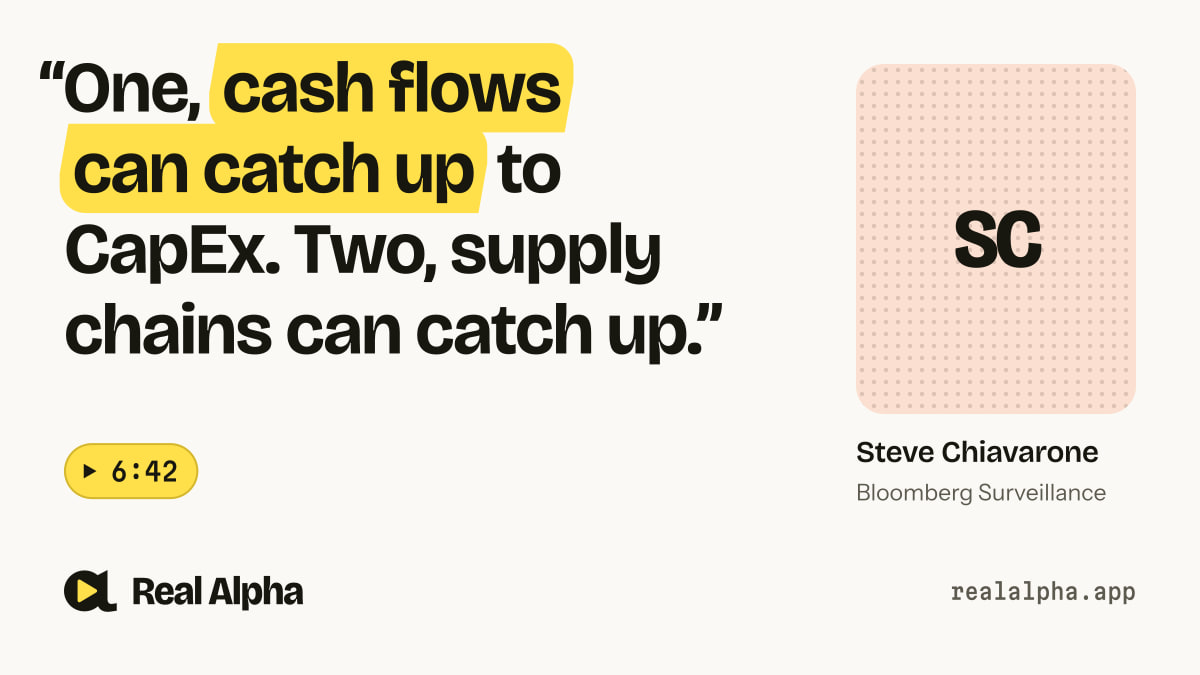
“One, cash flows can catch up to CapEx. Two, supply chains can catch up.”
Takeaways Pro pick
- He says political fear alone should not drive investment decisions.
- A slower buildout lets cash flows catch up to capital spending.
- Supply-chain catch-up could reduce overinvestment and credit risk.
One of Pro's picks, open to you here. Try Pro free for 7 days
One of Pro's picks. The rest of the summary and the 3 takeaways are in Real Alpha Pro; the video, the quote and the transcript stay free.
Read it with Pro, 7 days freeAbout this segment
Steve Chiavarone argues that political fear is a poor investment strategy, while a measured slowdown could help cash flows and supply chains catch up. That may make the AI expansion more sustainable.
CIO: Global Equities, Federated Global Investment Management
- TK
Tom Keene, Host
- PS
Paul Sweeney, Host
- LM
Lisa Mateo, Host
- MB
Michael Barr, Host
From “Bloomberg Surveillance TV: November 24th, 2026 | Bloomberg Surveillance”, Nov 24, 2026. Watch the full episode
Answers “Is AI a bubble?” See all 99 answers
Thanks. We'll look at and fix what's off.
Transcript
From the transcript Bloomberg Surveillance publishes with the episode.
- 5:16
Well, but how do you characterize policy uncertainty? And this started before Jensen Huang left. This question of after the U.S. Election, there were. Real questions about pushback to data center build-out, pushback to a lot of the tech sector, now you're going to have hearings where people are dragged in front of different congressional committees and grilled about the national security risks at a time when we're having outages and a lot of major infrastructure.
- 5:40
I mean, there is an overhang of fear. How do you weigh that into your investment thesis, given that there are some fundamental implications?
- 5:47
Because fear is not a strategy. And I would say it a couple ways. Look, you can go out and you can find, you know, on both sides of Wall Street, if you go to Trinity Church, on the right side of the church and the left side of the church, are two graveyards of people that have lost their careers by getting clouded by politics when engaging with markets. I think the overreaction to the midterms was in fact an overreaction. I said it the day of, I was here the day of that election, and I said I thought that there'd be a potential for an overreaction. What you didn't want to have happen was this build-out continue completely unabated at the pace with which it was going, right? The circular financing represented a risk.
- 6:26
The shortfalls represented a risk. A little bit of a slowdown, and this has been our thesis all along, and it's a number of things. It's tighter financial conditions from the Fed. It's a little bit of regulatory pressure in terms of the data center buildup. If it slows this down a bit, it allows a couple of really important things to happen. One, cash flows can catch up to CapEx. Two, supply chains can catch up. And you reduce the risk of overinvestment or a credit blowup.
- 6:52
So I get it. There's fear. But if you look through that fear, which is essentially our job, what we see is that the chances of a kind of, you know, fill up and explode are lower because we're taking a little bit of a breath here. And I think that that's ultimately a good thing.
- 7:09
Now, it's difficult for markets to digest that. We've seen that. But I think we're going to get through it and you're going to have a more sustainable run.