The alpha, twice a week
That was 5 min.
Get the best new moments in your inbox every Wednesday and Saturday. It's free.
Check your inbox
We sent a link to your address. Click it to finish signing up. Not there in a minute? Look in spam.
or
Sabrina Halper Show · 5 min · Sep 2, 2026
A two-year COBOL migration took four days with a Droid
 Matan Grinberg
An enterprise migrated 30-year-old COBOL in four days, work that used to take two years.
In this episode
Full analysis- 23:56Enterprise AI is shifting from usage targets to ROIPro pick 5 min
- 28:05Open models can be worth the risk of a closed monopoly6 min
- 40:53Recursive self-improvement does not guarantee runaway growth6 min
- 18:14A two-year COBOL migration took four days with a Droid5 min
- 49:03Choosing what not to build is the new software moat3 min
- 35:19The proposed policy exempts open models from federal review4 min
- 38:37Agents could cause a billion-dollar security incident this decade2 min
- 8:54String theory taught Grinberg to decide with incomplete information3 min
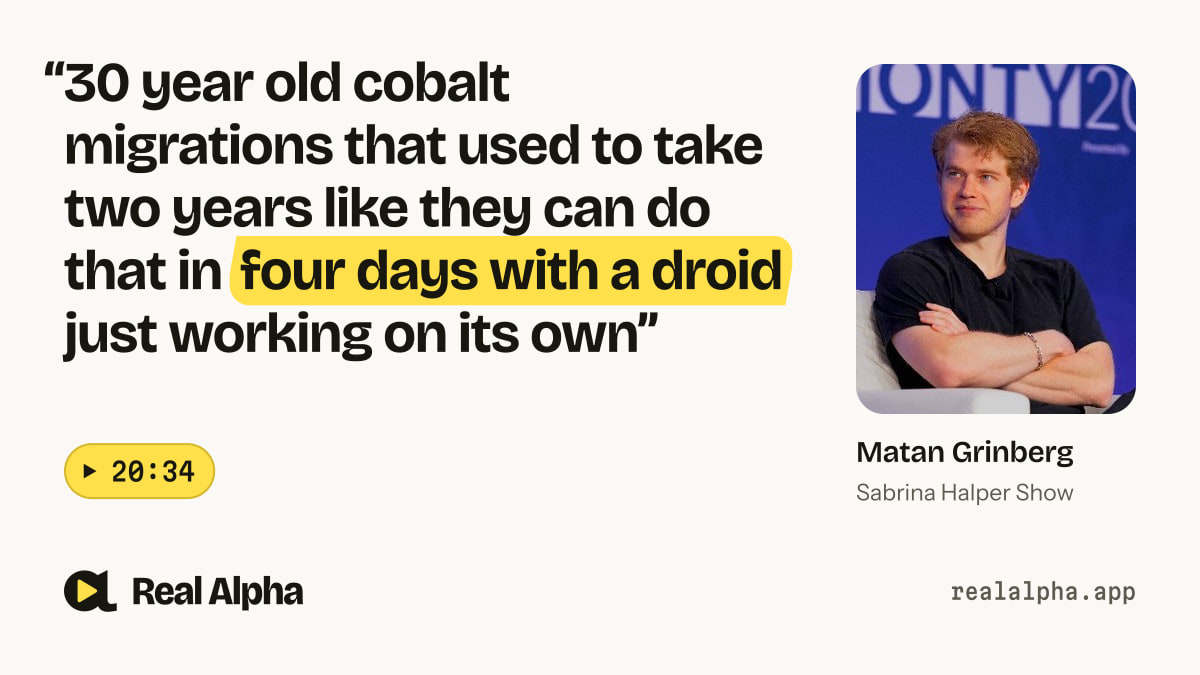
“30 year old cobalt migrations that used to take two years like they can do that in four days with a droid just working on its own”
 Matan Grinbergat 20:34 · Sabrina Halper Show
Takeaways
- One customer compressed a two-year migration into four days.
- Coding competitions no longer predict engineering success as well.
- Factory sees former founders as its strongest hiring signal.
About this segment
An enterprise migrated 30-year-old COBOL in four days, work that used to take two years. Matan Grinberg says hiring now favors high agency over coding speed.

Matan Grinberg is cofounder of Factory.

Sabrina Halper, Host · Host, Sabrina Halper Show
Has worked as an investor at HOF Capital and founded SHS Media.
From “Factory’s Matan Grinberg on Recursive Self-Improvement, Chinese Models & Lessons From String Theory”, Sep 2, 2026. Watch the full episode
Answers “Are AI agents ready for real work?” See all 104 answers
Answers “Is AI paying off for companies?” See all 54 answers
Thanks. We'll look at and fix what's off.
Transcript
Transcribed by machine (Whisper) from the episode’s audio, so a word may be off here and there.
- 18:27
like that but okay so i want to i want to quickly ask you about this period where you were like i think you've described it before as like going through the desert where you had the vision so on point like this is where it's heading and this is what i want to build but it it like wasn't the technology like wasn't actually possible so um it has now started obviously really working in the past maybe year would you say yeah but what changed enable it to like actually work yeah i mean i think it takes two to tangle on one hand it's the models getting better but i actually think one of the biggest barriers is just behavior which is like you know developers are some of the like smartest personas in the world you know at systems thinking and solving problems but they're also um very particular and very picky and they've built their workflows
- 19:17
typically over like decades like they know exactly you know the type of development environment that they like to use the type of workflows they like to use they're very thoughtful about it um which is unlike you know there are people talk a lot about like i don't know consumer products and like the whole like steve jobs isms of like people don't know what they want like i know what they want better than they do developers really are particular and they know what they want and they like things that are modular and that they can kind of compose and configure um so you think developers have just adapted to all of this in the past year because because they're having to rethink yeah i think i think people are just much more open-minded about like you know what everything that we thought was holy is not and like let's rethink everything for first
- 19:59
principles about how we should be building And then that combined with the models getting a lot better has made it such that now software development looks completely, completely different. So factor as it is today, like what can a Droid do today and what do you hope a Droid looks like in five years? so right now it's kind of like we'll sometimes joke internally that anything that can be done on a computer can be done with droid which is true the question is just how much do you need to configure or like put put up around it to make sure it does it reliably um and i think that's the biggest thing that we're working on making even easier is like you know if before you had to provide a ton of instructions now droid can kind of autonomously go and figure stuff out about what you used to do and what you might want to do in the future um but we're seeing enterprises do like
- 20:47
30 year old cobalt migrations that used to take two years like they can do that in four days with a droid just working on its own wow it's like insane the biggest barrier is not how much can you know droids do it's literally who is the person who's going to say oh here's how here's what we should give to a droid here are the types of things that we should prioritize now um which is crazy like the new bottleneck is not doing the thing it's like deciding what to do even at anthropic they published this paper that said like 80 of code is now being written by claude sure um and i was talking to someone there and they were like we actually have to start really rethinking our technical interviews to hire because the skill set is actually different so when you think about like hiring great engineers whether they're super advanced in
- 21:38
their career or whether it's someone who's like i'm about to graduate what should i be trying to get really good at like what is that skill set now like who are the people that actually like really succeeded these companies the biggest predictor i would say like probably 10 years ago the biggest predictor of like a killer engineering hire is like coding competitions like olympiads that type of thing because you want people who are really fast at this stuff that is now like not negatively core it's just decoupled it is decoupled because having deep and like quick understanding of particular languages or algos, like it doesn't really matter right now because these models will just know it better than most humans, whatever, 90% of the time.
- 22:16
The thing that we find is a much better predictor is, or the thing to predict is high agency. And one of the best predictors of that is just founders. Like former founders is by far the highest predictor of success at factory because we need people who have high agency to own outcomes and being really good at a particular language or particular like types of systems problem in particular that doesn't predict high agency like high agency is just like we need people to get shit done and figure out all the things that they need to solve that problem um and it might be like unorthodox or unconventional things and that is like the name of the game of what founders do okay amazing so if you're a founder and it's not quite working out or even if it's working out and you want to make it work out even better like it's the age of mma yeah like that's the thing
- 23:02
is we like the founders that we brought on we've actually never brought on like failing companies or anything like that it's always like companies who are doing really cool work that we admire and it's just like let's just increase the stakes increase you know the leverage of every hour and join forces and it's been it's been really cool to see um so you guys have really been crushing it i i think you're like doubling growth every month something like that i don't know if