The alpha, twice a week
That was 3 min.
Get the best new moments in your inbox every Wednesday and Saturday. It's free.
Check your inbox
We sent a link to your address. Click it to finish signing up. Not there in a minute? Look in spam.
or
80,000 Hours Podcast · 3 min · Nov 3, 2026
A UK campaign got 60 MPs to criticize DeepMind's safety record
 Rob Wiblin
 describes ways to reach politicians and the wider public, from social media to press appearances.
In this episode
Full analysis- 1:12Anthropic’s draft leaves a narrow path to stop dangerous AI development6 min
- 12:38Google DeepMind’s contract may silence criticism for life3 min
- 7:08OpenAI's leak inquiry likely relied on weak evidence6 min
- 16:34AI staff should use public dissent while they still have leverage4 min
- 22:40Outside experts can expose failures and help insiders act3 min
- 25:10A UK campaign got 60 MPs to criticize DeepMind's safety record3 min
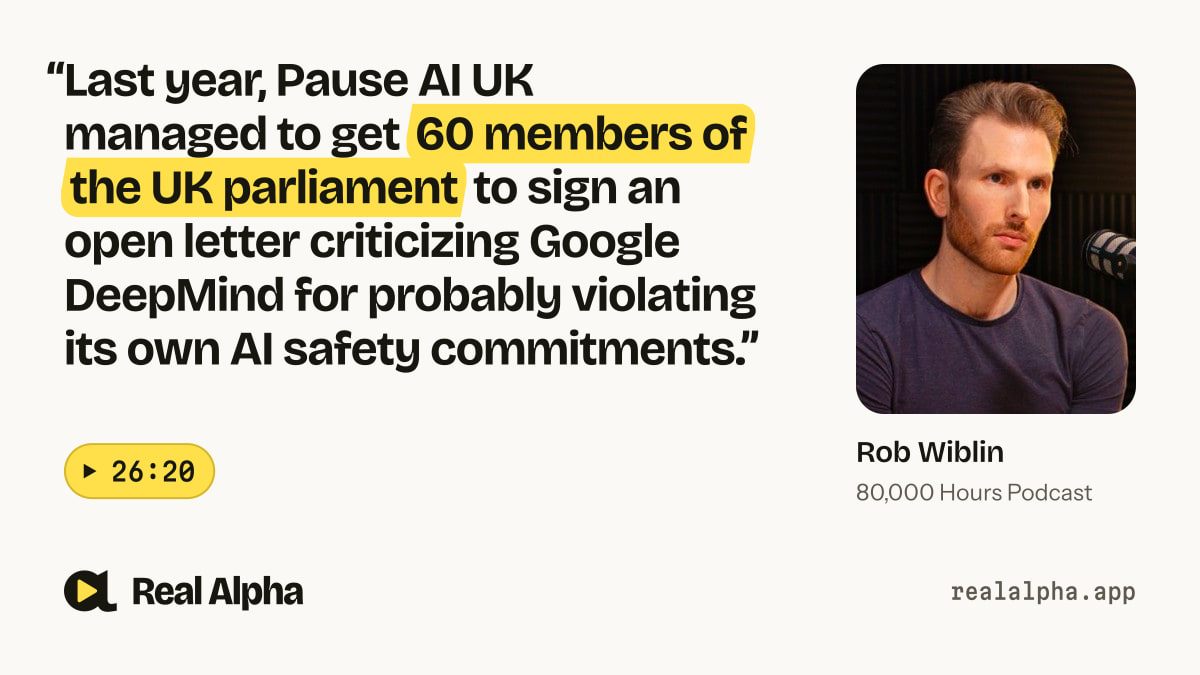
“Last year, Pause AI UK managed to get 60 members of the UK parliament to sign an open letter criticizing Google DeepMind for probably violating its own AI safety commitments.”
 Rob Wiblinat 26:20 · 80,000 Hours Podcast
Takeaways
- Build credibility with journalists before a major story breaks.
- Social media, TV, and other outlets can amplify public pressure.
- Former AI company staff can be especially credible public voices.
About this segment
Rob Wiblin describes ways to reach politicians and the wider public, from social media to press appearances. He points to a UK campaign that brought 60 MPs onto an open letter about DeepMind's safety commitments.

Rob Wiblin, Host
Host, 80,000 Hours Podcast
From “The latest scandals from OpenAI, Anthropic & Google are pretty bad | Rob Wiblin”, Nov 3, 2026. Watch the full episode
Thanks. We'll look at and fix what's off.
Transcript
Transcribed by machine (Whisper) from the episode’s audio, so a word may be off here and there.
- 25:14
to reach a broad audience outside the AI and tech industries to stimulate mass outrage when massively outrageous things are going on there's obviously a huge range of things in this category and i feel like i know less about it but again i'll throw out some thoughts one approach would be to disproportionately reach politicians and people who work in politics whether in dc or at the state level and another would just be to try to reach as many people as you can with massive coverage through social media tv newspapers podcasts and so on ideally we'll just have way more informed and credible people who the press knows to call when they want to discuss an emerging AI issue because they've helped with their reporting in the past, or they've been great on TV before, or they consistently put out good analysis online.
- 25:52
A group I'm really impressed with that does some of all of this is Encode AI, which has been involved in all sorts of campaigns. They both provide detailed analysis for legislators, and they're very effective at reaching a wider public audience as well. Nathan Calvin, who you saw criticizing Anthropik's proposed legislation and getting a response from the company, he works at Encode, and we interviewed their founder, Sneha Revener, a few months ago.
- 26:14
There are many pause AI and control AI organizations that they're also in this broad category, and they might be well-placed to take advantage of this issue becoming much more important and salient to the public over the next few years. Last year, Pause AI UK managed to get 60 members of the UK parliament to sign an open letter criticizing Google DeepMind for probably violating its own AI safety commitments.
- 26:33
Now, if you have a knack for directing attention to particular topics by producing engaging content or getting earned media, that could absolutely be your biggest opportunity for impact i'm thinking stunts memes jokes billboards clips viral videos and text posts and so on it takes a particular kind of person to succeed at this and it's a weirdly valuable skill in the modern world one that in most cases should be cultivated rather than squandered you might start by racking up views on youtube or instagram or tiktok or facebook or wherever you have a relative advantage and then convert that into also getting your ideas covered on tv cable news magazines newspapers podcasts and so on this work is naturally open to a wide range of people who don't have any existing involvement in the tech industry. That's one of the attractive things
- 27:14
about it. But I would be remiss if I didn't say that people who used to work at AI companies are really unusually credible to the public on the topic of whether an AI company is behaving badly, and if so, what it should do differently. If you're an ex-company employee, and you can stomach it, get professional comms advice and training and prepare yourself to be available to go on TV or do interviews with newspapers or write op-eds when these topics flare up to massive public attention as they're absolutely certain to do again unfortunately a lot of opportunities for media are being dropped or not used very effectively because many potential spokespeople they're not honing their communication skills or getting connected or even just putting themselves