The alpha, twice a week
That was 4 min.
Get the best new moments in your inbox every Wednesday and Saturday. It's free.
Check your inbox
We sent a link to your address. Click it to finish signing up. Not there in a minute? Look in spam.
or
Upstarts · 4 min · Jul 23, 2026
Abridge challenged Microsoft with a conversation-first vision
 Shiv Rao
 explains why Abridge chose enterprise sales early and challenged Microsoft’s Nuance product with a conversation-first vision.
The episode’s best minutes
Full analysis- 31:32Abridge challenged Microsoft with a conversation-first vision4 min
- 27:00Clinical notes connect care delivery to healthcare payment3 min
- 43:21A difficult IVF journey shaped Abridge’s mission3 min
- 5 more moments in the full episode
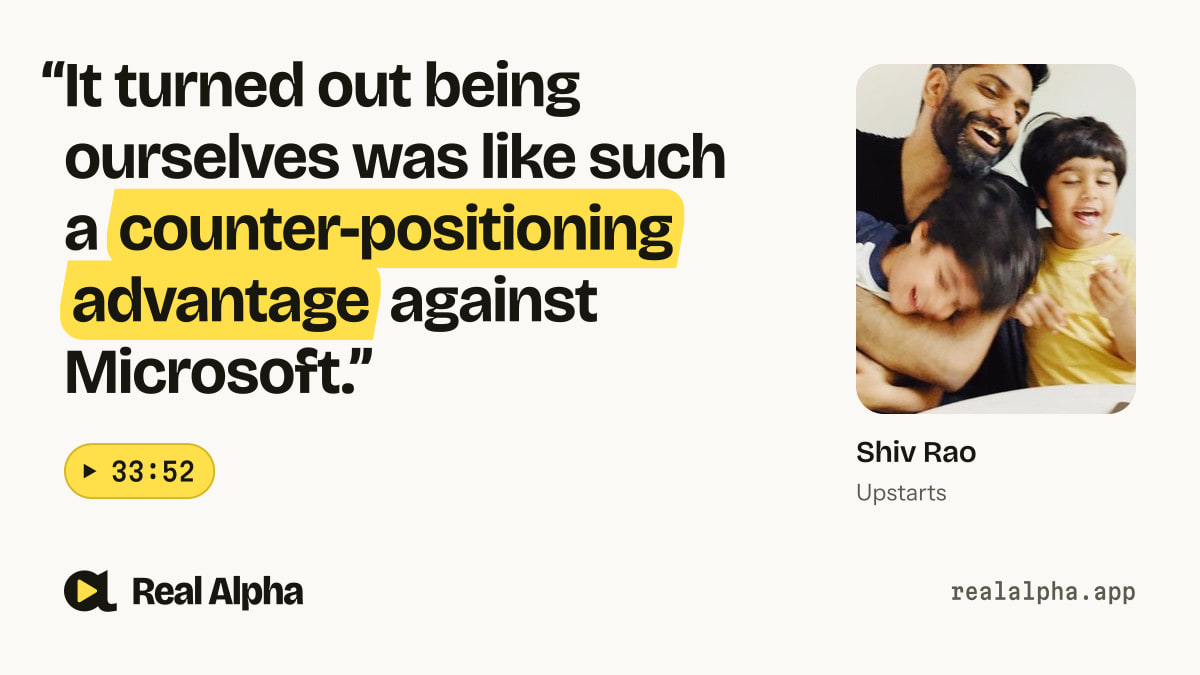
“It turned out being ourselves was like such a counter-positioning advantage against Microsoft.”
 Shiv Raoat 33:52 · Upstarts
Takeaways
- Abridge chose top-down enterprise sales despite the risks.
- Its pitch focused on the conversation, not just notes or billing.
- Early head-to-head wins helped build word of mouth among CIOs.
About this segment
Shiv Rao explains why Abridge chose enterprise sales early and challenged Microsoft’s Nuance product with a conversation-first vision. Winning meant proving it was 10x better and earning trust among health-system leaders.

Shiv Rao is cofounder and CEO of Abridge; practicing cardiologist.
Co-founded Abridge, which brings context and understanding to medical conversations, and practices as a UPMC cardiologist.

Alex Konrad, Host · Founder & editor, Upstarts Media
Ran Forbes' Midas List for ten years and co-created its Cloud 100 list; founded Upstarts in 2025.
From “Abridge’s Shiv Rao: Taking On Microsoft To Cure Doctor Burnout With AI”, Jul 23, 2026. Watch the full episode
Thanks. We'll look at and fix what's off.
Transcript
Transcribed by machine (Whisper) from the episode’s audio, so a word may be off here and there.
- 31:36
I think getting conviction on go-to-market, really in 2022, 2023, we were walking through a one-way door. I think in some ways you could say that we were going to put all of our energy into top-down enterprise. And that meant we had to go after huge bosses. Like the first big boss we had to go after and compete against, I should say, was Microsoft. Microsoft had bought a company called Nuance for like 20 billion plus some years before.
- 32:06
They have and had a product that was directly competitive. Microsoft, you know, no one gets fired for using Microsoft. Every CIO, speaking of personas, loves Microsoft. Everyone's always going to be a customer of Microsoft. so now we're this startup that at the time was like 50 people and we're saying we can go up against microsoft it was a yolo move like i think that's why most VCs tell their startups, go down market first, figure out PMF with a small clinic, build something that the end user loves, and then like swim over time upstream and get to that large system.
- 32:41
And for a lot of reasons, including the amount of money we had in the bank, there was no other way. Because like, ultimately, you have to get to those big systems. That's where 75% of the doctors in this country practice. So if you're going to build a big, impactful, legacy-leaving generational company, you need to get there as fast as you can. If it didn't work out for us with those first couple of systems, we would have been dead because all those CIOs are in WhatsApp groups with each other.
- 33:06
And when they see something they don't like, they tell each other the word of mouth is crazy. And then like you probably have to rebrand or recap and come back for your next shot on goal. Like you're just not going to get many shots, probably not more than one shot. Unless you do the second startup, you know, and then you get your second shot. Yeah, exactly. So on the show, we call something an upstart moment where you're most back against the wall, punching above your weight. It sounds like there might have been an upstart moment when you're trying to get these first couple systems that will be tastemakers on board. Was there a tactic or a strategy that you took that really helped make that happen? I don't know if it was like basically camping out at the hospital or something. What did you do as an upstart there?
- 33:48
It sounds like very, maybe a bit too contrived, but like it was kind of being ourselves and being ourselves. It turned out being ourselves was like such a counter-positioning advantage against Microsoft. Just saying, hey, this is what our true north, this is what we're trying to build. We had this one slide in all of our pitch decks at the time that made clear our thesis about the conversation, that it wasn't about notes.
- 34:13
It wasn't about orders. It wasn't about billing. It was about the conversation. And on top of that, we could do all these things over time. And that over time, what that meant was that clinicians could just talk. They could just like be creative. They could just focus on all the things they learned in med school and nursing school because we could get technology out of the way. like that there was something paradoxically profound about ai actually removing all the other technology or pushing it into the background people like resonate with that and microsoft wasn't saying that and i probably still don't believe that and i think that resonance allowed us to figure out how to build relationships with cmios and those doctors because they believed in this because like hey this is this is the story we all want
- 35:01
They would go sell to CIOs, convince them, like, hey, we know you love Microsoft, but give this company a shot. Let's just see a head-to-head. And then we had to, like, nail those first few head-to-heads. And we had to demonstrate that we were 10x better. And then those same WhatsApp groups, they worked for us because everyone was like, hey, actually, give this company a shot. So if we were to boil this down for, you know, other startups to learn from, it's the vision and the audacity to sort of share that bigger vision.
- 35:30
Say we're biting off this big, you know, effort.