The alpha, twice a week
That was 9 min.
Get the best new moments in your inbox every Wednesday and Saturday. It's free.
Check your inbox
We sent a link to your address. Click it to finish signing up. Not there in a minute? Look in spam.
or
Odd Lots · 9 min · Nov 27, 2026
Affordability needs immediate relief and public investment
 Isabella M. Weber
 pairs targeted price stabilization for essentials with public investment in energy infrastructure and negotiated prices for staple foods.
The episode’s best minutes
Full analysis- 9:47Affordability needs immediate relief and public investment9 min
- 32:52Essential-price shocks explain why the economy feels worse4 min
- 37:58Price stabilization depends on the sectorPro pick 5 min
- 3 more moments in the full episode
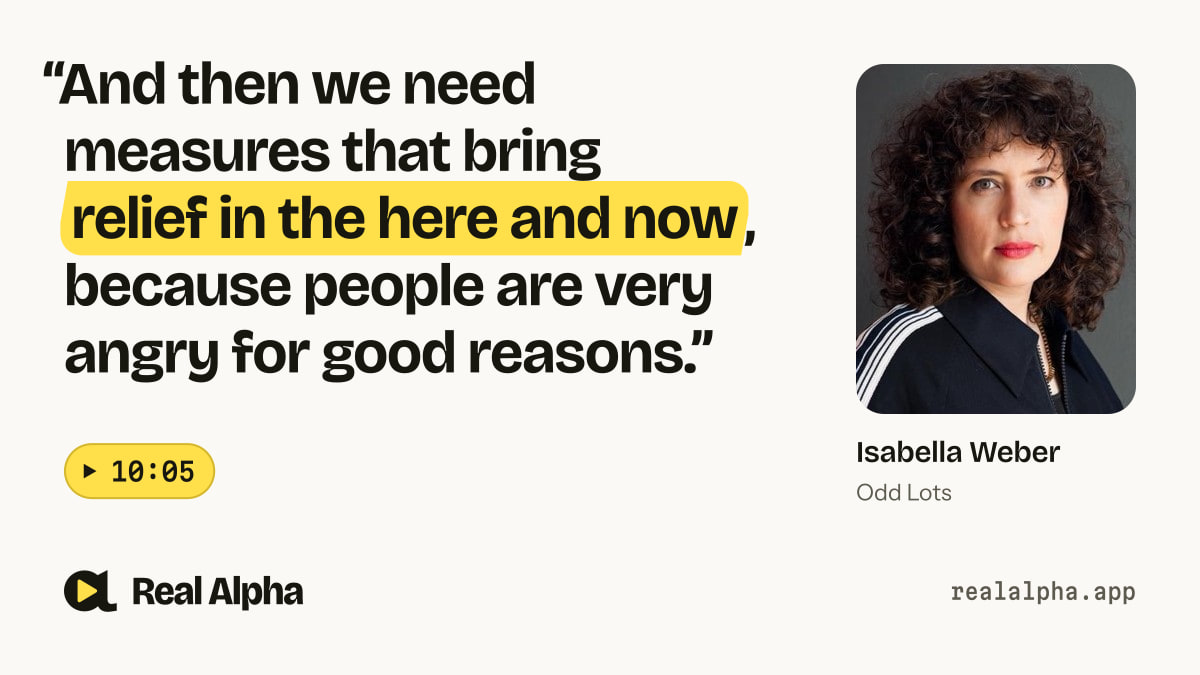
“And then we need measures that bring relief in the here and now, because people are very angry for good reasons.”
 Isabella Weberat 10:05 · Odd Lots
Takeaways
- Cap prices for a basic amount of household energy.
- Use public authorities to build large-scale energy infrastructure.
- Negotiate stable prices for a basket of food staples.
About this segment
Isabella M. Weber pairs targeted price stabilization for essentials with public investment in energy infrastructure and negotiated prices for staple foods. The combination aims to ease pressure now while building more resilient supply.

Isabella M. Weber is a professor of economics at the University of Massachusetts.
Explained China’s market reforms in an award-winning book and advances policies for inflation and affordability.
- JW
Joe Weisenthal, Host · Bloomberg
- TA
Tracy Alloway, Host · Bloomberg
From “Isabella Weber's Vision for an Affordability Agenda | Odd Lots”, Nov 27, 2026. Watch the full episode
Thanks. We'll look at and fix what's off.
Transcript
From the transcript Odd Lots publishes with the episode.
- 9:59
Yeah, I mean, I think the number one lever is to realize that essentials is what really matters. So that step, you know, from everything to the stuff that people really care about because it defines their livelihoods, I think is.
- 10:12
The first step that we need to take. So in that sense, we need and economics of essentials.
- 10:17
And then we need measures that bring relief in the here and now, because people are very angry for good reasons. And we need measures that bring relief on a very short time horizon. You can't say, you know, we're going to build new infrastructures that might come online in five, 10 years.
- 10:35
And which in the meantime could be inflationary because they're going to compete for resources when you build them. Exactly.
- 10:41
So that's why I actually still think that we need price stabilization measures. What kind of measures you apply depends very much on the sector. But the logic should be that you apply them within the essentials to the part that people can't do without. So if you take the example of utilities, what we did in Germany was to implement this gas price break during the energy crisis, where the idea was everybody needs a certain amount of gas to be able to heat their homes and cook and take a shower. And that is like some sort of almost like a human right to be able to have access to this like basic needs bundle of gas. And for that amount of gas per person, the price has to be capped. And then if you consume more than that, you are on the market price. So that's, I mean, a basic nonlinear pricing scheme that which I think could
- 11:34
be really important in addressing utility price insecurity, which, I mean, of course, is not only about gas, also about electricity, heating oil. And if you look at what's been happening this summer with the extreme heat in places like Idaho, where people, you know, have been like literally pushed over the edge because of electricity prices exploding and them not being able to cool down their homes anymore, then this increasingly becomes really a question of people having access to a space in which they can live a healthy enough life.
- 12:09
That is, of course, a short-term measure, right? And then the question is, how do you use the time that you buy with a measure like this to rebid the systems? And in the case of electricity, I would argue for basically a public utility, a national public utility, I mean, call it an electricity authority or whatever you want to call it, that would be building out the grid because we know that the grid is a natural monopoly by design, which means that if you have these kind of network structures in private hands, they will tend to be underinvested and you will tend to pay monopoly rents, which will add to the cost of utilities. So I think there's a very strong case there for a public entity building out the grid. And if we go further up the value chain, then, I mean, I think we have to think about building out the strategic petroleum reserve in ways
- 13:06
that it cannot be drawn down as it currently is. And we need to think about diversifying this as a reserve that is not only about oil, but that becomes a bundle of key energy sources to have the same principle of basically counter cyclical stabilization mechanisms in order to have the goal of defending a price floor and a price ceiling for oil and gas. And I think that's really important because what we see is that in energy crisis like the one that we are living through right now, fossil fuel profits explode. And this fossil fuel profit explosion rehabilitates a sector that needs to be phased out for the sake of climate change mitigation, which, I mean, let's not forget the climate crisis is increasingly one of the root causes of of affordability, of the affordability crisis. In that sense, we need these price floor and ceiling kind
- 14:02
of mechanisms that can be backed up with buffer stocks like the Strategic Petroleum Reserve.
- 14:08
And then we need build out of renewable energy. And there I would argue that anything that is large scale, that is like solar parks, wind parks, hydropower plants, anything that is on an infrastructure level should as much as possible be developed by a public authority because we don't want to reproduce the same market structures in the new energy system that we are inheriting in the old energy system that has basically created a situation where one sector can hold the whole economy hostage, because we see that the price of energy and the provisioning of energy is just critical for the functioning of the economy as a whole.
- 14:48
That doesn't mean that, you know, you shouldn't have a solar cell in your backyard or on your balcony or your rooftop. All of that should be encouraged. But anything that is, you know, large scale infrastructure scale with increasing returns to scale, on my mind, should. Be built out publicly. So this is really the idea of, you know, basically like a New Deal style initiative to build out these new infrastructures, but combined with these short-run stabilization measures because we need relief in the here and now. I think the same principle can be applied even to something like food, where of course things become thornier because in contrast to energy, I mean, it's much more heterogeneous. If you go to a supermarket, you'll find like thousands of different products. You don't usually have like a long-term contract with your grocery
- 15:40
store in contrast. To your utility and so on, right? So a very different setup in that sense.
- 15:47
But what the Mexican government did is to draw up a basket of food staples and then negotiate a deal between the government and the largest grocery stores that the grocery stores have to keep the price of this basket as a whole stable. And I think that's smart. It basically utilizes the fact that the grocery sector is incredibly concentrated in most countries, including the United States. So it's not like you have to talk to hundreds of different companies.
- 16:18
You literally have to get the representatives of four or five companies into the room to strike up an agreement like this. And what it does is very much in contrast to the idea of, oh, democracy is great, but.
- 16:31
Unfortunately we can't do anything for you. It positions the government as an entity that negotiates on behalf of consumers with the companies that people are relying on every day. And I think that is really critical in reviving a sense of democracy of, you know, those guys in Washington are actually out there to speak to my interests. And What Claudia Scheinbaum does is not only negotiate this agreement, but actually she holds a press conference regularly where she reports on how well or poorly companies have been doing and, you know, holding up the agreement.
- 17:10
So she's saying, you know, not only do I negotiate on your behalf, but I am also holding those companies accountable on your behalf. Now, this is, of course, a measure that in the Mexican case, it's 24 products. I mean, one would have to discuss what the products would be in the U.S. Case. This is, again, like, you know, this short-term measure that really gets the price stabilization for the most essential part of the essentials. But we know that the food system is, A, incredibly fossil fuel intensive, which makes it very vulnerable to fossil fuel price volatilities, and B, extremely vulnerable to climate shock.
- 17:49
So, you know, we need to transform the food. Industry because otherwise, you there won't be sustainable affordability because these shocks will just, you know, keep hitting. So in that spirit, I actually think that experiments with, for example, public grocery stores as we have them in New York City, but also public grocery stores that are part of military bases can be procurement levers that you could use to, you know, experiment with green forms of food production.