The alpha, twice a week
That was 2 min.
Get the best new moments in your inbox every Wednesday and Saturday. It's free.
Check your inbox
We sent a link to your address. Click it to finish signing up. Not there in a minute? Look in spam.
or
MTS · 2 min · Nov 5, 2026
Agent backends are becoming multi-agent systems
Chirag Shah contrasts traditional full-stack apps with agentic applications built around agents, tools, memory and context.
The episode’s best minutes
Full analysis- 2:28Agents need memory that changes with the userPro pick 4 min
- 9:46Building agent memory can distract from the business logicPro pick 3 min
- 15:45Agent backends are becoming multi-agent systems2 min
- 3 more moments in the full episode
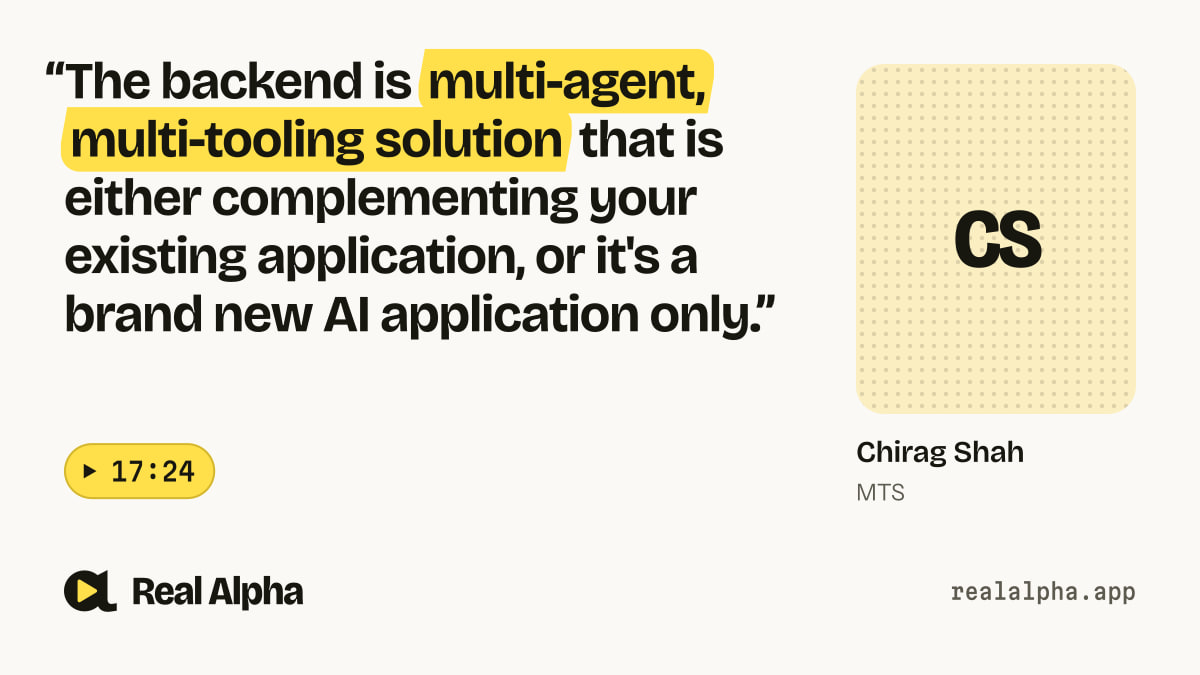
“The backend is multi-agent, multi-tooling solution that is either complementing your existing application, or it's a brand new AI application only.”
Takeaways
- Traditional apps pair a front end with business logic and a database.
- Agentic backends can combine multiple agents and tools.
- Memory, context and guardrails become part of the application.
About this segment
Chirag Shah contrasts traditional full-stack apps with agentic applications built around agents, tools, memory and context. The shift changes how enterprise software is structured, not just how users interact with it.
Chirag Shah is SVP, GM, and head of AI platform at MongoDB.

Theo Jaffee, Host · Co-founder & host, MTS
One of the first members of a16z's new media team; earlier hosted the Emergent Ventures-backed Theo Jaffee Podcast.

Sophia Dew, Host · Host, MTS
From “AI Agents Will Replace Full-Stack Backends | Chirag Shah”, Nov 5, 2026. Watch the full episode
Thanks. We'll look at and fix what's off.
Transcript
Transcribed by machine (Whisper) from the episode’s audio, so a word may be off here and there.
- 15:51
Completely. If we were to zoom out and we just say, OK, once memory is solved, once this becomes a lot more. Efficient and enterprises can ensure that they have agents with memory in production deployed at scale. What does that look like? What is now enabled from a builder perspective and point of view? Yeah. So for a minute, once the enterprise starts to build and deploy this memory, and it becomes an ongoing business for them, right? Just the way you became an ongoing customer of an e-commerce company. I'll just take a friendly name, Amazon, right? You're a prime customer, prime member, for example, and you've been a member for five years or 15 years, what have you. That's become an ongoing memory, right?
- 16:38
And that's what, because now I start that relationship to establish with that vendor or that company is captured into the digitized system. And with agentic solutions, that starts to become the memory. That's a relationship. That's an enterprise workload that will start to look like. But even if you further zoom out for one quick minute, look, in the last 20 plus years, what we have built is applications, what we call full stack applications from a developer's point of view.
- 17:07
There's a front end and there's a business logic on the client side and then there's a database and the whole back end and what have you. And that's how they think about it. That's how we build those enterprise applications. Today, what we are starting to already see is this full stack applications are literally becoming agentic applications. The back end look completely different. The back end is not a plain straight back end logic with a database.
- 17:31
The backend is multi-agent, multi-tooling solution that is either complementing your existing application, or it's a brand new AI application only. And that looks completely different from a technical point of view. To us, that's the translation of what you use as a user in a business and how developers build it with our tools and our solutions into that agentic apps, where memory, context, and security, guardrail, all of those things coming together with your agentic framework and your LLM, is what it would look like as an application in the enterprise.