The alpha, twice a week
That was 5 min.
Get the best new moments in your inbox every Wednesday and Saturday. It's free.
Check your inbox
We sent a link to your address. Click it to finish signing up. Not there in a minute? Look in spam.
or
Possible · 5 min · Nov 18, 2026
AI adoption depends on helping workers through job disruption
 Reid Hoffman
 argues that AI companies must acknowledge job losses and show how the technology helps people.
The episode’s best minutes
Full analysis- 15:07AI can compress early drug discovery from years to weeks5 min
- 9:56AI adoption depends on helping workers through job disruptionPro pick 5 min
- 4:57Data center deals should deliver local benefits4 min
- One more moment in the full episode
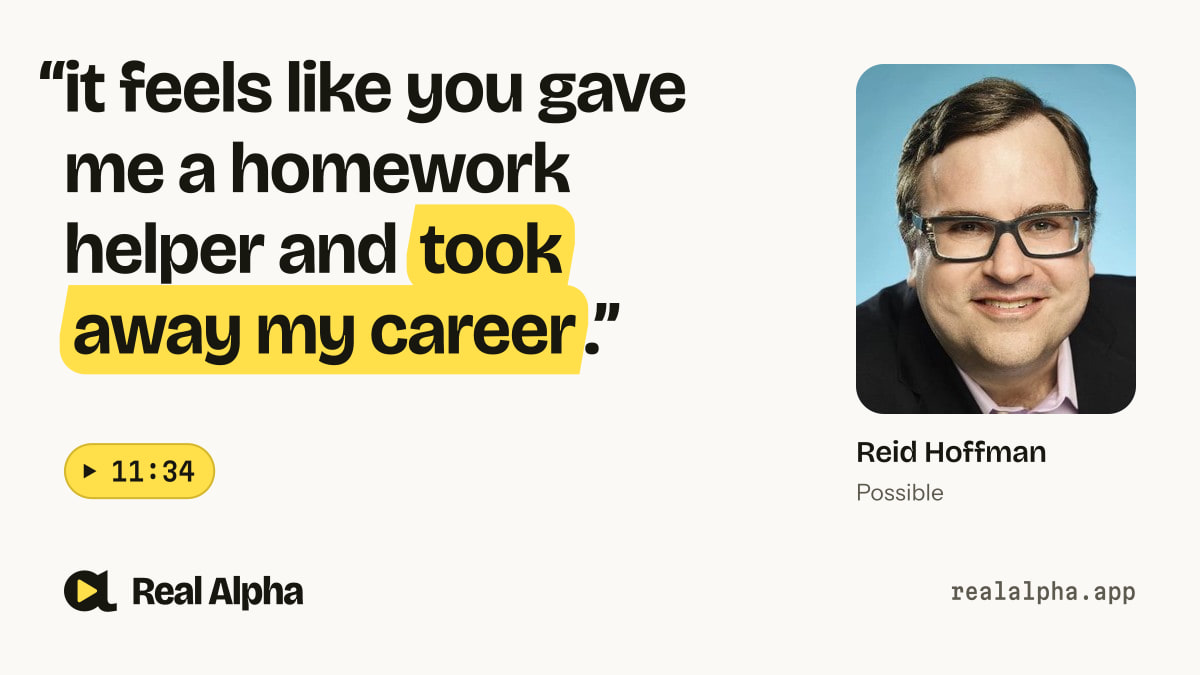
“it feels like you gave me a homework helper and took away my career.”
 Reid Hoffmanat 11:34 · Possible
Takeaways Pro pick
- Job changes and losses are real, so blanket reassurance rings hollow.
- People need visible benefits beyond a promise of future productivity.
- AI can help more people start small businesses.
One of Pro's picks, open to you here. Try Pro free for 7 days
One of Pro's picks. The rest of the summary and the 3 takeaways are in Real Alpha Pro; the video, the quote and the transcript stay free.
Read it with Pro, 7 days freeAbout this segment
Reid Hoffman argues that AI companies must acknowledge job losses and show how the technology helps people. He points to transition support and entrepreneurship as ways to build trust.

Reid Hoffman, Host
Co-founder, Manas AI
Co-founded LinkedIn; one of OpenAI's first investors; Greylock partner.
- AF
Aria Finger, Host
From “Live at Masters of Scale: AI pacing and data centers | Reid Hoffman”, Nov 18, 2026. Watch the full episode
Answers “Which jobs will AI replace, and which are safe?” See all 241 answers
Thanks. We'll look at and fix what's off.
Transcript
Transcribed by machine (Whisper) from the episode’s audio, so a word may be off here and there.
- 10:01
So, I think this is a serious question, in part because there will be job transition. Some of it will be job loss, some will be job change. We obviously hope to get as much in the job change versus job loss, and then I also legitimately, strategically, and intelligently optimistic about job creation. It's part of the reason why I think, and part of the reason why events like this done in Silicon Valley and so forth, is entrepreneurship we forget that all of our institutions that we have today you know there was not banks back in the stone ages you know etc etc so it's like how do we build them in entrepreneurship and we're now at this kind of you know at an accelerated disruptive age even from the industrial revolution which is of course you know anxiety producing and people should we should feel anxiety, help, you know, you know, the vast majority of people navigate it, but
- 11:00
it will have transition. And I think the people would say, oh, it'll all be fine. Don't worry about it is, is legitimately not believable. Uh, but on the other hand, uh, so I think there's a couple of things. So one is, as you know, I said, look, how do you get people on board with, okay, that'll be a difficult jobs journey. Well, one is provide me the other benefits, right? Provide be a medical assistant, an educational tutor, a legal assistant, et cetera, makes, okay, I get where this is valuable to me. Not like, for example, why do graduates kind of use AI a whole bunch in school and then boo it in commencement speeches? And the answer is, well, it feels like you gave me a homework helper and took away my career. And it's like, no, no, take your homework helper back and give me my career back. And it's like, no, no, we're working on the career part,
- 11:50
Here's some other things that are very good, right, in terms of how it operates. So I think you have to do that. Second thing is I think you want to be clearly working on things that help people with transition and work, right? And one of the magnificent things about AI is it can do a lot of these things. So if you say, well, I used to be in the marketing department. Well, what I did was I filled out all of the forms and kind of did the analysis of how the digital ads were working and all the rest, and frankly, 90% of what I do, any of the frontier models can do now, maybe certainly do faster, and if not better today.
- 12:30
better soon. So it's like, okay, that 90% just goes away. What can I do? It's like, well, okay, let's first look at what the 10% is and whether or not that expands in terms of doing things. And then what other capabilities you have that you go, okay, there's all kinds of things that are useful for new things that you can do. And as part of those new things you can do, here's how you can learn them, here's how I can help you do them as the AI, here's how I can help you find the jobs that make it happen. And part of the reason why I was first talking about entrepreneurship is I actually think AI, this is kind of third, is an enormous boon to entrepreneurship around the world. Because entrepreneurship is almost by definition pioneering. And it's like going into the zone that people aren't there before. Because if there was someone there,
- 13:18
they'd be there already. Even if it's like opening a restaurant on the local corner. And so now you have, and that's not just a plug for Read AI in the other building, right? Now you have an ability to have a lot more people try entrepreneurship in terms of how they're operating. And that creation of entrepreneurship, yeah, this is important enough. And so that entrepreneurship in terms of how do we, and it doesn't have to be, oh, it's all creating only scale tech companies.
- 13:51
It can be solo businesses. It can be small businesses being created. Like, say, for example, I'm really, really good at creating ceramics, but I don't know shit about marketing. I don't know shit about how to do digital stuff and should I use eBay for this or anything else. Well, we have an AI to help you, right? And by the way, your judgment and taste in ceramics is probably a long ways off before the AI is even in.
- 14:16
You might be using it in various ways. And, like, for example, one of the things that I know from a friend of mine, Kevin Scott, who's really into ceramics as part of the reason I chose a ceramics example, is one of his friends is, like, the world expert at, like, color mixing for ceramics and made, vibe-coded an app so to help everyone else do this. And those are the kinds of things that become possible.
- 14:36
And it's substance how you build back trust. It's be doing things. Not just be in dialogue. That's important. Not just be listening. That's important. but to be doing things where you show that you're investing and helping people. And then people begin to think, okay, maybe you're on my side. So speaking, we can clap for that.