The alpha, twice a week
That was 2 min.
Get the best new moments in your inbox every Wednesday and Saturday. It's free.
Check your inbox
We sent a link to your address. Click it to finish signing up. Not there in a minute? Look in spam.
or
Wall Street Week · 2 min · Oct 23, 2026
AI adoption may matter more than producing frontier models
Jacob Kierkegaard argues that productivity gains come from adopting AI, not necessarily producing frontier models, as long as access holds.
In this episode
Full analysis- 17:16Communities can negotiate better data center deals3 min
- 26:00Open models give enterprises more control over AI3 min
- 43:22Energy could turn Argentina’s dollar shortage into a surplus3 min
- 39:05A stronger peso is squeezing Argentina's labor-intensive sectors4 min
- 1:25Many campaigns have spent past the point where money helps3 min
- 7:15Campaign money has its biggest effects in primaries and referenda4 min
- 32:15AI adoption may matter more than producing frontier models2 min
- 13:40Loudoun turned leftover fiber into a data-center tax base3 min
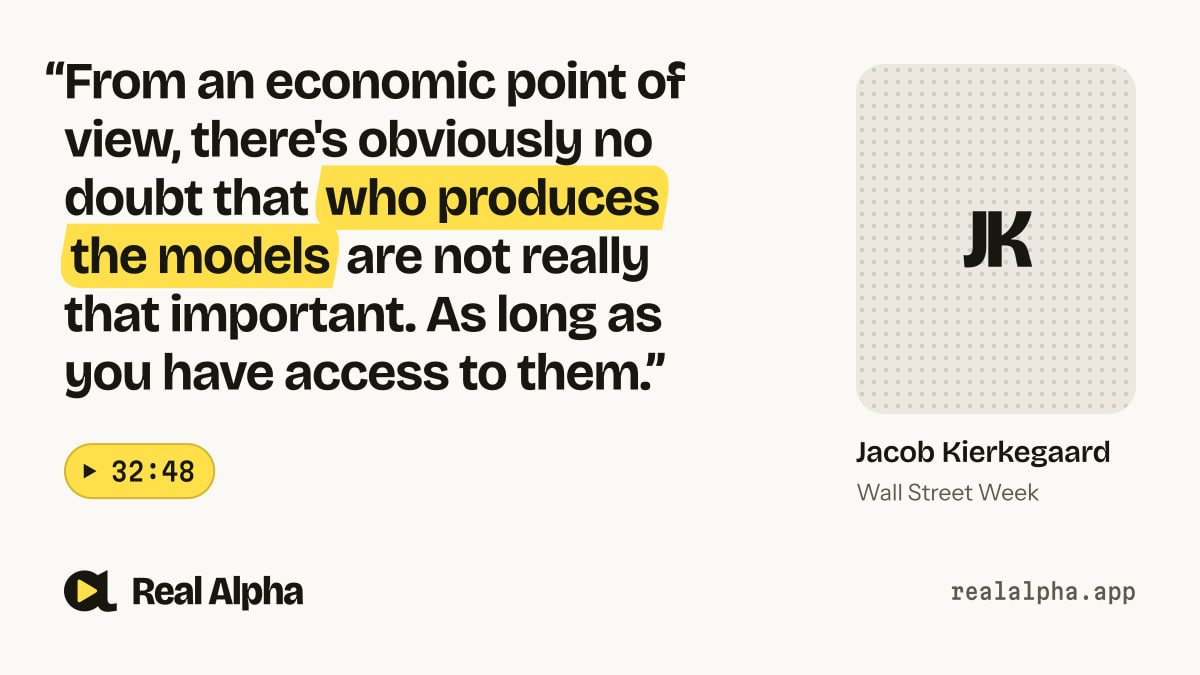
“From an economic point of view, there's obviously no doubt that who produces the models are not really that important. As long as you have access to them.”
Takeaways
- Economic gains come from access and use, not only model creation.
- Export bans could make reliance on foreign models a security risk.
- Kierkegaard says Mistral now emphasizes services and open models.
About this segment
Jacob Kierkegaard argues that productivity gains come from adopting AI, not necessarily producing frontier models, as long as access holds. He flags export bans as a security risk and says Mistral has shifted toward services and open models.
- DW
David Westin, Host
From “Money Floods Politics, Compute Meets Community, Europe’s AI Player, Argentina’s Two Economies |...”, Oct 23, 2026. Watch the full episode
Answers “Will AI boost economic growth?” See all 34 answers
Thanks. We'll look at and fix what's off.
Transcript
From the transcript Wall Street Week publishes with the episode.
- 32:18
When you're talking about AI and broad productivity benefits or productivity growth boosts, it's very important in my opinion to make the clear distinction between AI producers or model generators, creators, the sort of anthropic and open AIs of the world, And then the AI users or AI adopters. And this is really the key to understanding AI as a technology. It's a general purpose technology. From an economic point of view, there's obviously no doubt that who produces the models are not really that important. As long as you have access to them. But the problem with that argument, some would obviously immediately say, is national security. Because you could very well in Europe, if you sort of hypothesize a world in which Europe also relied on almost exclusively US and or Chinese open source models, that one day Washington and
- 33:23
Beijing would say, all right, we ban the exports or the supply of these models to foreign customers. I think in.
- 33:30
Many ways Mistral is certainly an outlier in the sense that it is arguably the most advanced, largest sort of pure AI company in Europe. It was, I would say, until recently close to, if not at, the frontier of model development. They have now, as I interpret their recent strategic shift, decided not to compete or try to, or invest to develop closed frontier models anymore. So, they are a company that really is more in the provision of AI-related services and open source models rather than a frontier lab, so to speak. They are no longer, I would say, they don't want to be viewed in the same category as, you know, anthropic or OpenAI.