The alpha, twice a week
That was 3 min.
Get the best new moments in your inbox every Wednesday and Saturday. It's free.
Check your inbox
We sent a link to your address. Click it to finish signing up. Not there in a minute? Look in spam.
or
Newcomer Pod · 3 min · Nov 13, 2026
AI agents earn revenue by automating repeat business workflows
 Aravind Srinivas
 explains how usage-based pricing and recurring automations drive Perplexity’s revenue.
The episode’s best minutes
Full analysis- 7:37AI agents earn revenue by automating repeat business workflowsPro pick 3 min
- 15:55AI value comes from high-ROI work, not mass adoption3 min
- 18:25High AI retention matters only if it can be monetized3 min
- 3 more moments in the full episode
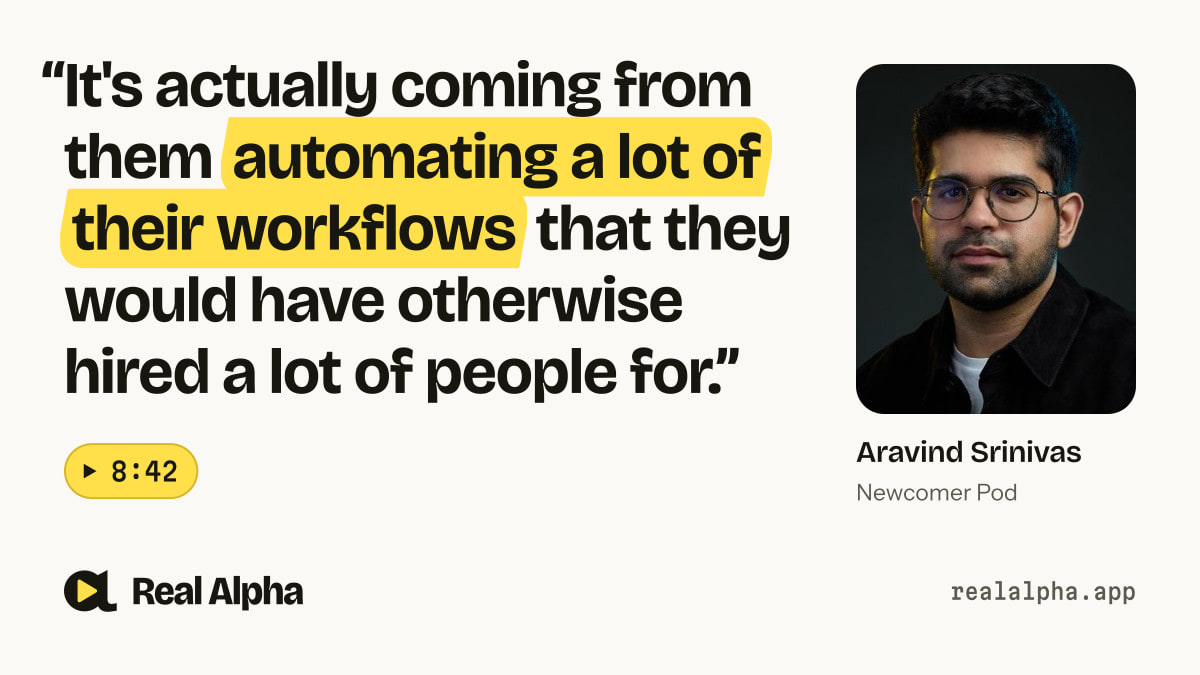
“It's actually coming from them automating a lot of their workflows that they would have otherwise hired a lot of people for.”
 Aravind Srinivasat 8:42 · Newcomer Pod
Takeaways Pro pick
- Agent usage can exceed subscription credits, creating paid usage.
- Repeat automations make revenue sticky.
- Perplexity routes work to models that can lower costs over time.
One of Pro's picks, open to you here. Try Pro free for 7 days
One of Pro's picks. The rest of the summary and the 3 takeaways are in Real Alpha Pro; the video, the quote and the transcript stay free.
Read it with Pro, 7 days freeAbout this segment
Aravind Srinivas explains how usage-based pricing and recurring automations drive Perplexity’s revenue. Businesses pay when agents take on work that might otherwise require staff.

Aravind Srinivas is CEO of Perplexity.
Held research roles at OpenAI and Google DeepMind before co-founding the AI search engine Perplexity in 2022.
From “Perplexity CEO on NVIDIA and Who Wins the AI Race”, Nov 13, 2026. Watch the full episode
Answers “Which jobs will AI replace, and which are safe?” See all 241 answers
Answers “Are AI agents ready for real work?” See all 210 answers
Answers “Is AI paying off for companies?” See all 116 answers
Answers “How do AI companies make money?” See all 122 answers
Thanks. We'll look at and fix what's off.
Transcript
Transcribed by machine (Whisper) from the episode’s audio, so a word may be off here and there.
- 7:41
you guys sort of began with subscription-based, right? People were paying for like the pro version of Perplexity, which uses multiple models. And then you guys, I think, do some sort of token usage-based products now. And I imagine that's kind of part of your shift more towards enterprise customers, is that you kind of are more token-based. Yes. A big part of our revenue growth this year has been coming from consumption-based or token-based, and we charge for usage basis on our computer agent, and every subscription plan gets a certain amount of bootstrap credits. On the $200-a-month plan, everybody gets a certain number of credits every month, and we have a quota system for the $20-a-month plan as well.
- 8:22
But the demand for actually automating a lot of your workflows in an enterprise or a business context is very high. The people run out of those credits pretty quickly and are happy to pay for credit-based usage. A lot of usage comes from repeat automations. It's not coming from the same user going again and again and chatting one more time and adding to their credit consumption. It's actually coming from them automating a lot of their workflows that they would have otherwise hired a lot of people for.
- 8:55
Analysts, SEO, marketing, growth marketers, ad campaign management, chief of staff or admin like usage, corporate development, strategy, competitor tracking. These are all like repeat automations that you once set it up and your whole business relies on this. So the revenue is sticky. The net dollar retention is very high. and our job is to actually keep lowering the cost for doing the same task that was more expensive six months ago by continually orchestrating and routing to the best possible model for the job and lowering the price and we often see that that takes a hit on our usage based annualized revenue in the short term but the usage expands enough and then total revenue keeps going up what would you say I mean what is the the main use right now like the most amount of use of perplexities tools coming is coming from one research monitoring automations
- 9:42
almost all forms of knowledge work outside of coding mm-hmm we have pretty much a really good market fit because all of it comes down to like orchestration routing and accuracy mm-hmm and our harness is really good for that yeah and semi analysis pointed out like yesterday that increasing percentage of their AI usage is around persistent agents right that they can delegate to like a slack co-worker and perplexity has the best harness and product experience around that and because that's because we we really own the underlying infrastructure powering these agents we built our own sandboxes we built our own model routing and we host our own models when we delegate to like open-weight models that are fine-tuned and so this is the way in which like we get to be the orchestrator of all possible knowledge work yeah I saw you
- 10:31
know you had an exchange with Dylan Patel of semi analysis about this