The alpha, twice a week
That was 5 min.
Get the best new moments in your inbox every Wednesday and Saturday. It's free.
Check your inbox
We sent a link to your address. Click it to finish signing up. Not there in a minute? Look in spam.
or
The Logan Bartlett Show · 5 min · Sep 12, 2025
AI agents expand software into labor markets
 Bret Taylor
 argues that agents can perform work, not just make workers more productive, expanding software into markets like legal services.
In this episode
Full analysis- 5:59Outcome pricing captures value beyond cost savings8 min
- 18:00Incumbents struggle most with the messy middle of a shiftPro pick 8 min
- 1:07AI agents expand software into labor markets5 min
- 27:33Applied AI companies need value beyond making the tech work2 min
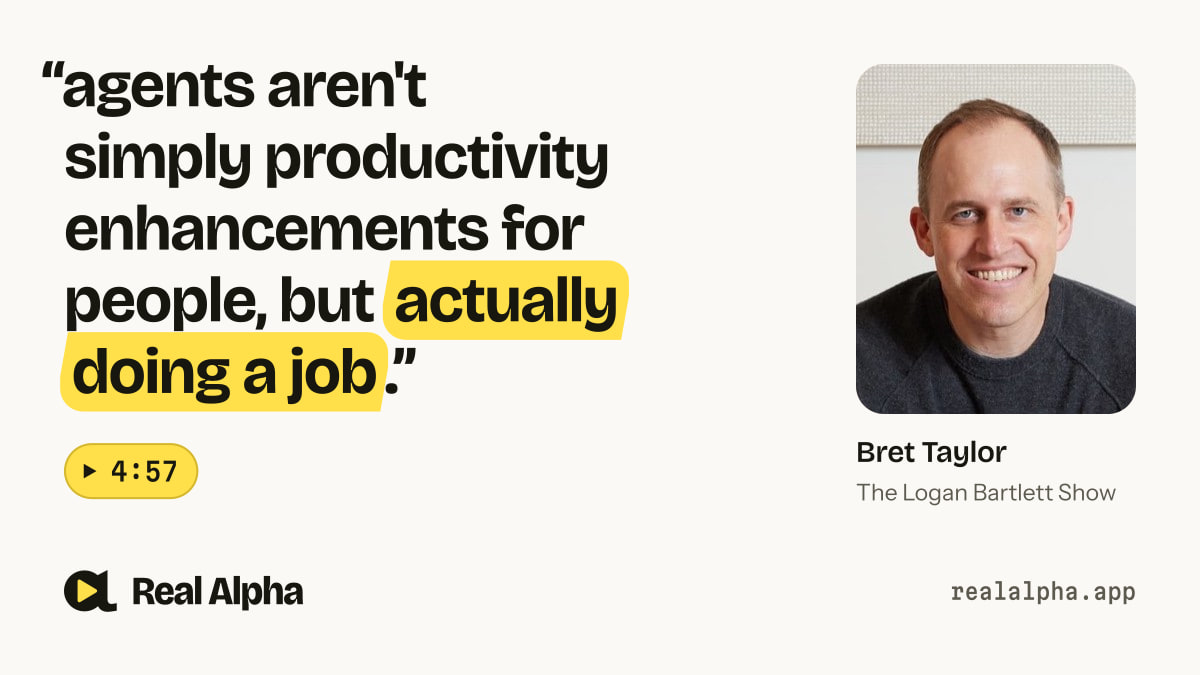
“agents aren't simply productivity enhancements for people, but actually doing a job.”
 Bret Taylorat 4:57 · The Logan Bartlett Show
Takeaways
- AI categories may be clear, but product, business model and packaging decide winners.
- Agents can sell labor, not just productivity tools, into fields like law.
- Software markets can grow to include the labor agents perform.
About this segment
Bret Taylor argues that agents can perform work, not just make workers more productive, expanding software into markets like legal services. That changes how large the opportunity can be.

Bret Taylor is CEO of Sierra and chairman of the board of OpenAI.
Co-founded and leads Sierra, an enterprise AI agent company; chairs OpenAI's board and co-created Google Maps.

Logan Bartlett, Host · Software Investor, Redpoint Ventures
Backs enterprise software companies like Ramp, Cribl, Cyera and Legora.
From “Bret Taylor: A New Class of Software Winners”, Sep 12, 2025. Watch the full episode
Thanks. We'll look at and fix what's off.
Transcript
From the transcript The Logan Bartlett Show publishes with the episode.
- 1:11
way. I guess what do you think to that? And when you're making that comparison to internet versus AI, where do you think that parallels exist? And what do you think breaks down as you kind of think about comparing the two? One thing that I think is quite similar is there were some very obvious bets on the internet like search and e-commerce being two of the most prominent impairments. You know, you didn't need to be that savvy about the internet to think, wow, it might be useful.
- 1:38
People could buy things, you know, digitally. And the question was who will own that market? Will Amazon and Buy.com had very different strategies, even different portfolios of products that they initially sold? Amazon clearly had a much better both strategy execution. There's a lot of details they got right. Look at the search market. You know, I mentioned altavisto in Google, but one of the more impressive technical companies that we competed against was ink to me.
- 2:06
They had a really good engineering team and you know, I could tell you why PageRank was better, but they had a solid team, but they had a B2B business model. They're essentially licensed. They search engine to portals. And that left out the opportunity to create outwards, which turned out to be the greatest business model of all time. So there's so many details that, you know, dictate whether you're the one you turn into Google or altavista or ink to me.
- 2:30
But going back to your question, what's interesting about the AI market is there are a few areas that are obviously going to be impacted by AI, software engineering, customer service, content marketing, visual effects industry. There's probably others, different than the legal industry. And as a consequence, you know, it's not like, I got this great idea. Hey, if I told you, oh my gosh, AI for customer service, it's not the concept is obvious. The question is, do you have the right product? Do you have the right good market model? That's what I mentioned, the ink to me, Google thing, you B2B or you B2C. What is the packaging? What is the form factor that will become dominant? And so as a consequence, it's an intensely competitive time.
- 3:14
Just like my recollection of the .com era is. And I think that's really interesting. So you have very clear markets with very intense competition. And that's different than other markets. You know, I think in the mobile phone came out, some of those categories like ride sharing wasn't like a self evident market. And then there was a couple great insights and created the ubers and the lifts of the world. I think right now, many of the biggest markets are already known. And as a consequence, one of our company values is actually competitive intensity, which is unusual. And it's the first line of that as we know we're not entitled to our success.
- 3:56
And I think it's a really important part of being successful in this era. We're a bricks down. I think it's shifted the landscape of what is a software company. I love the example of Harvey is a company I really admire. I can't think of like a great legal tech company. I'm sure there are a couple. I don't mean that in a backhanded way towards any of them. But it wasn't like as you went through the top 10 enterprise software companies in public markets. There's not one in legal tech, right? There's ERP systems and CRM systems and all these others. It's just not one of the key categories. In part, because the tam for selling productivity enhancement to lawyers is not that big. But now all of a sudden with Harvey, you're actually doing the work and doing the antitrust review. All of a sudden the total dressable market looks huge because the addressable
- 4:44
market of legal advice and legal labor is actually quite large. So that's really interesting to me because I think the traditional perception of where there are addressable markets in software I think has been upended because agents aren't simply productivity enhancements for people, but actually doing a job. As a consequence, I think how you evaluate the value of a piece of software starts to move away from traditional software productivity metrics. Think about a CIRA agent that actually makes a sale for you. The way you would value that is not really even related to AI or software. The way you'd value it is basically one of the margins on that sale.
- 5:33
What would be the commission you'd pay a person to make that sale? And so as a consequence, I think it really has dramatically shifted the traditional view of how to value software, just as either a venture capitalist or an economist, it's really changed the markets. And I think