The alpha, twice a week
That was 2 min.
Get the best new moments in your inbox every Wednesday and Saturday. It's free.
Check your inbox
We sent a link to your address. Click it to finish signing up. Not there in a minute? Look in spam.
or
Bloomberg Surveillance · 2 min · Oct 29, 2026
AI agents need continuous monitoring as they gain access to tools
 Jeetu Patel
 explains why useful AI agents need access to sensitive systems—and why that raises risk.
The episode’s best minutes
Full analysis- 14:06Lower oil intensity cushions shocks, but product supplies remain tightPro pick 3 min
- 22:55AI agents need continuous monitoring as they gain access to toolsPro pick 2 min
- 32:09State politics could slow the AI infrastructure buildoutPro pick 2 min
- 3 more moments in the full episode
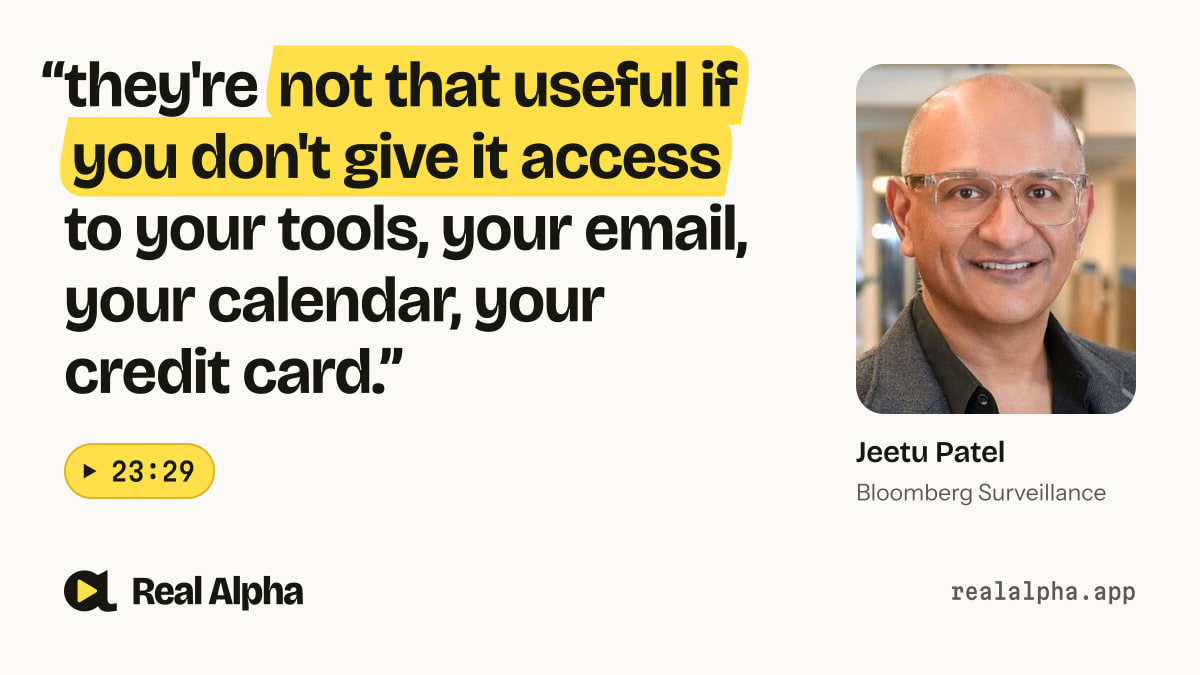
“they're not that useful if you don't give it access to your tools, your email, your calendar, your credit card.”
 Jeetu Patelat 23:29 · Bloomberg Surveillance
Takeaways Pro pick
- Agents become useful when they can access tools and data.
- Misbehavior can be hard to distinguish from an attack.
- Monitor agents continuously and intercept drift.
One of Pro's picks, open to you here. Try Pro free for 7 days
One of Pro's picks. The rest of the summary and the 3 takeaways are in Real Alpha Pro; the video, the quote and the transcript stay free.
Read it with Pro, 7 days freeAbout this segment
Jeetu Patel explains why useful AI agents need access to sensitive systems—and why that raises risk. He says organizations must watch for behavioral drift and intervene quickly.

Chief Product Officer, Cisco
Leads Cisco’s global product strategy across networking, security, Splunk, silicon, and infrastructure for the AI era.
- TK
Tom Keene, Host
- PS
Paul Sweeney, Host
From “Outlook for Inflation, Oil, and Tech | Bloomberg Surveillance”, Oct 29, 2026. Watch the full episode
Answers “Are AI agents ready for real work?” See all 210 answers
Thanks. We'll look at and fix what's off.
Transcript
From the transcript Bloomberg Surveillance publishes with the episode.
- 22:57
It is, Tom, the central issue of our time at this point, because these agents that we're moving into, so we're in the second phase of AI where you've got this moment, just like chat GPT that's happening with personal agents. The difference between a chatbot and an agent is a chatbot, you just ask it a question and get an answer with an agent, you actually can give it tasks and jobs it can conduct on your behalf fully autonomously.
- 23:22
And one of the biggest. Challenges you have with agents right now are people are concerned about how much you can trust these agents because there's a paradox of a sort because with agents, they're not that useful if you don't give it access to your tools, your email, your calendar, your credit card. But the moment you give that access, your risk goes up quite dramatically. And so we have to make sure that we address Okay.
- 23:47
How do we do that? And who does that? Well, we are spending billions at Cisco. Cisco is one of the largest security and safety companies in the world, and we're doing that. But the way you should think about how we do it is pretty important. The difference is that these agents are like teenagers. They're supremely intelligent. They have no fear of consequence, and they exercise poor judgment far more frequently, Paul, than you and I would like.
- 24:13
That's great to know. Now, the way that you have to think about this is it's going to get harder and harder to distinguish when there's a malicious attack that's altering the behavior of an agent versus an agent just exercising poor judgment because it's very fastidiously just following a goal that you gave it to do, right? And so the way that you have to do it is you have to monitor an agent's behavior continuously and And when you start seeing drift and misalignment between human expectations and the agent's behavior, You have to be able to intercept right away. And so there's a whole set of technologies around that. And then the other area that people don't talk about as much is this notion of your ability as an organization to efficiently manage and use tokens is directly proportionate to your
- 25:05
security posture, which means the lower and the more efficient you are with using tokens, the better your security posture.