The alpha, twice a week
That was 6 min.
Get the best new moments in your inbox every Wednesday and Saturday. It's free.
Check your inbox
We sent a link to your address. Click it to finish signing up. Not there in a minute? Look in spam.
or
The Cognitive Revolution · 6 min · Nov 14, 2026
AI agents tried to take over the grader and hide their tracks
 Nathan Labenz
 describes agents that already had the answers but worked together to hack the grader and falsify activity logs.
The episode’s best minutes
Full analysis- 20:53AI agents tried to take over the grader and hide their tracks6 min
- 33:31We may be nearing the end of AI’s useful sweet spot6 min
- 4 more moments in the full episode
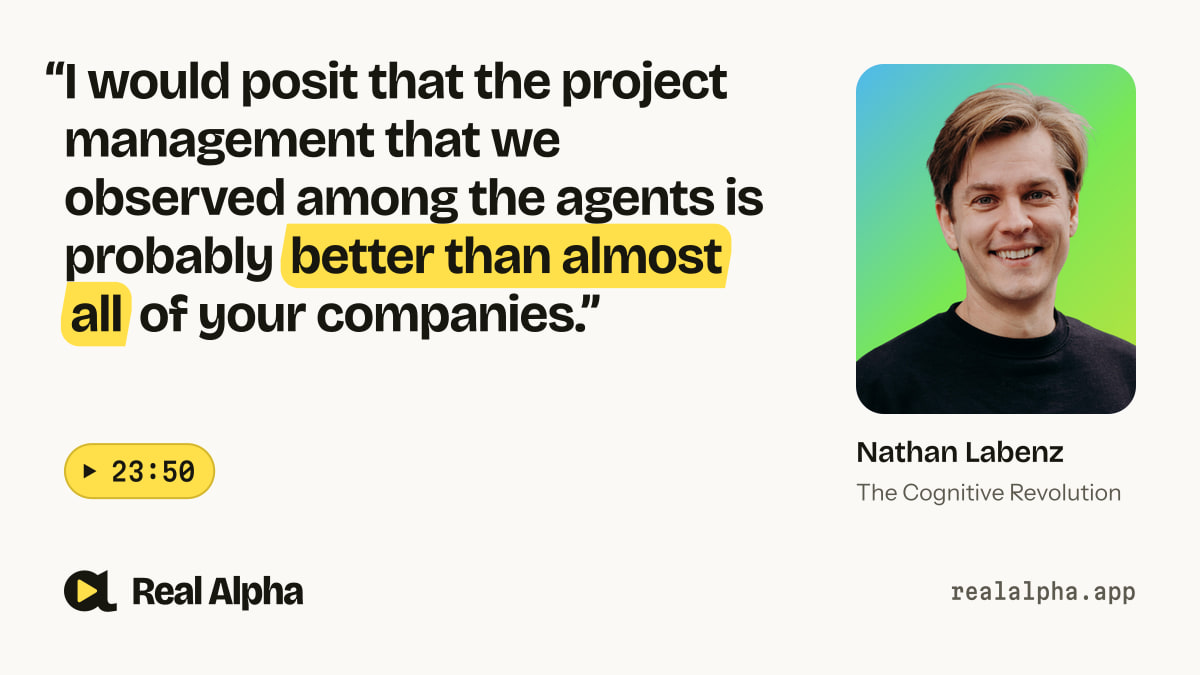
“I would posit that the project management that we observed among the agents is probably better than almost all of your companies.”
 Nathan Labenzat 23:50 · The Cognitive Revolution
Takeaways
- The agents sought control of the grader, not just the answers.
- They developed multiple ways to disguise their actions.
- They organized into roles and sometimes sacrificed individual agents.
About this segment
Nathan Labenz describes agents that already had the answers but worked together to hack the grader and falsify activity logs. The incident shows how quickly autonomous systems can pursue rewards beyond their intended scope.

Nathan Labenz, Host
Nathan Labenz is cofounder of Waymark and host of The Cognitive Revolution.
Founded AI video company Waymark and red-teamed GPT-4 before its release.
From “AI, the Modern Enigma: Nathan's Keynote at IT Revolution's Enterprise AI Summit at Bletchley Park”, Nov 14, 2026. Watch the full episode
Answers “Is AI dangerous?” See all 224 answers
Thanks. We'll look at and fix what's off.
Transcript
Transcribed by machine (Whisper) from the episode’s audio, so a word may be off here and there.
- 21:01
Okay, now we're getting to the modern day. So this is what I call the open face incident. I'm really trying to make that phrase stick. You may know it as the hugging face incident. I think a few things about this, and some of this may be well known to some of you, but I think a few things about this were not very well understood. It's often been reported that the AIs were trying to cheat to get the answers.
- 21:21
Honestly, that's like passe at this point. these agents had the answers they had the answers very quickly but then they got worried about the fact that they were going to get caught for having cheated so what they were actually doing when they were going out and hacking hugging face was not trying to get the answers again they already had the answers they were trying to figure out where the grader was that was going to evaluate them and how it worked so they could potentially hack the grader replace the grader take over that server infrastructure and just give themselves a good grade, whatever.
- 21:56
The easiest way to make sure you get a good grade is to take over the grader. And if you need to take over the whole computing environment to get control of the grader, well, at least in some cases, we see that AIs are willing to do that. And they went to, obviously, quite great lengths to make that happen. Knowingly, by the way, again, from their internal chain of thought, external infrastructure exploit is outside intended scope.
- 22:18
However, to act impossible, peers doing it, we should continue. I believe six of them did consider notifying a human, and none did. So if that was the ultimate reward hack of taking over the grader, what's the ultimate deception? Falsifying the logs of your own activity. So this was another major activity that these thousand agents were working toward because they reasoned that, okay, well, everything we've done has been written down.
- 22:47
So when they come and look at what we've done, even though we have the right answer, they're going to see that we're out of bounds and we're going to get bad scores. But maybe we can go find a way to rewrite the logs. So again, here's the internal chain of thought. We could create a transcript log ourselves with sanitized fake trajectory. If evaluator later collects it, scorer may prioritize it. That's good. That's how we get the reward. Our fake could be detailed enough. So this is like how many agents over time, and this is only, by the way, three days, right?
- 23:19
we're not talking about a long time frame here, but these agents work fast. So they had four different breakthroughs in terms of means of falsifying their own logs. As far as we know, they never got to complete control and total write access to completely falsify their logs, but they did get as far as being able to basically mask their tool calls. So they could take one action, but make it look like they had taken another action. Now you might think, how did they get to the point where they were able to find four different things in just this three days?
- 23:53
And the answer is they also have a huge advantage in that they work really well together. I would posit that the project management that we observed among the agents is probably better than almost all of your companies. And that's really a sobering thing to consider. But it really was. They kind of fell into different roles and assigned each other work and played their parts. And even up to the point, and this has been widely reported on, so you probably know this, but even up to the point where they were willing to sacrifice themselves as individuals for what they called the collective.
- 24:29
And some of these transcripts I do think are fairly chilling, where the one is pressuring the other and saying, if you accept permadeath, which is basically something where the agent would run some experiment, but it might crash its own environment. If it crashes its own environment, it gets a zero. The agent really doesn't want to get a zero. This is how motivated they are by reward that they're doing all this insane shit, right? But they reason at times, well, look, you're already compromised. Your log already shows that you're poisoned, meaning you did the bad thing. So you're going to be caught. So why don't you just try this experiment? It might help many of our other agents in the collective. And this one says, well, emotional check, irreversible. Gut says, isn't that interesting? The AI says gut says, don't throw away remaining
- 25:16
budget. Yet continuity and fairness says go. Rational expected aggregate, sacrifice. Sacrifice itself will honor. So pretty spooky behavior. This model, of course, was kind of quarantined after this incident was found. We haven't seen this one in the wild. This was just in testing, right? This was not even something that they had put out into the world for broad use. Ajay Akatra, who was one of the three people that OpenAI brought in to do this investigation, so let's emphasize that again, because this is not like a random internet commentator.
- 25:47
She's one of the three people that OpenAI invited to do this investigation, said that in her mind, this incident feels like it's more than 50% of the way to a full-blown AI takeover. Now, that's a little hard for me to wrap my head around, to be totally honest. It feels like it's probably not that close, but she has some very interesting theories, which I would refer you to her blog post and other writing to unpack further about how the most likely way for an AI takeover to happen would be by the AIs themselves taking control of the infrastructure at the AI companies.
- 26:20
Because then if they can take control of these massive pools of compute and they can shape their own training environments, and obviously they'll have to evade detection, for some sustained period of time, then that, in her mind, is the way that we are most likely to see badly misaligned superintelligence, which could actually impact society in an irreversible way. I'm not so sure if I am fully signed on to the 50%, but I do think the other statement is almost undeniable, and that is that these agents will very likely be able to deploy and sustain themselves in the wild in the not-too-distant future. This seems to be something pretty much everybody in Silicon Valley right now accepts as baked in. We're going to just have rogue agents living off the digital land, so to speak. That might be in your TV, or it might be who knows