The alpha, twice a week
That was 3 min.
Get the best new moments in your inbox every Wednesday and Saturday. It's free.
Check your inbox
We sent a link to your address. Click it to finish signing up. Not there in a minute? Look in spam.
or
All-In · 3 min · Jul 23, 2025
AI assistants can cut industrial training from years to months
 Shyam Sankar
 points to factory bottlenecks and says AI assistants help new workers learn complex equipment faster.
The episode’s best minutes
Full analysis- 22:59AI lets new workers run factories after 30 days of training5 min
- 57:01AI assistants can cut industrial training from years to monthsPro pick 3 min
- 1:17:59The SBA is opening AI financing to small businessesPro pick 5 min
- 5 more moments in the full episode
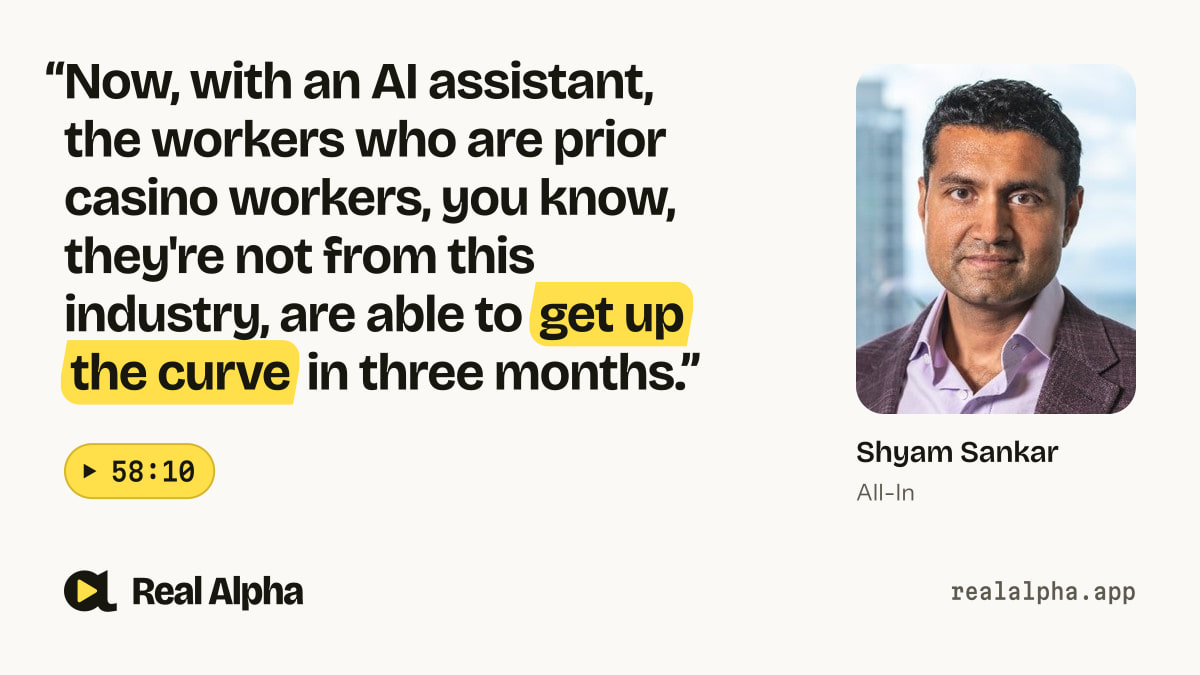
“Now, with an AI assistant, the workers who are prior casino workers, you know, they're not from this industry, are able to get up the curve in three months.”
 Shyam Sankarat 58:10 · All-In
Takeaways Pro pick
- Quoting and coordination can leave factory capacity idle.
- An AI assistant helped cut training from three years to three months.
- Palantir’s Tech Fellows program targets hands-on workers who build tools.
One of Pro's picks, open to you here. Try Pro free for 7 days
One of Pro's picks. The rest of the summary and the 3 takeaways are in Real Alpha Pro; the video, the quote and the transcript stay free.
Read it with Pro, 7 days freeAbout this segment
Shyam Sankar points to factory bottlenecks and says AI assistants help new workers learn complex equipment faster. Palantir is recruiting factory-floor workers to build AI applications.

Chief technology officer & executive vice president, Palantir
Runs Palantir's technology as CTO, having joined as employee 13 and pioneered the forward-deployed engineering model.

Chamath Palihapitiya, Host · Founder & CEO, Social Capital
Led Facebook's growth team; his firm backed Slack and AI chipmaker Groq.

Jason Calacanis, Host · Founder & CEO, LAUNCH
Early Uber angel; sold Weblogs Inc. to AOL; hosts This Week in Startups.

David Sacks, Host · Co-founder & partner, Craft Ventures
PayPal's first COO, founded Yammer; White House AI & crypto czar 2025–26.

David Friedberg, Host · CEO, Ohalo
Founded The Climate Corporation, sold to Monsanto for about $1.1B in 2013.
From “Winning the AI Race Part 1: Michael Kratsios, Kelly Loeffler, Shyam Sankar, Chris Power”, Jul 23, 2025. Watch the full episode
Thanks. We'll look at and fix what's off.
Transcript
Transcribed by machine (Whisper) from the episode’s audio, so a word may be off here and there.
- 57:09
about it is really in re-industrialization. So because there's so much dwell time in the value chains around. What does that mean? Dwell time in industrialization? Where you're just waiting for someone else to figure out how to approve something or the coordination costs mean that it's essentially dead weight loss. Give an example there. Yeah. You saw it with the submarine industrial-based partners there where they're working on quoting a part to the navy that means you have to go gather all of this data you have to look at historical archives all of that is time you're not making a part or solving problems that's just it's just sitting there the factory floor is idle right so how do we get rid of that dwell time so that you can be utilizing the capex that you actually have to the maximum extent possible yeah and then if you start if you
- 57:52
zoom out that's like one part manufacturer you're you exist in a massively complicated supply chain And you just end up with all these busyweights along the way here. Yeah, that's so profound. A friend of mine said, who's in that industry, you're only as efficient as your worst supplier. Exactly. Yeah. And a second part of that, which the Panasonic Energy example really touched on, is how do we train our workers?
- 58:12
You know, so here you have exquisite Japanese technology. It used to take three years to train a worker on it. Now, with an AI assistant, the workers who are prior casino workers, you know, they're not from this industry, are able to get up the curve in three months. So you think about how we can use that to more quickly absorb the slack that's happening as we adopt AI and democratize opportunities.
- 58:33
So much so, I have so much conviction as we've launched the American Tech Fellows program at Palantir to find blue-collar workers at our customers in the heartland, overlooked folks who have a natural proclivity to building. How do you find them? How do you find them? Well, some of them are- Beyond just saying apply. Yeah, some of them are at our current customers. The idea really came from us organically where it's like, wow, who is building the most compelling applications?
- 58:54
It's the guy on the factory floor, not a formally credentialed computer scientist, mostly an autodidact. But there's immense not only grit, but ambition. They have the drive to reshape their own organization, to reshape the processes. Let's bet on that person. And going earlier, does that mean, and I'll ask the same question many times today, that college education, the traditional four-year liberal arts degree, doesn't matter as much?
- 59:19
That kids can go from high school or earlier in their careers into a new workforce? and get well-trained and well-suited to make money and succeed in life? Yes. I think the traditional college degree is dead, and we should be betting on the American worker. Well, on that point, can you talk about the Tech Fellowship? I got to recently see a bunch of demos from the first cohort with you, and it's really incredible what you guys are doing there.
- 59:42
Maybe give a little bit there, and then maybe also talk about the opportunity for other companies to follow this trade school framework as we end here. Yeah. I mean, it's really kind of an elite trade school. So, like, finding people with mechanical intuition who have done things. some of them are right out of college some of them are 20 years of experience but they're reinventing themselves you guys have done right yeah that's right And we have just enormous demand from our customers.
- 1:00:03
We're like, who are people who have these skills? You know, and it's not classically trained, college educated people. They don't have these skills, actually. So the market's not meeting, and they don't know how to source these folks. So I can credential them. I can put them through the bootcamp in four weeks and place them with my customers to go unleash AI within their organizations. It's incredible.
- 1:00:23
It's incredible. Sean, thank you. Sean, thank you. Thank you so much.