The alpha, twice a week
That was 3 min.
Get the best new moments in your inbox every Wednesday and Saturday. It's free.
Check your inbox
We sent a link to your address. Click it to finish signing up. Not there in a minute? Look in spam.
or
Bloomberg Surveillance · 3 min · Oct 28, 2026
AI buildout leaves the Fed weighing inflation and crash risks
 Gita Gopinath
 says an AI-market correction could wipe out $41 trillion in global wealth, while the buildout adds major demand.
The episode’s best minutes
Full analysis- 3:07AI buildout leaves the Fed weighing inflation and crash risksPro pick 3 min
- 17:05AI spending is shifting its bottleneck from chips to power4 min
- 3 more moments in the full episode
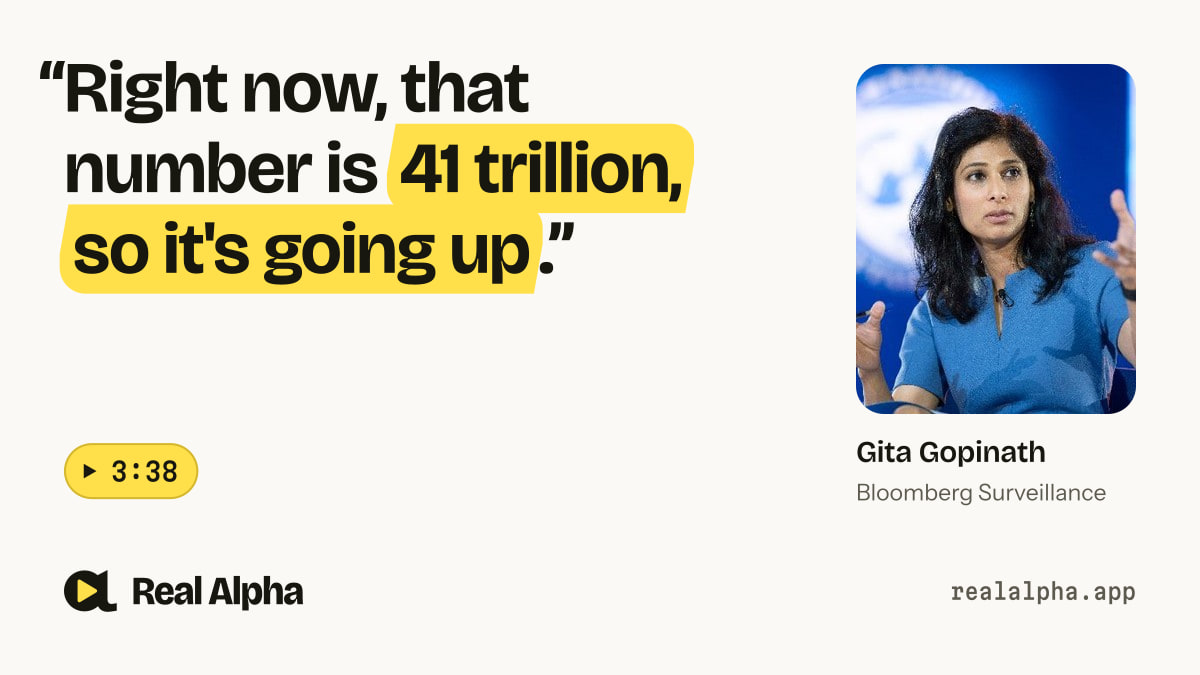
“Right now, that number is 41 trillion, so it's going up.”
 Gita Gopinathat 3:38 · Bloomberg Surveillance
Takeaways Pro pick
- Her estimate of wealth at risk rose from $35 trillion to $41 trillion.
- AI infrastructure spending is a large source of demand pressure.
- A serious market correction could call for rapid rate cuts.
One of Pro's picks, open to you here. Try Pro free for 7 days
One of Pro's picks. The rest of the summary and the 3 takeaways are in Real Alpha Pro; the video, the quote and the transcript stay free.
Read it with Pro, 7 days freeAbout this segment
Gita Gopinath says an AI-market correction could wipe out $41 trillion in global wealth, while the buildout adds major demand. She says the Fed should keep both inflation and a sharp correction in view.

Former Deputy Managing Director, IMF
Led IMF surveillance and programs as deputy managing director, and steered the World Economic Outlook as chief economist.
- TK
Tom Keene, Host
- PS
Paul Sweeney, Host
- LM
Lisa Mateo, Host
- MB
Michael Barr, Host
From “Bloomberg Surveillance TV: October 28th, 2026 | Bloomberg Surveillance”, Oct 28, 2026. Watch the full episode
Thanks. We'll look at and fix what's off.
Transcript
From the transcript Bloomberg Surveillance publishes with the episode.
- 3:09
You've talked about this bubble in financing for AI, and you did worry that it was a bubble, and if it did blow up, that it would end up creating a real financial crisis of sorts. What do you think the Fed's role in this should be? Should they be tightening financial conditions to restrict some of the financing that's being done right now?
- 3:29
Yeah, when I wrote that piece, I guess it was a year ago, my estimate was that the hit would be about 35 trillion to global wealth if there was a dot-com site correction. Right now, that number is 41 trillion, so it's going up. There continues to be a lot of enthusiasm in putting money in U.S. equity markets, even though there's some caution building up around that. In terms of what the Fed should do, the Fed should certainly not go out there specifically to burst a bubble. I mean, that would be a terrible idea. They're going to have to look at the conditions that matter for inflation, whether they're actually seeing that their inflation target is moving forward, you know, that the actual inflation is staying well above their inflation target for too long. That would be their bigger concern. You don't want to go out there certainly
- 4:18
and try and spook markets and burst the bubble. That's certainly not something you want to do.
- 4:22
Agitha, what's your reaction to the sequencing of things that the Fed chair has articulated? That the first move is a demand shock and the second move might be some supply relief. How are you thinking about that?
- 4:35
It certainly is the case that what we're seeing right now is a demand shock from AI. The supply relief, I mean, we're not seeing anything right now. I think the expectation is that it'll show up over time. But if you just look between now and the next two, three years, the amount of build-out in AI infrastructure is just huge. I mean, so just compared to, for example, what the U.S. government is putting out in terms of its borrowing needs, that's about $ 2 trillion a year. the amount of build out that we're expecting over the next year is over a trillion and a half. So these two are really very, very large numbers, which is why more generally interest rates are moving up. So this is very big, I would say, demand effect that's coming if this continues. the way it does. And I don't, you know,
- 5:20
there's a fair bit of uncertainty. I think there are two scenarios to prepare for if you're Fed chair at this time. There's one scenario, which is the baseline, which is we continue this way. We have the pressure that's coming from demand. We have the inflationary effects of the AI build out energy and so on. And, you know, you follow the policy that you follow now. But there's also a possibility that you could have a serious market correction, in which case you would be in the mold of cutting interest rates very rapidly. So there is That's a lesser likely scenario, but that's absolutely not trivial at this point, I think, to keep on the table.