The alpha, twice a week
That was 5 min.
Get the best new moments in your inbox every Wednesday and Saturday. It's free.
Check your inbox
We sent a link to your address. Click it to finish signing up. Not there in a minute? Look in spam.
or
a16z Podcast · 5 min · Oct 19, 2026
AI can make custom software scale better than FDEs
 Jean-Denis Greze
 explains how Town uses customer interviews and reusable routines to tailor workflows by role.
The episode’s best minutes
Full episode- 3:04A nearly $1M tax business still wasn’t venture scale7 min
- 24:35A $1 monthly routine can save a restaurant thousands3 min
- 29:00AI can make custom software scale better than FDEsPro pick 5 min
- 5 more moments in the full episode
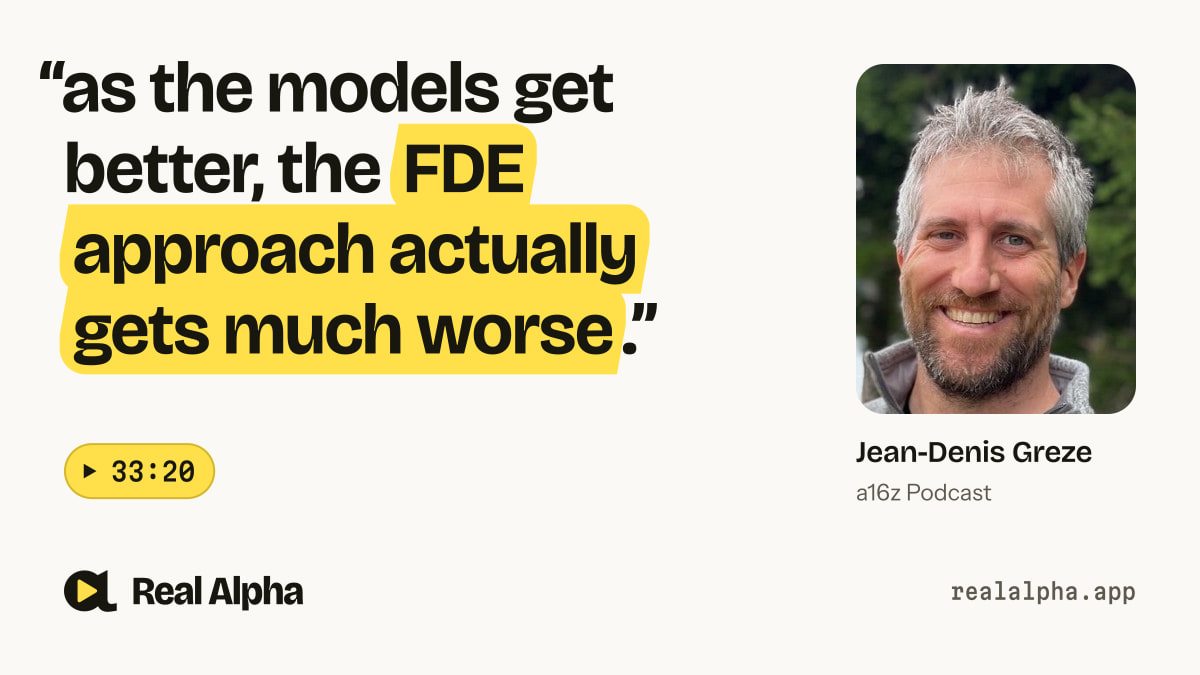
“as the models get better, the FDE approach actually gets much worse.”
 Jean-Denis Grezeat 33:20 · a16z Podcast
Takeaways Pro pick
- Shared workflows can seed useful routines for specific roles.
- Customer interviews help refine recommendations as the library grows.
- Greze expects better models to weaken the FDE approach.
One of Pro's picks, open to you here. Try Pro free for 7 days
One of Pro's picks. The rest of the summary and the 3 takeaways are in Real Alpha Pro; the video, the quote and the transcript stay free.
Read it with Pro, 7 days freeAbout this segment
Jean-Denis Greze explains how Town uses customer interviews and reusable routines to tailor workflows by role. He argues that improving models will make this approach scale better than human-led custom deployments.

Jean-Denis Greze is founder and CEO of Town.
Led Plaid’s EPD from $10M to $300M+ in ARR, then co-founded Town, an AI assistant for everyday work.

Erik Torenberg, Host · General partner, Andreessen Horowitz
Helped build Product Hunt; founded On Deck, Village Global and Turpentine.
From “Why a $1M Startup Wasn’t Worth Building in the Age of AI”, Oct 19, 2026. Watch the full episode
Thanks. We'll look at and fix what's off.
Transcript
Transcribed by machine (Whisper) from the episode’s audio, so a word may be off here and there.
- 29:07
So the way I think about most AI products today is that the capabilities will be very similar. Meaning most harnesses in the work context will be able to do the same things. And so the differentiator, I think what has been the main differentiator in Silicon Valley for a long time, which is you have different product features that are ahead of market. it's going to be more and more difficult to sustain that kind of an advantage.
- 29:35
And we'll put a pin in this one, but we can have an interesting conversation about, I think the unit of value in software has changed from the app to the computer, but what that really means, it's gone from an app to anything that a human can do, and a human can do almost anything with a computer. So we're abstracting away the app layer totally, and I think the value will drop in the app layer. so if the capabilities aren't different then how do you build a successful company and I think our take on that is we're betting that as AI gets better it can better customize the product for each user like very specifically to their need meaning if you're an electrician that signs up for town and you're onboarding the things we recommend to you that we can automate are very specific to electricians.
- 30:28
And if you're a venture capitalist, they're very specific to a venture capitalist. And if you're an EA, it's specific to an EA in that industry and so on and so forth. And so how do you do that? Well, the models aren't yet good enough where when you just ask the model, hey, recommend for Alex, who's a VC, things that he could automate with town. I think you get pretty good surface level suggestions, but not really deep ones.
- 30:52
So what we do, because we don't look at user data. Part of being enterprise ready is you can't look at user data. So what we do is we look at aggregate metrics of who are our power users on the platform today. And then we go talk to them. And when we talk to them, they tell us the kinds of things they've automated. And so we might talk to 10 power users that run restaurants. And what we'll see when we talk to that, there's five things in common that they all do.
- 31:19
And then we'll sit internally and we'll build prototype automations we call routines for restaurant owners that we think are really good, like the one about wholesalers. And we'll use that as the seed, right? And so when someone joins, we look at your email and inbox and we're like, you seem to be a restaurant owner. And then we have templates of what we think really good problems and potential solutions are for restaurant owners that we've kind of hand carved from those interviews.
- 31:46
And we put those in front of you and you sign up and you start using the product. And then AI is getting better and we're talking to more restaurant owners and now we don't have just five. We have like 15 things that we can do for restaurant owners. Still a little bit manual, but you can speed it up. You can schedule interviews automatically. You can ask the restaurant owners, you give them a free Amazon card and you're doing an AI recorded interview of them and what they do with your piece of software.
- 32:11
So you're no longer operating at the speed of humans, you're operating at the speed of AI. And this library is getting better. and then the models get better. And so now the recommendations use the library less because, and what we think is over time through this approach, we'll be able to offer 80-20 very customized software for people. And people aren't just one role in the future, right? Like, yes, you're a restaurant owner, but also you run finance for your restaurant too because you don't have a separate person doing that.
- 32:42
And also you have a vacation rental that you rent. And so really, you want your townie to be good at those three things. And also you have two kids at school, and it can help you schedule their activities for the summer. So it's custom software all the way through. And our belief is that you can use AI to build that. I think the other strategy that you see in the market, which is I think what the labs do, is an FDE approach.
- 33:06
And this is very different. FDE is like, I'll have a human go into your business, understand how your business runs, then they'll build custom software with AI that uses my lab's AI in order to sort of view better. I think the FDE approach, if you're an enterprise that's willing to spend like $5 million a year paying OpenAI for FDs, it looks really good right now. But I think over time, as the models get better, the FDE approach actually gets much worse.
- 33:30
And our approach, which is much more around automation and using AI to build the custom software, will scale much better. And so the bet we're making is we start with PLG, SMB, mid-market enterprises that are very tech forward because their approach scales really, really well. We'll let other people fight in the enterprise for this much more handcrafted software. And the bed that we're making is the things that we learn in the flywheel that we can get will make us more successful in the long term than these more custom approaches.
- 34:00
But maybe also define why is town better