The alpha, twice a week
That was 5 min.
Get the best new moments in your inbox every Wednesday and Saturday. It's free.
Check your inbox
We sent a link to your address. Click it to finish signing up. Not there in a minute? Look in spam.
or
Sources · 5 min · Nov 17, 2026
AI changes the economics behind Airtable’s SaaS model
 Howie Liu
 says Airtable had reached nearly $500 million in revenue but faced a choice between optimizing a mature SaaS business and selling.
The episode’s best minutes
Full analysis- 0:29AI changes the economics behind Airtable’s SaaS model5 min
- 31:49Multiplayer agents offer a less crowded opportunity4 min
- 36:07AI agents can help small businesses do work they cannot staff6 min
- 5 more moments in the full episode
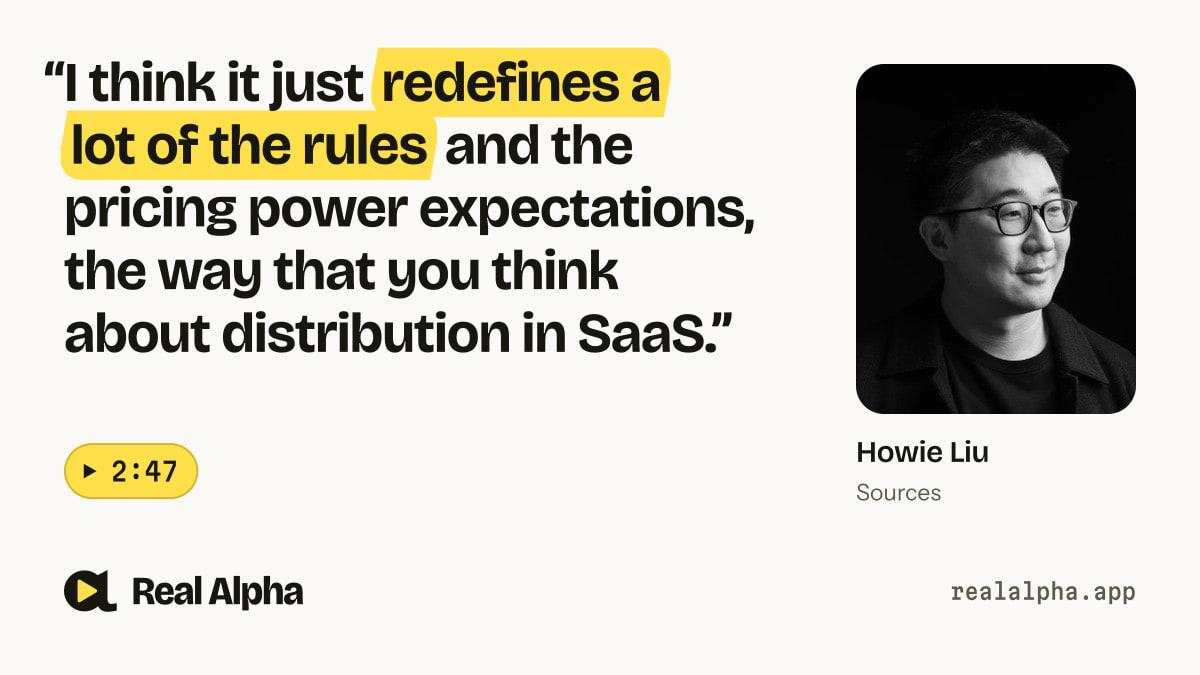
“I think it just redefines a lot of the rules and the pricing power expectations, the way that you think about distribution in SaaS.”
 Howie Liuat 2:47 · Sources
Takeaways
- Airtable was still growing and generating cash flow when it sold.
- AI shifts businesses beyond seat-based pricing and employee productivity.
- Bending Spoons could run Airtable as a mature SaaS business.
About this segment
Howie Liu says Airtable had reached nearly $500 million in revenue but faced a choice between optimizing a mature SaaS business and selling. He saw AI changing pricing, distribution and business economics.

Howie Liu is founder of Airtable and founder of Hyperagent.
Co-founded Airtable and now leads Hyperagent, building AI agents that learn and take on business workflows.

Alex Heath, Host · Founder & host, Sources
Left The Verge to start Sources in 2025; it has made over $1M since, mostly from sponsors.
From “Airtable’s founder on why AI breaks the SaaS playbook”, Nov 17, 2026. Watch the full episode
Answers “Is SaaS dead?” See all 61 answers
Answers “How do AI companies make money?” See all 122 answers
Thanks. We'll look at and fix what's off.
Transcript
From the transcript Sources publishes with the episode.
- 0:31
with HyperAgent. Walk me through that decision process. You know, I ultimately think that companies are built, you know, at either the beginning, middle or end of a certain technological era, software companies at least. And, you know, when Airtable was being founded, when we started this company back in 2012, it was really kind of at the beginning of a lot of trends. Beginning of PLG, like up to that point, Dropbox and Evernote were probably the only known products that were pure PLG.
- 0:58
Slack had not yet launched. The whole B2B SaaS -PLG movement had not happened yet. And really the advent of like the browser becoming this really powerful platform for rich desktop-grade applications. Right. So, you know, back in 2012 2015 the first time you really started seeing robust single-page app experiences So, you know, Figma, Airtable, Miro, et cetera, a lot of these companies kind of were formed of that era because of this new technological capability, right?
- 1:31
And, you know, obviously there was a lot of like business thinking that went into the original Airtable idea, but I think it was the right place, right time. And if you kind of fast forward a decade plus to today, this was back in 2012, maybe through 15 to now, a lot has changed, right? I mean, not just AI, but like The whole SaaS revolution happened, that ushered in economics and a way of thinking about that type of business.
- 1:58
And yet, I think we've obviously entered into this new era where AI is clearly the most potent technological component. You know, foundation to any new business. And it's really kind of rewritten as with every era, the rules and kind of the structurally, you know, kind of good or bad properties of a business. And so all that is to say. You know, when I look back and see Airtable today as a, you know, kind of a great business, we got to nearly half a billion in revenue scale, we were generating a lot of cash flow, we were still growing and had a really high quality product and, you know, customer base, etc.
- 2:35
And even though it's got really good bones, I saw it as being in a very different moment from at the beginning or even the middle of the kind of like SaaS golden era. And so when I see the opportunity ahead in AI, I think it just redefines a lot of the rules and the pricing power expectations, the way that you think about distribution in SaaS. And ultimately, we had a choice in running Airtable. You should try to execute optimally on this, you know, fundamentally SaaS business, right?
- 3:09
You can obviously add AI on top of SaaS, but ultimately, you know, a lot of the underpinnings of a SaaS business are rooted in the SaaS era, right? Seat-based pricing for one, right? And a seat-based product, it's kind of It's all about employee productivity enhancement versus potentially highly variable token spend or complete autonomy, completely automating certain processes with AI. And secondarily, there's just a different stage to Airtable In particular, as a business, because we had reached this kind of more mature point than obviously when we were starting out and just building initially a great product that could get some traction.
- 3:44
And so in retrospect, I think there was a fork in the road. We could have continued running Airtable. And building it into the best possible SaaS business we could have in the AI era, or we could find a buyer for it. And in this case, Spending Spoons is a great high quality buyer. I had a huge amount of respect for them and their team They're extremely high integrity. I think they really care about buying quality businesses and holding on to them forever.
- 4:13
That's their model. They're not just here to flip it and make a quick buck. We could let them run the business, pay out investors and pay out shareholders. Everybody makes something from the exit, but ultimately allow them to run the business as ultimately it could be optimally run. As a, again, like kind of SaaS business now in the AI era. And meanwhile, you know, what we decided to do with Hyperagent, which I had actually incubated within Airtable, is to, you know, spin it out and effectively give a lot or all of our Airtable shareholders a piece of upside And also Hyperagent as kind of a bet on the purely AI native, you know, kind of future opportunity that we had conceived with the product.
- 5:00
So long-winded way of saying, you know, I think there was a big, you know, kind of fork in the road to decide what do we want to do with a business that we had created of a different era? And now, you know, still a high quality business, but... A lot of the assumptions and kind of tailwinds that we had built the product and business originally on were no longer there or things have changed.