The alpha, twice a week
That was 4 min.
Get the best new moments in your inbox every Wednesday and Saturday. It's free.
Check your inbox
We sent a link to your address. Click it to finish signing up. Not there in a minute? Look in spam.
or
The Pragmatic Engineer · 4 min · Nov 16, 2026
AI coding shifts engineering toward intent and verification
 Satya Nadella
 sees decision engines as reusable, token-efficient logic and says AI-written code makes verification harder.
The episode’s best minutes
Full analysis- 9:55AI coding shifts engineering toward intent and verification4 min
- 15:32Software factories make codebases easier to learn and operatePro pick 5 min
- 46:03Companies need control of their own AI learning loop7 min
- 5 more moments in the full episode
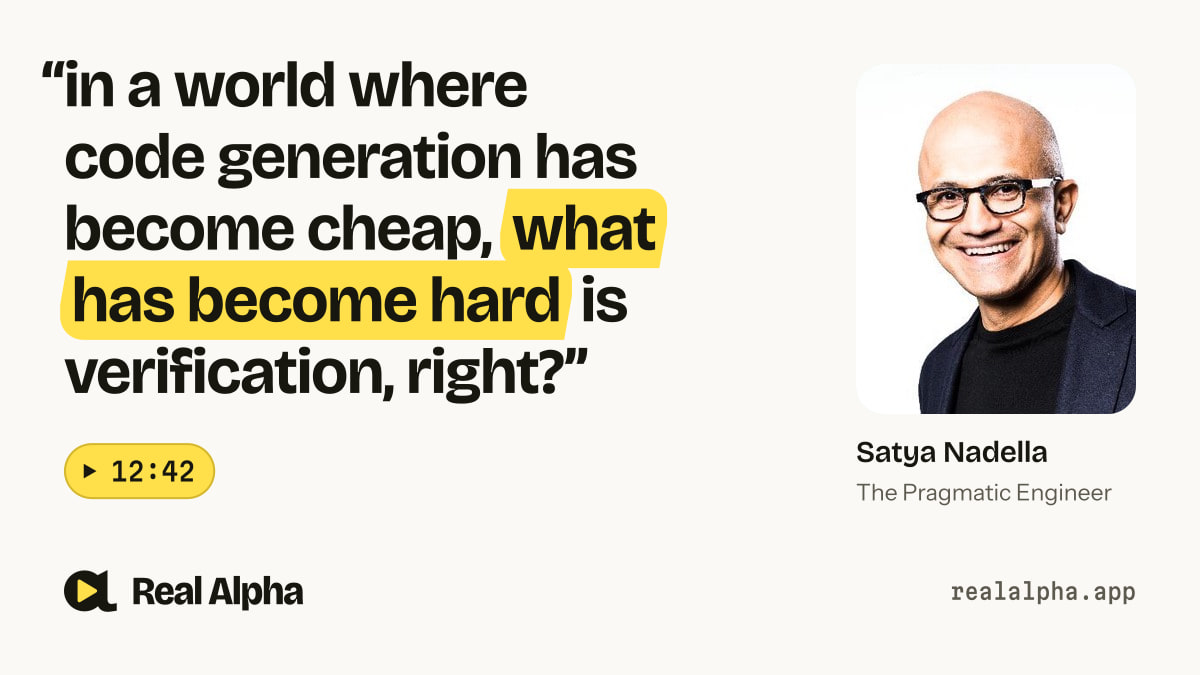
“in a world where code generation has become cheap, what has become hard is verification, right?”
 Satya Nadellaat 12:42 · The Pragmatic Engineer
Takeaways
- Decision engines can make repeatable choices without regenerating code.
- Clear intent and reliable verification matter more as code generation gets cheaper.
- Turn failures into tests and verify fixes.
About this segment
Satya Nadella sees decision engines as reusable, token-efficient logic and says AI-written code makes verification harder. Teams need to turn failures into tests and validate each change.

Satya Nadella is CEO of Microsoft.
Led Microsoft's cloud infrastructure and services transformation, and has been CEO since February 2014.

Gergely Orosz, Host · Host, The Pragmatic Engineer
Spent four years at Uber heading mobile, web and backend teams; shipped part of its payments system.
From “Software engineering after code becomes cheap with Satya Nadella”, Nov 16, 2026. Watch the full episode
Answers “Which jobs will AI replace, and which are safe?” See all 177 answers
Answers “Will AI replace software engineers?” See all 56 answers
Thanks. We'll look at and fix what's off.
Transcript
Transcribed by machine (Whisper) from the episode’s audio, so a word may be off here and there.
- 10:00
thinking changed on both decision models but also on the limits of lm specifically for for programmatic tasks for for coding for for building software in a reliable way yeah i think that that's kind of it right which is look i think the llms are fantastic and we can talk about like even how you know we're engineers let's cut to the point where they're fantastic right right uh in the sense of how do you even think about the software factory. And there's an entire thing that we can go into. But what I love about decision engines is it's kind of a new primitive, right? And how Diego talks about it and how our own decision engine and Achint and others are talking about it. And I like that because, you know, it's kind of like, you know, Excel macros, right? You know, what happened to spreadsheets with macros can happen with code with intelligence embedded as a primitive,
- 10:50
Right. And so, I don't know, you build any system, like I think I was looking at an Xbox system that they'd built for managing all of the community feedback. Right. It's a classic community feedback comes. I make a set of decisions based on it. I don't want to really generate LLM code on it. I just want to be able to make decisions. So it's better to embed this primitive. Right. It has a distribution. You can make a call.
- 11:15
It's sort of it doesn't need to be generated again and again. It's token efficient. And so I think that this is one of those places where software engineering remains very much alive. It's changing. One of the things I like about Diego's thing is he wants to make it as boring as databases. In fact, to me, a relational database, I grew up with the most favorite product in the developer chain, other than the compilers and the Lex and Yak and what have you, was the database.
- 11:43
Because the relational database is a reliable way to be able to store, query your information just made all kinds of applications possible. And I think decision engines in the era of intelligence will also do the same. Well, in fact, the databases are the hardest. So we talk about what is the essence of a software company. It's the business logic, right? But when you go deeper, it's often in the database.
- 12:06
In fact, so much of the business logic used to be coded in store transactions, some of these things. So I wonder if- Yeah, it's a good one. It's like this is the stored procedure of the intelligence era. Yeah, so I wonder if there's an analogy or a hope because I do see that we haven't found the right primitive. Like we know that LLMs can generate code. We can use LLMs to do unreliable stuff, but we still, we're missing these kind of primitives, right?
- 12:31
Yeah, yeah. So I'm very excited about it. And this is, I think, the beginning of how, you know, because one of the other challenges, so let's go to the software factory for a second, right? If you look at even how Cowork is built or even the GitHub Copilot runtime is built today. And, you know, I think people have blogged about it. And it's fascinating, right? You know, in a world where code generation has become cheap, what has become hard is verification, right?
- 12:53
In fact, one of the things that I feel like, oh my God, I wish, you know, I want to join one of the... These Mark Rusernovich, Scott Henselman, you know, perceptorships or whatever they call, because I kind of feel like I got to learn because I've not worked in a team that is mostly now code as output, right? But the code as output has a particular order of operations. It's not like code as output means everybody's just generating all sorts of random code.
- 13:17
The way you got to build the verification stuff, how do you take every failure and then build back the test case and make sure you truly verify the test, right? I mean, there's just so much, I would say, new type of tribal knowledge people are building up in managing complex software projects. In fact, it was a nightmare. I think even in that Rust migration they were having, they had to revert back.
- 13:41
And so that is sort of all the, quote, the great advantages and some massive disadvantages. So that's why, to your point, having additional primitives like this decision engine, I think are good. And you mentioned that as a CEO of like this amazing company, you see all of the things