The alpha, twice a week
That was 3 min.
Get the best new moments in your inbox every Wednesday and Saturday. It's free.
Check your inbox
We sent a link to your address. Click it to finish signing up. Not there in a minute? Look in spam.
or
Bloomberg Surveillance · 3 min · Nov 3, 2026
AI companies have less time to prove they can monetize
 Dan Ives
 says investors are becoming more selective as AI spending and capital raises mount.
The episode’s best minutes
Full analysis- 7:04Michele wants Treasury to stop issuing 20-year bonds3 min
- 17:28AI companies have less time to prove they can monetize3 min
- 11:03Betting markets can repeat polling errorsPro pick 3 min
- 2 more moments in the full episode
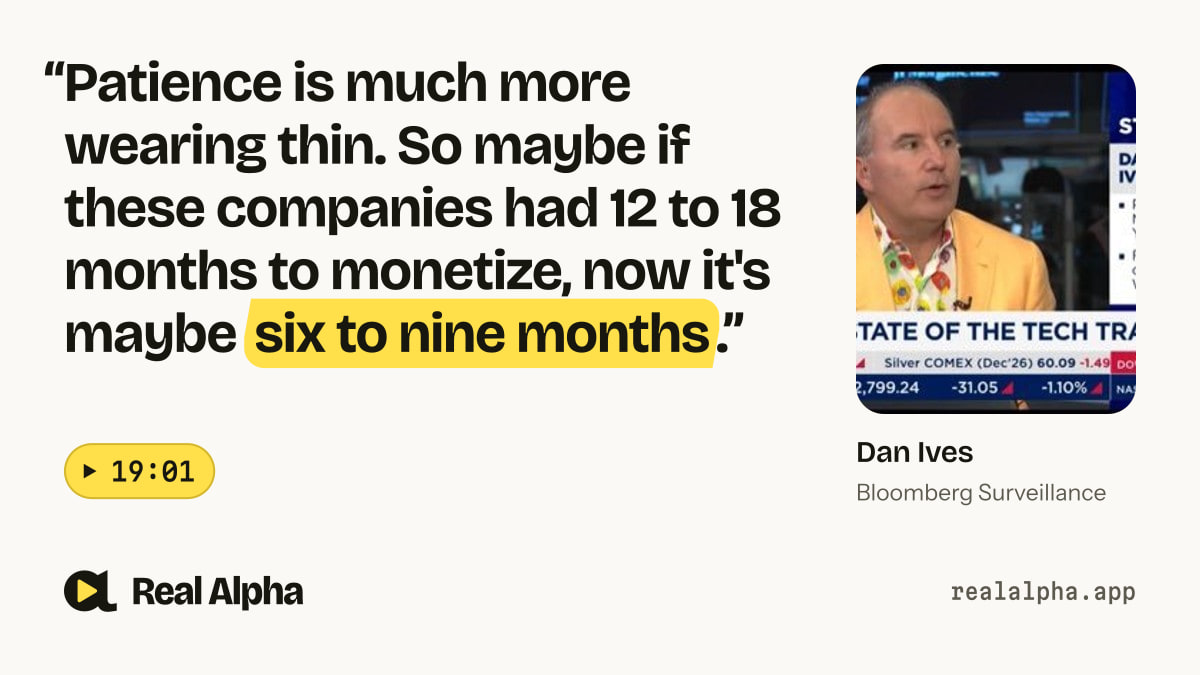
“Patience is much more wearing thin. So maybe if these companies had 12 to 18 months to monetize, now it's maybe six to nine months.”
 Dan Ivesat 19:01 · Bloomberg Surveillance
Takeaways
- AI references alone no longer make it easy to raise capital.
- Investors' patience for monetization is wearing thin.
- The next phase will separate winners from companies that struggle.
About this segment
Dan Ives says investors are becoming more selective as AI spending and capital raises mount. He thinks companies may now have only six to nine months to show monetization progress.

Senior Managing Director & Partner, Yorkville Ives & Co.
Built a globally recognized technology research franchise, covering software and broader technology markets for over 25 years.
- TK
Tom Keene, Host
- PS
Paul Sweeney, Host
- LM
Lisa Mateo, Host
- MB
Michael Barr, Host
From “Bloomberg Surveillance TV: November 3rd, 2026 | Bloomberg Surveillance”, Nov 3, 2026. Watch the full episode
Answers “What will AI look like in the next few years?” See all 395 answers
Thanks. We'll look at and fix what's off.
Transcript
From the transcript Bloomberg Surveillance publishes with the episode.
- 17:31
You know, what's the sweat factor for you right now when suddenly these valuations seem to be in free fall, regardless of what they post in earnings, regardless of what they can finance in debt markets?
- 17:42
Yeah, I mean, I'd say right now the nervousness is, from an investor perspective, in my conversations, SaaS apocalypse type feel, going back to like March, April, and maybe even worse, just because the capital raises.
- 17:55
That we're seeing kind of flooding the market. Now, in terms of like my, you know, fear, the words in terms of the tech trade, look, I think it's a tale of two cities, because the hyperscaler numbers, the CapEx, check, check. You look at Palantir, the use cases, that's accelerating. But I think then the level of disruption that we've seen, memory, Intel, advertising when it comes to Google, software when it comes to ServiceNow and even Fortinet and some others, I think that's what's really caused this to be not just a white-knuckle moment, but this is a gut-check period. This will be the start of winners and losers and who ultimately sort of gets through.
- 18:33
Can I jump in, Dan? That sounds like quite a diplomatic way of saying the bubble's burst. No, I don't.
- 18:38
I mean, to me, I view it different. I view it as like we're just. No, we're entering, in my view, the next phase where it's not just because you say AI 30 times in your conference call, you could raise capital. I think it's more discriminant in terms of who the winners will be in, not just in terms of raising capital, but just in terms of executing. And I think patience, John, to my view... Patience is much more wearing thin. So maybe if these companies had 12 to 18 months to monetize, now it's maybe six to nine months.
- 19:13
To me, the concept that Anthropic may not have an investment grade rating is actually a watershed moment because it highlights these companies that used to be asset-light and revenue-heavy. are completely flipped on their heads. And in order for them to keep expanding, they're going to have to pay so much money to give us all new roads if they want to build a data center, and frankly, to investors, debt investors, to raise money. At what point do you think that fundamentally the equity valuations are going to be compromised going forward as a result of all of these extra costs?
- 19:40
I think there's a line in the sand. I think Oracle would probably be more the poster child. I mean, some could say Cori, but I think Oracle where there's a line in the sand where you're like, okay, this is the amount that we're going to raise. We're not going to raise more. We're going to build out these data centers. call it 800 to 1,000. We've talked about data centers in the US next 12 to 18 months.
- 20:00
If that gets cut by 10, 15%, and then it comes down to who are the winners? Is it Microsoft? Where's Alphabet? Can they build and their advertising business still be strong? I think they can get through it. But it comes down, it's going to be a gut check.
- 20:13
Moment, not just for investors, but for these companies. And I think It's ultimately healthy, in my opinion, to get to the other side of this. But we're going through one of those periods where not everyone is going to come out of this party in good shape.