The alpha, twice a week
That was 6 min.
Get the best new moments in your inbox every Wednesday and Saturday. It's free.
Check your inbox
We sent a link to your address. Click it to finish signing up. Not there in a minute? Look in spam.
or
MD MEETS · 6 min · Jul 13, 2026
AI could raise living standards while widening wealth gaps
 Alex Karp
 argues that many people may benefit from AI, but its biggest gains could accrue to an unusually small group.
The episode’s best minutes
Full analysis- 35:33Europe needs political leadership and top tech talent to adopt AI6 min
- 41:57AI could raise living standards while widening wealth gaps6 min
- 51:19China’s AI edge depends on hardware and faster procurement7 min
- 3 more moments in the full episode
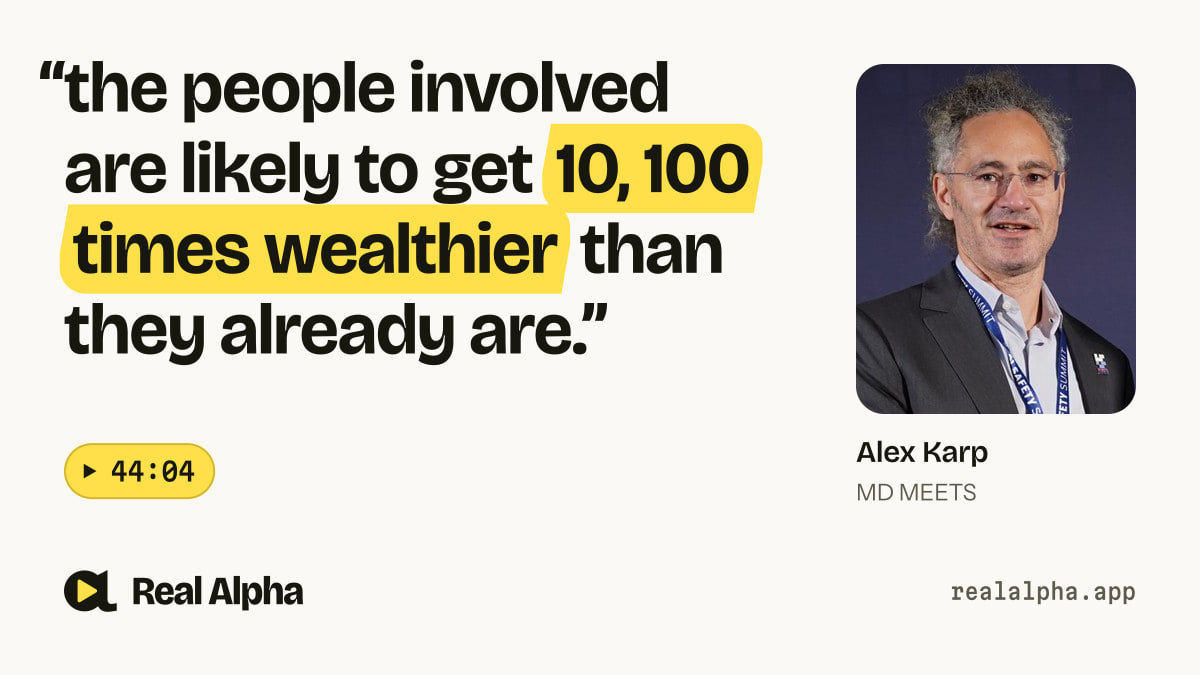
“the people involved are likely to get 10, 100 times wealthier than they already are.”
 Alex Karpat 44:04 · MD MEETS
Takeaways
- AI may improve life for many people.
- The wealth gains could be radically unequal.
- Public fear grows when tech leaders predict job loss.
About this segment
Alex Karp argues that many people may benefit from AI, but its biggest gains could accrue to an unusually small group. He says that gap and job fears are real political risks.

Alex Karp is CEO of Palantir.
Co-founded Palantir with Peter Thiel and has run it as CEO, selling data and AI software to governments.
- MD
Mathias Döpfner, Host · CEO, Axel Springer
From “Palantir CEO Speaks Out on the Dangers of AI”, Jul 13, 2026. Watch the full episode
Thanks. We'll look at and fix what's off.
Transcript
Transcribed by machine (Whisper) from the episode’s audio, so a word may be off here and there.
- 42:01
Nevertheless, it is one of the most skeptical times. There is a lot of fear. There is a lot of anger. How do you explain that? Is it simply the speed of change? Well, it's too much. Now, let me just focus on America. I think... And by the way, that is not a European origin. No, no, no. That is a white problem. And it is an arguably bigger problem here. This is where I do think America might have...
- 42:24
Like, I think... Okay, Europe has an obvious tech problem with political consequences that are really bad. America has a more of a political problem where left, far left, far right of just like... they, it's more hurt that people are successful than any solution. And they're very serious about that. And, you know, the idea they couldn't win is not true, unfortunately. The central framing I'm skeptical of here with people, so people I agree with, probably you and definitely people in my tech world. It's always like, this is going to be a bastion of plethora of good things that everyone's going to profit from. And there are no dangers. I'm not saying you say this, but it is a commonly held view. And the tech people want everyone to just stand up and say that. And I think that is not credible. But what I think is actually just like the overselling of AI in this
- 43:28
country is really, really, really somewhat disconcerting, but it's also depressing because you don't have to do it. This is a natural resource that is net excruciatingly valuable for the betterment of humanity, but it does have some negative externalities. First of all, we don't know where it's going to go. These things are not deployable without processing engines, application layers, ontology, et cetera.
- 44:01
And the biggest problem in this country is it does – while it will raise the standard of living of the average person, the people involved are likely to get 10, 100 times wealthier than they already are. That's a problem for society. You know, the way I try to explain to my Silicon Valley colleagues is, do you think that the wealth, I mean, if we go back to history, then innovation and new technologies have always led to growth, to prosperity, and to an improvement of the standard of living of all people, particularly of the lower income classes.
- 44:39
that has started centuries ago. It was true when the wheel was invented. It was true when the steam engine was invented. It was true when computers were invented. It has, in the end, if we draw a line, contributed to the well-being of people and it has improved the shape of society. Nevertheless, at the beginning, there's always the concern the steam engine is going to destroy. Let me just, sorry.
- 45:08
jobs. We are always afraid. So my point is, do you think that it is now different? Let me give you a different answer that I think sums up a lot of the problems in Europe and America. This is a new playbook. Or there is no playbook. Like, why am I doing so well? Because this is a neurodiversion age. And what the people had skills. So, so this is a different revolution. And even if that is true, and let's assume it is that everybody will do well, I think that's not, I think most people will do better.
- 45:42
You think society is going to divide into a very few with incredible wealth and the mass that has nothing? No, no, no, I'm not saying that. Again, I think that's like, that's kind of the, that's not what I'm saying. I'm saying most people who are middle and middle and middle class will do better. Everybody, people who are willing to change their jobs are likely to do better, but not everyone. But that's not the real political problem. We have a political problem in this country, not a tech problem. In past revolutions, the person at the bottom, maybe their salary doubled and the person at the top became five times wealthier. But like it was very unusual to be a billionaire 40 years ago, right? You now have a revolution where, you know, I could become 20 times wealthier than I am now. And the person who was working out here could
- 46:32
become, you know, they could have their salary could go over, certainly could go up significantly by any normal standard over a period of 10 years, go up 50% or double. Okay. It, when you have a complete decoupling of like unimaginable wealth and normal and that unimaginable wealth. And then this is where we're not really allowed to say this, but it's done by people that you don't really relate to. Like these are like very oddly shaped IQ specimens that, you know, you probably wouldn't want to have over for dinner. And if they were over for dinner, you have nothing to talk to about. And by the way, vice versa. And, you know, and then our whole fabric is not like I got screamed at for like, first of all, it wasn't a draft. I was like, we should have some kind of service. By the way, by that I meant hospital, taking care of old people. Our fabric of our
- 47:25
society is already strained. Wealthy people, it's not like in the 50s and 60s where people actually knew each other, went to the same schools. We're already totally separate societies, right? It basically is i mean it's inflammatory but we already live in a separate but non-equal society and then you hypercharge it with like extreme economic wealth but like egregiously extreme while everybody else is kind of growing and even if it's not true people are afraid even if it is true that most people raise the actual fear people have is I'm going to lose my job.
- 48:01
Now, that fear, even if it's not true, the people running the lab companies who are the leaders told you it's true. They're telling you your life is going to suck. And they're also getting very wealthy and you don't find them very likable.