The alpha, twice a week
That was 3 min.
Get the best new moments in your inbox every Wednesday and Saturday. It's free.
Check your inbox
We sent a link to your address. Click it to finish signing up. Not there in a minute? Look in spam.
or
Masters in Business · 3 min · Oct 30, 2026
AI could shift advisors from process work to client service
 Rich Steinmeier
 predicts AI will reverse the current 30/70 split between client-facing advice and process work.
The episode’s best minutes
Full analysis- 51:48AI could shift advisors from process work to client service3 min
- 29:40LPL aims to scale without erasing acquired firms’ strengths7 min
- 42:36LPL retains advisors by earning their business every day4 min
- 4 more moments in the full episode
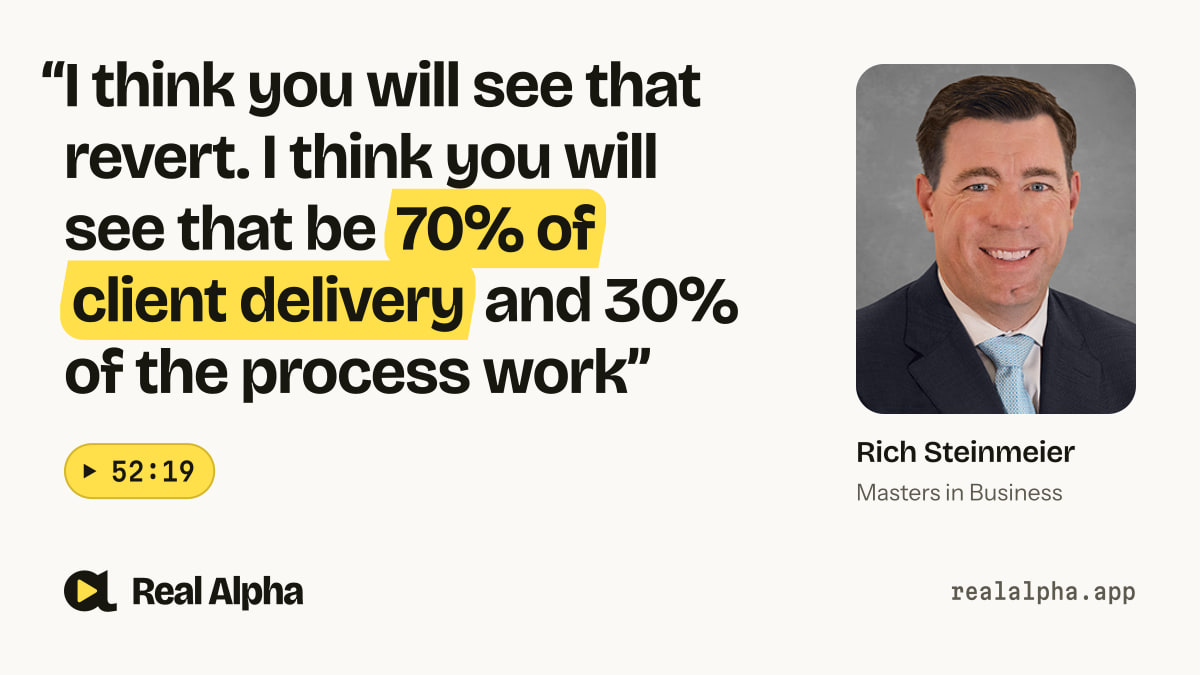
“I think you will see that revert. I think you will see that be 70% of client delivery and 30% of the process work”
 Rich Steinmeierat 52:19 · Masters in Business
Takeaways
- Today, advisors spend about 30% of their time delivering advice.
- He predicts that client-facing work will rise to 70%.
- He expects only a handful of firms to build integrated platforms.
About this segment
Rich Steinmeier predicts AI will reverse the current 30/70 split between client-facing advice and process work. He expects that freed capacity to help advisors serve more clients.

Rich Steinmeier is CEO of LPL Financial.
Led LPL’s growth and advisor recruiting, onboarding more than 7,700 producing advisors and 100 institutions.
From “The Future of Financial Advice: Masters in Business with Rich Steinmeier”, Oct 30, 2026. Watch the full episode
Answers “Which jobs will AI replace, and which are safe?” See all 241 answers
Thanks. We'll look at and fix what's off.
Transcript
From the transcript Masters in Business publishes with the episode.
- 52:01
Interesting. So let's look out 10 years. What do you think the future of financial advice will look like? What do you think, what do you believe that you suspect a lot of other people in the industry might disagree with you about? And how is LPL positioning itself consistent with those beliefs? That's a lot in one question. It is a lot. The first is, I do think if you look at
- 52:25
that 10-year arc, I think you will see the inversion of that kind of today is 30% client-facing and 70% kind of process work. I think you will see that revert. I think you will see that be 70% of client delivery and 30% of the process work that occurs in the background. That means there's going to be a freeing up. So I mentioned, you mentioned that we have 32,000 advisors, but across our entire, the staff that exists inside of advisors offices, we're closer to 70 to 75,000 individuals.
- 52:51
That's amazing. And so what I think you'll see in that is that so many of those folks are actually doing the work behind the scenes. A lot of that work's going to get done on their behalf. And so you're going to see a freeing of capacity to deliver advice to the point that you made earlier to lower levels of assets than we've seen in the past, because at the same time, basically cost right into the team of employees, you are going to be able to have more client facing capacity. And so I think either serve existing clients more broadly or serve a broader set of clients. And so I think there is a real opportunity for those that are running practices to expand their advice capacity for delivery.
- 53:28
And so I like that. I don't know that that's controversial. The thing that I might say that's probably controversial is that of the firms that look of our ilk, I think there's only going to be a handful that are going to be. Able to survive. Those are firms that are trying to provide a comprehensive set of tools that are available in support of advisors. We believe strongly in actually doing our own tech dev, having our own technology, augmenting it with third-party technology. And so not just an aggregation of third-party technology, but an actual proprietary set. I mentioned the developers. And I think those integrated players who believe that they should have their own workstations, believe they should have their own advisory platforms, believe they should have their own investor capabilities, believe that
- 54:09
they should be self-clearing and take all of that data together to harmonize that and put agents against it to make the most productive use of that environment. I think there are only going to be a handful of those firms. We aspire to be one of those firms.