The alpha, twice a week
That was 3 min.
Get the best new moments in your inbox every Wednesday and Saturday. It's free.
Check your inbox
We sent a link to your address. Click it to finish signing up. Not there in a minute? Look in spam.
or
Bloomberg Surveillance · 3 min · Nov 3, 2026
AI data center delays may make growth more sustainable
Heath Terry says power, permitting, labor and equipment delays are pushing projects into later quarters.
The episode’s best minutes
Full analysis- 0:45Household distress shows up outside bank data3 min
- 24:24AI data center delays may make growth more sustainablePro pick 3 min
- 30:43AI capex is becoming a permanent cost of doing businessPro pick 4 min
- 3 more moments in the full episode
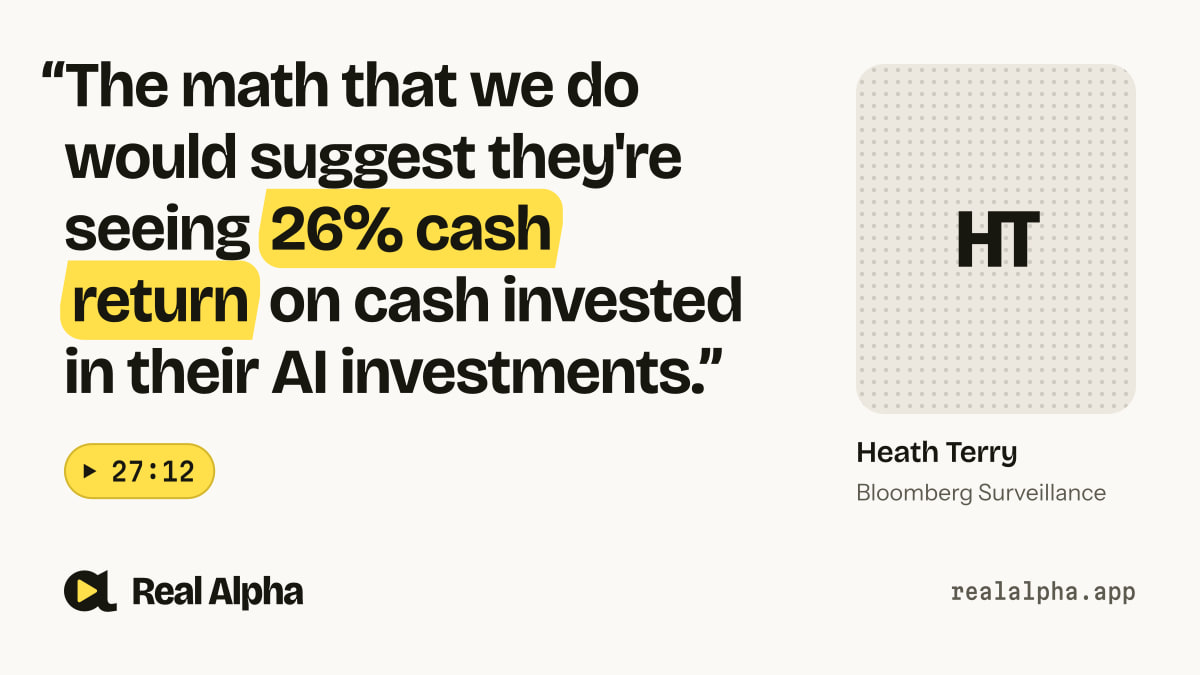
“The math that we do would suggest they're seeing 26% cash return on cash invested in their AI investments.”
Takeaways Pro pick
- Many projects slated for Q4 are slipping into Q2 or Q3.
- Delays are pushing supply back into the chain.
- He estimates a 26% cash return on AI investment.
One of Pro's picks, open to you here. Try Pro free for 7 days
One of Pro's picks. The rest of the summary and the 3 takeaways are in Real Alpha Pro; the video, the quote and the transcript stay free.
Read it with Pro, 7 days freeAbout this segment
Heath Terry says power, permitting, labor and equipment delays are pushing projects into later quarters. He argues the extra time could create a more durable earnings ramp.
Head of Tech and Communication Research, Citi
Led Goldman Sachs’ AI research working group and built its venture-capital research practice.
- TK
Tom Keene, Host
- PS
Paul Sweeney, Host
From “Tech, Markets, and the Midterms | Bloomberg Surveillance”, Nov 3, 2026. Watch the full episode
Answers “Is AI paying off for companies?” See all 116 answers
Answers “Is there enough power for AI?” See all 61 answers
Thanks. We'll look at and fix what's off.
Transcript
From the transcript Bloomberg Surveillance publishes with the episode.
- 24:27
It is really easy to talk about building data centers. We've had plenty of companies announce big APEX spending plans, and we're going to build a 10 gigawatt data center here. And then when it actually comes time to do it, and the permitting, the power, the labor, the electrical equipment, it's hard. And what we've seen a lot of this year is these Q4 projects that were expected to get done by December are now Q2, Q3 projects for next year.
- 24:56
And that's pushing a lot of that supply back into the supply chain. So you're seeing spot markets show softness because of that. And you're seeing companies that were expected to be able to turn that revenue on.
- 25:09
Sooner, having to push out some of that upside. Ultimately, I don't necessarily think it's a bad thing for the broader AI trade if we push some of this out. You and your colleagues were talking about what you do with Micron at 11 times. That's the market telling you that it doesn't trust that this growth for them is sustainable. And so to the extent that we're able to push some of this building out into 27, 28, 29, and these companies have more sustainable earnings because of that, I don't think that's necessarily a bad thing.
- 25:44
So that's kind of where I wanted to go, Heath. I know you spend a lot of your time speaking with institutional investors around the world. And I just want to get a sense of where the AI discussion is these days. For the longest time, it seemingly was build. Build, build. Then we kind of migrated to more of, I need to really see a return on investment. But that doesn't stop the hyperscalers this week from rushing to the markets for debt financing, equity financing.
- 26:07
So where is the writ large conversation these days? Yeah, the writ large conversation is really struggling with the fact that, particularly when you're talking about the hyperscalers, it's sort of a tale of two cities because there is the AI-related part of their business where you're seeing this massive acceleration in revenue growth, 900 basis points of growth acceleration from Q2 to Q3, hyperscaler backlog up 142% year over year. Everything on that side, You're generally positive. And then you get to their legacy businesses, Google search business, Amazon's retail business, Microsoft software business.
- 26:48
And it's a different story. And that's what's dragging those stocks down because AI is effectively crowding everything else. Out.
- 26:56
I know you guys talk to economists all the time. There's the AI part of the economy, and then there's the other part of the economy that's not doing so well.
- 27:03
And I think that's what's really weighing on this. But for the hyperscalers, they know they've got to continue to invest in AI to generate the returns that they're seeing for it. And they are. The math that we do would suggest they're seeing 26% cash return on cash invested in their AI investments. And so if you can borrow money at 6% and get a 26% return, you're supposed to do it. He makes it sound so damn easy.