The alpha, twice a week
That was 5 min.
Get the best new moments in your inbox every Wednesday and Saturday. It's free.
Check your inbox
We sent a link to your address. Click it to finish signing up. Not there in a minute? Look in spam.
or
Prof G Markets · 5 min · Oct 29, 2026
AI infrastructure funding may become harder to secure
Gil Luria explains how rising AI capital spending can push companies to raise debt or equity, and why that funding is finite.
The episode’s best minutes
Full analysis- 3:06Microsoft limits AI spending to what its cash flow can support4 min
- 6:31Google’s search growth raises questions about AI competition4 min
- 10:57AI infrastructure funding may become harder to secure5 min
- 3 more moments in the full episode
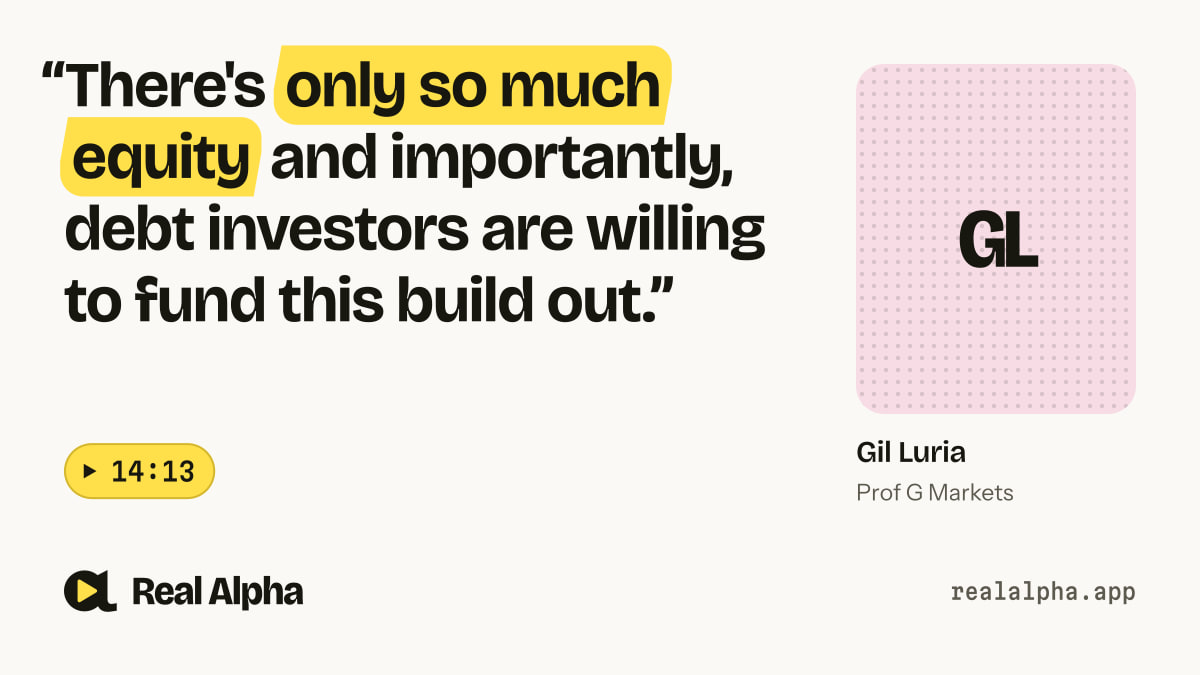
“There's only so much equity and importantly, debt investors are willing to fund this build out.”
Takeaways
- Google’s negative free cash flow could require more financing.
- Capital is available, but it is not unlimited.
- Smaller AI infrastructure players may struggle to raise funds.
About this segment
Gil Luria explains how rising AI capital spending can push companies to raise debt or equity, and why that funding is finite. Microsoft is better positioned, while companies farther down the value chain face greater risk.

From “Microsoft Rises, Google Tanks: Why Investors Are Polarized On Big Tech”, Oct 29, 2026. Watch the full episode
Thanks. We'll look at and fix what's off.
Transcript
Transcribed by machine (Whisper) from the episode’s audio, so a word may be off here and there.
- 11:09
Is it significant, in your view, the amount that they are technically losing on a cash flow basis to build these data centers? Yes, because it means that they'll have to go back to the capital markets if they keep it this way. Let's not forget, last quarter they told us and they just, when they reported, they repeated that they're going to increase CAPEX significantly next year. We're all taking that to mean that they're going to from 200 to 300.
- 11:35
that's a lot of capital they're going to have to raise and the capital is available to them when we talk this isn't core weight right that people will be willing to lend to Google. People will be willing to buy Google shares in the market. But still, that's pressure. It's pressure on the yield that they're going to have to pay. It's pressure on the share price. The more they use cash, the more they have to raise.
- 12:00
That's going to be on investors' mind as well. One of the interesting things that they said was we are now starting to offload because we can't handle all the demand. So again, Microsoft started this strategy three years ago and is now in a much better position to manage its cash flow. Google now realizes that it has to do it as well and is reacting by offloading capacity. That means lower margins, which again feeds into these concerns about the core business.
- 12:31
What do you make of these share sales, these equity issuances, these debt issuances? because it seems like this ai trade is increasingly becoming or these companies are becoming increasingly dependent on someone that isn't them specifically the capital markets and you know that's okay so long as there is real demand in the capital markets and it appears there is we can look at meta's share sale where my understanding it was five times oversubscribed and it you know it worked. They wanted to go out and raise, I think, 85, 95 billion dollars, and they were able to do it. But at the same time, you're opening yourself up to this vulnerability, which is like, we're no longer self-sustainable on this path. We require help from you, from investors. We need you to fund us via issuing shares or via issuing debt. And I guess the logical next question as we enter this
- 13:33
next chapter is how long can that go on like at what point could the music stop and investors say we don't want to do this anymore and when that happens i mean they're screwed right is that is that too is that too much to say that it depends on who you mean by that so yes capital is finite. That hasn't seemed like it so far. A lot of capital has flown until building out the AI ecosystem. But it is finite.
- 14:06
In fact, Meta pointed this out in their filing last week. They said, hey, look, we need to go get capital before it's all gone. on. SpaceX raised a lot of capital. Anthropik's going to raise a lot of capital in three weeks. And now Google went out and got a lot of capital. Meta's going and it's finite. There's only so much equity and importantly, debt investors are willing to fund this build out. So at some point, not everybody's going to get a piece. And some parts of the capital markets may actually already be seizing up, right?
- 14:41
That's what we saw with some of these higher CDSs and very high yields on some of these outstanding bonds is that it is finite. Some parts of it may be seizing up, but Microsoft's going to be fine. They don't need capital. Amazon, Google, Meta, still investment grade. Can probably raise as much as they want to a point. It's everybody else that you have to worry about. Oracle talked about the fact that they've changed their plans, that they're now only going to raise $20 billion, $10 billion in equity and $10 billion of debt.
- 15:19
That's not because they don't need a lot of capitalists, because they had to go to plan B. Plan B is bring your own chip. Plan B is vendor financing. And because they are recognizing that the capital is not as available as it used to be. Once you start getting past them in the value chain, in the food chain, and you get the ankle biters like Corwig, I'm not sure where the capital is going to come from.
- 15:42
Gil Luria is head of technology research at DA Davidson. Gil, always appreciate your time.