The alpha, twice a week
That was 3 min.
Get the best new moments in your inbox every Wednesday and Saturday. It's free.
Check your inbox
We sent a link to your address. Click it to finish signing up. Not there in a minute? Look in spam.
or
Bloomberg Surveillance · 3 min · Nov 6, 2026
AI infrastructure is becoming a capital-markets financing problem
Jeffrey Rosenberg says AI’s expanding infrastructure needs can no longer be funded solely by companies’ cash flows.
The episode’s best minutes
Full analysis- 9:15Anthropic may need an IPO to fund its compute commitments4 min
- 19:08AI infrastructure is becoming a capital-markets financing problem3 min
- 3:48Choose AI companies with strong margins and permitted capacityPro pick 2 min
- 2 more moments in the full episode
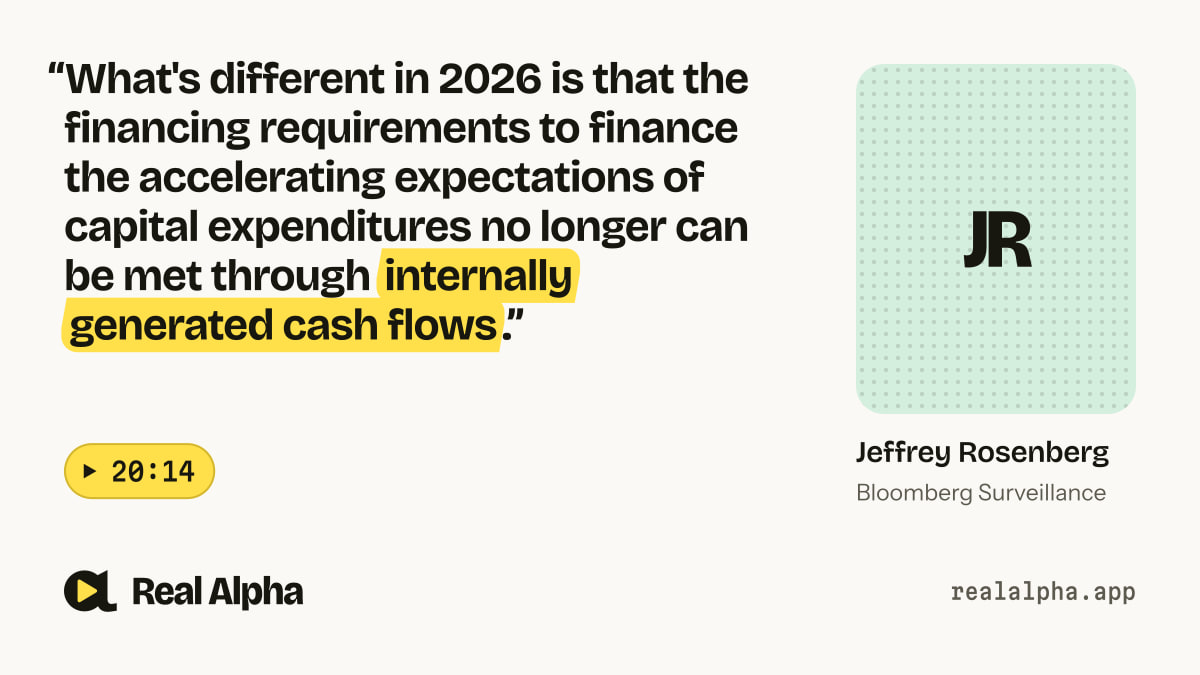
“What's different in 2026 is that the financing requirements to finance the accelerating expectations of capital expenditures no longer can be met through internally generated cash flows.”
Takeaways
- AI capex needs now exceed internally generated cash flows.
- A smaller equity raise could shift more funding pressure to credit.
- Higher financing costs raise the cost of the AI build-out.
About this segment
Jeffrey Rosenberg says AI’s expanding infrastructure needs can no longer be funded solely by companies’ cash flows. If equity and credit financing get more expensive, the cost of building capacity rises too.
Managing Director & Senior Portfolio Manager, BlackRock
Built pioneering commercial credit-risk analytics and leads active and factor investments across BlackRock fixed-income portfolios.
- TK
Tom Keene, Host
- PS
Paul Sweeney, Host
- LM
Lisa Mateo, Host
- MB
Michael Barr, Host
From “Bloomberg Surveillance TV: November 6th, 2026 | Bloomberg Surveillance”, Nov 6, 2026. Watch the full episode
Thanks. We'll look at and fix what's off.
Transcript
From the transcript Bloomberg Surveillance publishes with the episode.
- 19:11
When it comes to potentially a massive IPO coming to market but now valuations starting to report that it's going to be lower, I'm talking about anthropic, $ 2 trillion to maybe $ 1. 2 trillion, how is that going to impact potentially or maybe make this sell-off worse?
- 19:26
Well, I think it's important to kind of put the IPO and the equity raise in the broader context of what we're debating here. What we're really debating is this incredible technology requires and has fueled an incredible investment boom. So the macroeconomic impact of AI is that it's brought about this incredible investment. Expansion. And that investment expansion, you were just talking about it, we're seeing it in the payroll reports, the impact on construction, the impact on manufacturing, the impact on downstream growth, the broadening of the AI benefit. But that investment boom requires And that's the shift, and it's a really important sort of observation. We've been in this AI theme since ChatGPT launched in November 2022. What's different in 2026 is that the financing requirements to finance the accelerating expectations of capital
- 20:27
expenditures no longer can be met through internally generated cash flows. So now it's a capital markets issue. And that's what is the broader context of the equity IPOs is, well, how much of that financing will be met by the equity markets? If that size is reduced, then Will capital expenditures go down, or will the size of capital expenditures keep pace with the anticipated demand from agentic and other new uses that continue to lead to these expectations of exponential growth in demand that's fueling the required build-out? Well, then you're going to have to fund it in some other way if the equity raise is going to be lower.
- 21:10
And that's what a lot of the angst has been coming into this, is that the credit markets are not unlimited in their ability to price that capital. And that also becomes at what price. So, if the quantity is not unlimited, well, then where will markets clear? They'll clear at a higher, or in this case, a lower price, a higher spread. And what that means is just all the costs of the build-out go up. Well, if the costs of build-out go up, goes up, then that intersection point somewhere down in the future that no one knows what is the intersection of the endpoint of the price of demand, price times quantity in the future, how much revenues do we actually deliver from this incredible technology relative to the cost of the supply, that essential intersection becomes a little bit harder when the prices for funding.
- 22:02
That supply go up.