The alpha, twice a week
That was 5 min.
Get the best new moments in your inbox every Wednesday and Saturday. It's free.
Check your inbox
We sent a link to your address. Click it to finish signing up. Not there in a minute? Look in spam.
or
Uncapped · 5 min · Nov 12, 2026
AI infrastructure spending outran the revenue supporting it
 Eric Vishria
They trace the AI infrastructure selloff to lower data-center build estimates and a widening gap between AI revenue and planned CapEx.
The episode’s best minutes
Full analysis- 18:03AI infrastructure spending outran the revenue supporting itPro pick 5 min
- 41:05Recent VC fundraising leaves a hard question about where capital goes6 min
- 55:32Sequoia’s changes align its identity with its strategy6 min
- 4 more moments in the full episode
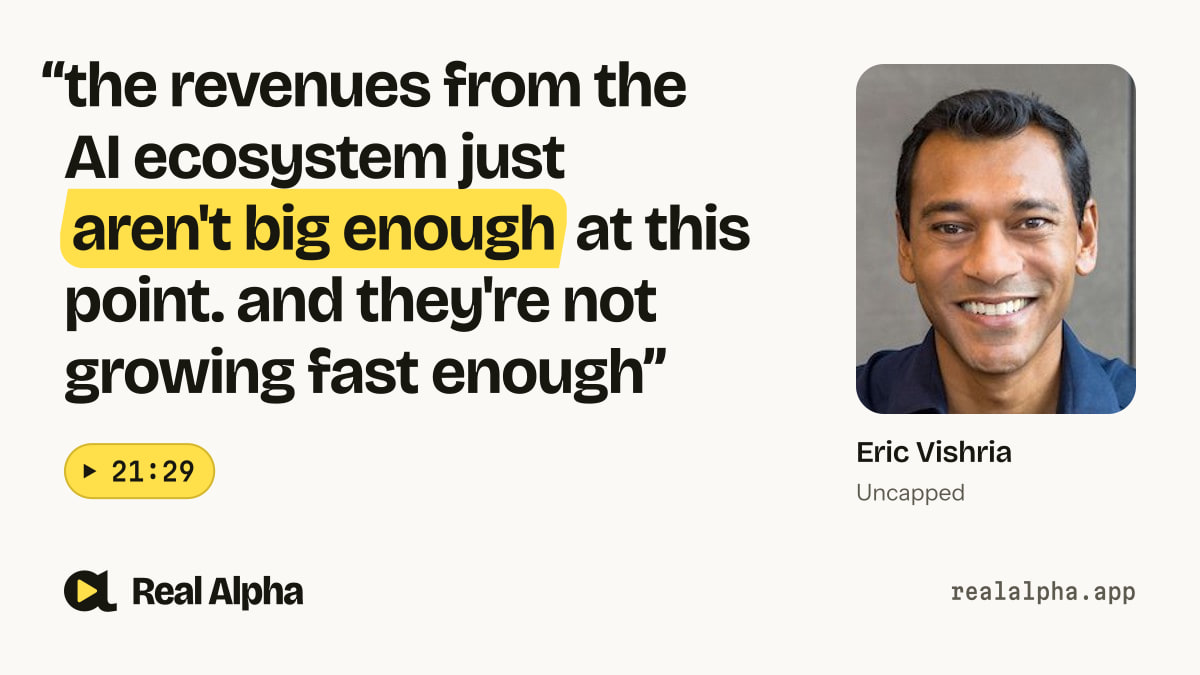
“the revenues from the AI ecosystem just aren't big enough at this point. and they're not growing fast enough”
 Eric Vishriaat 21:29 · Uncapped
Takeaways Pro pick
- New AI data-center capacity estimates fell from 70GW to 40–50GW.
- AI ecosystem revenue is not yet growing fast enough to support planned CapEx.
- Debt-funded infrastructure players are more exposed to doubts about returns.
One of Pro's picks, open to you here. Try Pro free for 7 days
One of Pro's picks. The rest of the summary and the 3 takeaways are in Real Alpha Pro; the video, the quote and the transcript stay free.
Read it with Pro, 7 days freeAbout this segment
They trace the AI infrastructure selloff to lower data-center build estimates and a widening gap between AI revenue and planned CapEx. That gap raises financing and viability risks for leveraged neoclouds.

Eric Vishria is a partner at Benchmark.
Co-founded Rockmelt and led Benchmark investments in Confluent and Amplitude, which both went public in 2021.

Jack Altman, Host · General partner, Benchmark
Co-founded Lattice and ran it until 2023, then started his fund, Alt Capital.
From “Benchmark Breakfast 11/12/26: Anthropic’s IPO, NVIDIA in Crisis, the Midterms, and $60B in VC”, Nov 12, 2026. Watch the full episode
Answers “Is AI a bubble?” See all 99 answers
Thanks. We'll look at and fix what's off.
Transcript
Transcribed by machine (Whisper) from the episode’s audio, so a word may be off here and there.
- 18:15
weeks ago we got to a place where you know people you know obviously this peaked over the summer but um you know and i'm when i'm talking about the ai trade i'm public you know the the public companies around neoclouds around building data centers around you know semis and memory and those kinds of things so yeah what was kind of your read on sort of that sort of pull down that happened and yeah socks and everything yeah so to so to put some numbers behind it so the socks or SOSX semiconductor ETF is down over 20% over the last month, which is obviously a large move.
- 18:33
And stocks like CoreWeave and others that are a little bit more on the higher beta range of the AI infratrate in public markets are down more than 40%. And I think like stepping back and thinking about how these big up and down trends in markets sort of forms, like at the start of like a big stock market shock. So think of this as like the chat GPT moment or COVID when stimulus started happening and everyone was sitting indoors downloading Zoom, like these random events that are very discontinuous from the prior times. Those moves are usually pretty illegible from investors and markets. Like they don't really know how to perceive or respond fund to the shock that happened to the market, like what we saw with ChatGPT and sort of the race to create these frontier labs. And so what happens in the months after that time, or even
- 19:32
years after that time, is that companies across all these sectors can start beating and raising their plans really rapidly, and stocks can go up 3, 5, or even 10x in rapid succession. So we talked about this last time on our last episode, where you had the ChatGPT moment, and then you had all these derivative trades, basically tracking, you know, okay, well, if AI data center volume and demand is going to go through the roof, what are all the different areas of stocks that are going to be positively impacted?
- 20:00
And there was like 8 to 10 different categories where you had stocks go up like 5x or more over the last three years. But eventually, analysts find, like they glom on and find some metric or a few metrics to use as like a barometer for things, for how things should trade. And as soon as there's some metric, I forget what the, like, you know, that law is called, but it's like as soon as you can measure something.
- 20:23
um you know like the the trading becomes much more efficient because then everything starts trading on that metric or it gets very tightly correlated to that metric and so the metric for the ai infatrade and for semis is how much data center capex will happen per year into the coming years typically quoted in gigawatts and so over the summer or like the spring into the summer when Anthropic was on an absolute tear adding 8, 10, 12 billion of ARR every single month.
- 20:53
With a crazy derivative on the growth. Crazy derivative on the growth. Like looked like it was going to do You're like, it's going to do a trillion of revenue next year. Yeah. At least like 400 billion. 500, yeah. Like 400, people were like 400, 500 billion if this continues is not crazy. Yeah. When you're sitting there, folks were pricing in something like 70 plus gigawatts for next year outside of China of new AI data center capacity built.
- 21:18
Now, it looks more like 40 to 50 gigawatts of data center capacity outside of China. And so you bring down that estimate. That's like a 40% decrease on the low end of the new estimate. And that is a huge haircut to all the numbers in the AI infiltrate. And at a deeper level, when you get down to it, the revenues from the AI ecosystem just aren't big enough at this point. and they're not growing fast enough at this point to justify the amount of CapEx that's being contemplated for the next two years.
- 21:53
So that does two things. One, it brings down the overall CapEx numbers and estimates and midterms, which we'll talk about, is also a part of this. But it also makes people doubt the ROI on all the CapEx that's happening. And so then for the players that are in maybe a more tenuous position relative to Microsoft and Meta and Google who have billions and billions of dollars of free cash flow and really strong balance sheets, so if you have a neocloud that is maybe financing a lot of their data centers with debt or having to and has maybe a more precarious balance sheet, if the ROI on this capex is getting called into question and the capital market starts seizing up and your cost of debt starts going up, then everything sort of gets questioned. It's like, okay, are these even businesses?
- 22:31
Are these even viable businesses? You kind of have to start from the consumption of tokens and sort of like the way that hedge fund people, you'll sometimes see them standing outside a store and trying to assess