The alpha, twice a week
That was 4 min.
Get the best new moments in your inbox every Wednesday and Saturday. It's free.
Check your inbox
We sent a link to your address. Click it to finish signing up. Not there in a minute? Look in spam.
or
The Mishal Husain Show · 4 min · Oct 30, 2026
AI investment should focus on making workers more productive
 Daron Acemoğlu
 argues that the race toward AGI crowds out practical uses of AI, including tools that help workers.
The episode’s best minutes
Full analysis- 25:54AI investment should focus on making workers more productivePro pick 4 min
- 2 more moments in the full episode
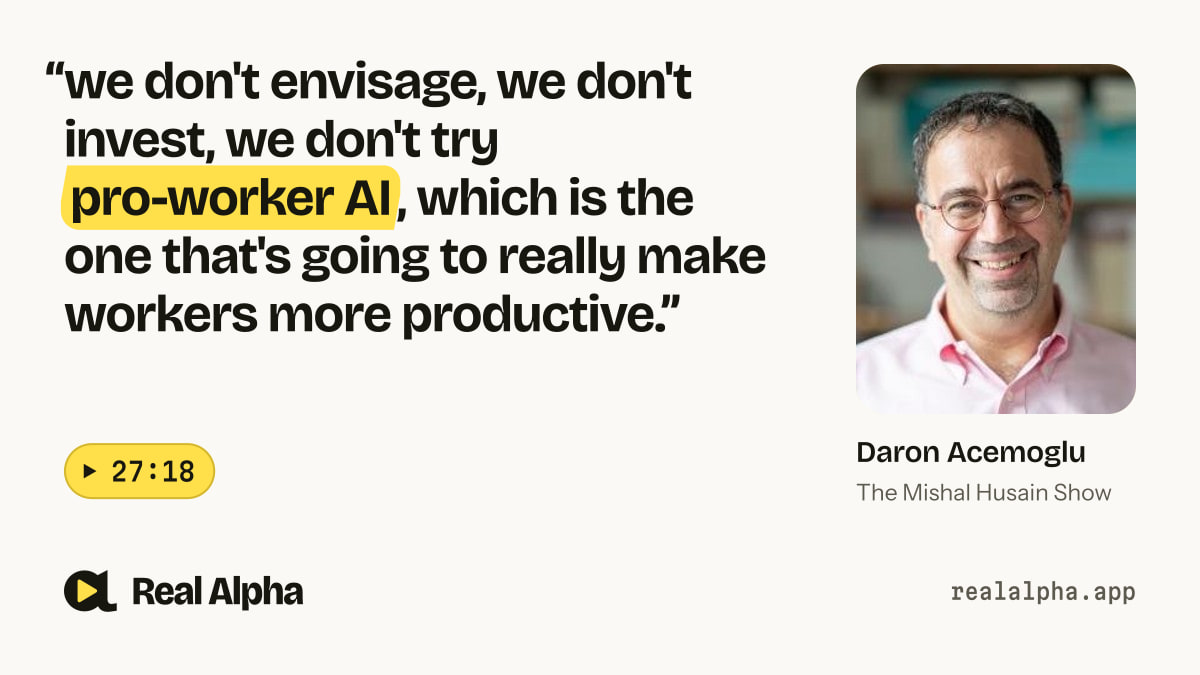
“we don't envisage, we don't invest, we don't try pro-worker AI, which is the one that's going to really make workers more productive.”
 Daron Acemogluat 27:18 · The Mishal Husain Show
Takeaways Pro pick
- Chatbot use is not the same as AI adoption in production.
- He says China is investing more in robotics and production uses.
- He wants talent and investment directed toward pro-worker AI.
One of Pro's picks, open to you here. Try Pro free for 7 days
One of Pro's picks. The rest of the summary and the 3 takeaways are in Real Alpha Pro; the video, the quote and the transcript stay free.
Read it with Pro, 7 days freeAbout this segment
Daron Acemoğlu argues that the race toward AGI crowds out practical uses of AI, including tools that help workers. He points to China’s production-focused efforts and calls for a change in priorities.

Daron Acemoğlu is an MIT professor and 2024 Nobel Prize in economics co-winner.
Nobel-winning MIT economist who studies how AI and automation reshape work, productivity, inequality and economic growth.

Mishal Husain, Host · Host, The Mishal Husain Show
From “Nobel-Prize Winning Economist Daron Acemoglu on Musk, AI and Democracy | The Mishal Husain Show”, Oct 30, 2026. Watch the full episode
Thanks. We'll look at and fix what's off.
Transcript
From the transcript The Mishal Husain Show publishes with the episode.
- 26:06
It again now. Anybody could make mistakes of every direction. There's so much uncertainty about AI. But let me tell you one other thing. What I really object to about AI, and I think what The Economist loves, is the hubristic direction for AI set as artificial general intelligence and then artificial superintelligence led by a few charismatic people and a number of companies and frontier labs. And I think that is not really the only direction. And it's not even the best direction. And that focus in the United States has actually slowed down the spread of AI. Look at China. Okay, fine.
- 26:47
We're told China is behind the United States in AI. And that's right. If you look at large language models, they're behind for something like six to 16 months or something like that. But the Chinese, despite all of their faults, and I've been a very long-time critic of the Chinese regime, its repression, its surveillance, its economic structure, but they are much more active in trying to integrate AI into the production process. They are investing so much more in robotics.
- 27:15
They have the engineers needed to do it. They're doing the same with AI. And that's where we're really not that fast in the United States or the UK. Part of it is because we don't have much of a manufacturing base, which is where a lot of benefits are going to come from. And the even bigger part, and that's where my focus is in the book, is we don't envisage, we don't invest, we don't try pro-worker AI, which is the one that's going to really make workers more productive.
- 27:38
So the Chinese are better essentially at doing AI galvanizing our productivity rather than thinking about AGI. I think you write in the book that belief in AGI is almost dangerous that once you become too obsessed with it, you don't explore alternative directions.
- 27:54
Absolutely. I don't even remember using the word almost there. I actually believe that. Belief in AGI can be self-fulfilling. Yes. Yeah. Even if it's not self-fulfilling, it's actually dangerous. Because if it's self-fulfilling, it will take us to a dystopian future. If it's not self-fulfilling, we'll try to go to that future and do a lot of damage without even any of the benefits.
- 28:12
But I don't know how you stop it. This technology is learning. Oh, yeah. And it's becoming more intelligent.
- 28:18
All the time as it learns. No, no, no. That's not... the right way to think about it. There is no will to the technology. Technology is not doing anything. It's the companies that are pursuing the technology and the amount of investment that's going into this technology is tremendous. And all of it is going, or most of it is going towards this AGI objective. We can change that. And we should. We should absolutely change it. But let me actually say even something slightly more audacious. If we woke up tomorrow morning And 60, even 50% of the tremendously talented young people who are going into AI changed their mind and they said, no, no, we're not interested in AGI. We want to use AI to make workers more productive, citizens more employable. democratic spaces broader. That's what we're going to get.
- 29:02
It's that simple. It's really where the talent and energy is going. And the question is, can we change policies? Can we change norms? And can we have democratic debate that convinced these amazingly talented and generally very, very well-meaning people To change direction. Many of them go into AI because they think working for AGI is the best thing you can do. And why do they think that? A heavy dovetail of science fiction. And that's what all of the media outlets in the United States have been telling them for the last 15 years. Plus... very charismatic people who are making a lot of money are telling them that.
- 29:40
So that's actually not that they're being selfish. It's like, I think they're being in their own minds, okay, this is the best way to do it. This is the only way we can actually improve our society. But that's not the case.