The alpha, twice a week
That was 8 min.
Get the best new moments in your inbox every Wednesday and Saturday. It's free.
Check your inbox
We sent a link to your address. Click it to finish signing up. Not there in a minute? Look in spam.
or
Silicon Valley Girl · 8 min · Oct 13, 2026
AI is changing jobs faster than it is eliminating them
 James Manyika
 argues that job losses will be limited as new jobs emerge and existing work changes.
The episode’s best minutes
Full analysis- 0:45AI is changing jobs faster than it is eliminating them8 min
- 11:43AI productivity does not guarantee higher wages3 min
- 3 more moments in the full episode
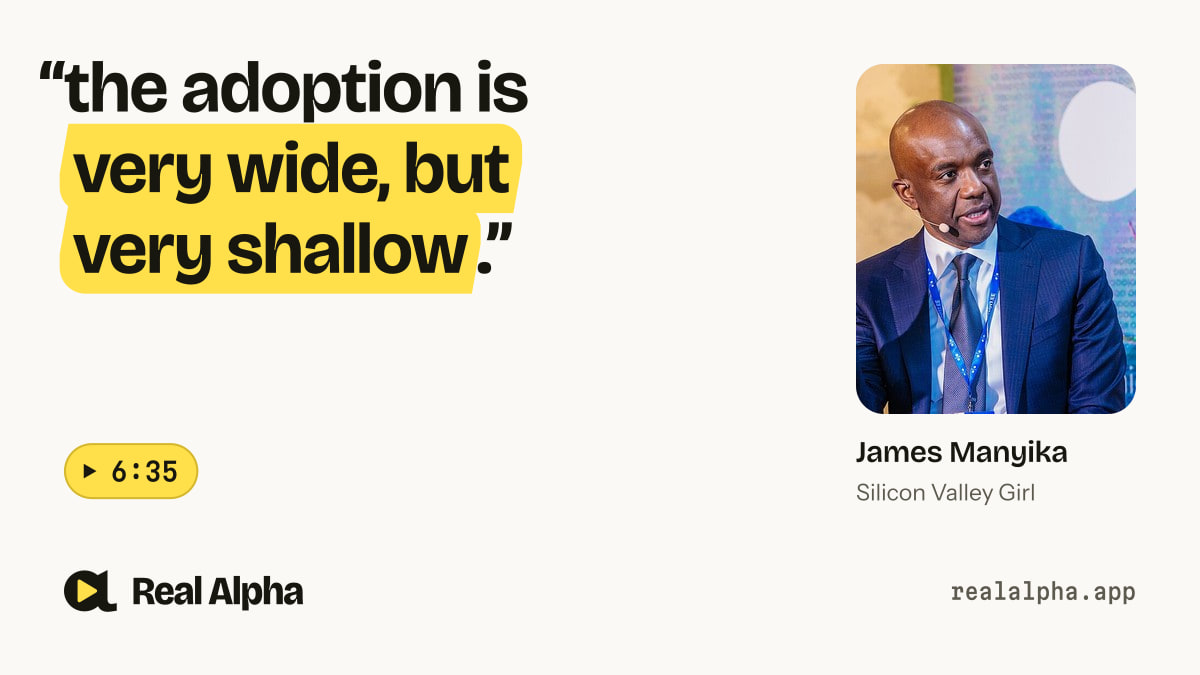
“the adoption is very wide, but very shallow.”
 James Manyikaat 6:35 · Silicon Valley Girl
Takeaways
- AI's economic effects lag its technical capabilities.
- Much of AI's job impact will change work, not eliminate it.
- AI is used on 21% of median-job tasks, mostly to assist.
About this segment
James Manyika argues that job losses will be limited as new jobs emerge and existing work changes. His study found AI use in a median job touches 21% of tasks, mostly as assistance.

James Manyika is a Senior Vice President of Research, Labs, Technology, and Society at Google.
Leads Google and Alphabet’s efforts to responsibly shape ambitious innovations for the benefit of people and society.

Marina Mogilko, Host · Host, Silicon Valley Girl
Co-founded LinguaTrip and built Linguamarina, an English-learning YouTube channel with almost 9M subscribers.
From “Top Google Exec: AI Moves Fast, Jobs Move Slow. Use the Gap”, Oct 13, 2026. Watch the full episode
Thanks. We'll look at and fix what's off.
Transcript
Transcribed by machine (Whisper) from the episode’s audio, so a word may be off here and there.
- 0:57
that we won't see 10% of jobs automated away within a year. That was your bet. This is a topic I've been spending quite some time over many years. The question of what happens when AI intersects and impacts jobs. And I've always had the view and a lot of the research that I've done and actually many economists have done is basically described that three things will happen and all of them will happen.
- 1:20
We can debate the proportions of them. the one thing that will happen is that there will be some jobs that will decline. And that's because some of the constituent tasks involved become easy to automate. So we'll see some jobs lost over time. What are the biggest jobs at risk? Well, I think you'll see that. So, for example, anytime people are doing a lot of kind of routine tasks, whether it's, you know, testing code, for example, or, you know, looking for bugs or those kinds of things.
- 1:48
So there's a whole range of tasks. In fact, by the original estimates that I did and many others did back maybe several years ago, we keep updating these, the proportion of jobs that could be lost that way added up to single digits number as a percentage of jobs, say, in the US economy. So, but you will see some jobs lost in that sense. But I think it's important to complete the picture. The other parts you'll see are jobs gained.
- 2:16
And the jobs gained will be of two kinds. On the one hand, there'll be some jobs whose demand will just go up, existing jobs. And we're seeing some of that today with electricians and a whole range of jobs where the demand will actually go up for those jobs, even though they exist. And this is the story of what happened with radiologists, what happened with even bank tellers of the advent of cash machines.
- 2:37
So there'll be some jobs gained of that kind. The other jobs that will be gained will be new occupations that didn't exist before. There's a long history of this. David Alter at MIT and others have done some research that basically shows if you looked at the US economy back in the 50s compared to now, something like 68% of the jobs we have today, occupations just didn't exist before. It's kind of like if you had looked in 1995 and said, is there a job called web designer?
- 3:06
Conscious creator. Conscious creator, content creator podcast. We'd say no, but now in hindsight, we'd say, oh yeah, those are real jobs. So jobs gained will be of two kinds. But the biggest effect that almost most economists who've looked at this will point to is the jobs changed, which is the third effect where many jobs, the content of them will change, even though we may still keep the same name for them.
- 3:28
So the reason I was taking the bet was because, you know, starting maybe about four years ago, there were some AI folks who were arguing that in two years time, we're going to have wipe out 50% of white collar jobs. And that's the bet I was willing to take. In fact, I took a bet with a couple of the people who were making those pronouncements. And you were right. And I asked them two years later to say, time's up.
- 3:51
What's happened? What was their response? And I said, no, no, no, we'll reset the timeline. So they'll say, okay, no, it's the next two years. But I think this expectation that we're going to see this massive job declines, I just don't think will happen, at least in the kind of 10, 20-year timeframes. Because part of what happens, I think the effect of technology, I mean, while technology is moving very quickly and the capabilities are extraordinary, I mean, we're right in the midst of it ourselves and many of the other frontier labs, the rate at which that translates into economic activity and into the economy is much slower.
- 4:24
Look at the pronouncers people were making last year. Look at what the job numbers actually say today. Jobs are actually up. What do you think will happen in the next five years? Will the supply of new jobs exceed jobs lost? My expectation, the growth in jobs coming from both new jobs and existing ones expanding will will be bigger than the declines we see i mean this is you may have seen the recent i think the economist did a good roundup of this which basically said at most the most jobs we can attribute to having been lost from ai is what i think their number was 200 000 and the jobs that have grown as a result of the ai effects were actually more than a million oh so yeah that's that's the data so far and even in areas that we all are very close to like software development those jobs are actually up.
- 5:12
Yeah, yeah. I should look at the actual data. So I think, you know, this is not to say, Marina, that we should, this will be the forever picture. We should take seriously the possibilities of the impacts of this technology on jobs and work. It's just that it hasn't happened yet. Or the worst things that people expect have not happened. They may not happen in my view. You touched upon the economic effect.
- 5:35
And this is very interesting because we have such powerful models and they're capable of so many things. escaping, breaking rules, etc. But at the same time, when it comes to practical tasks, I think your Atlas study suggests it's about 21% that could be automated with AI. Why is that so? What is going on with the other 79% tasks? Is that the model is not capable or we're still adopting the technology?
- 5:59
I think a lot of it, because of the 21% you're referring to, that was the median percentage, the percentage of a median job where the tasks were being used, where AI is being used in those tasks. And even then, it wasn't even to complete the task. So what we found in the Atlas study, maybe I should explain that. What that study looked at was we looked at all the activities through the Gemini app and Gemini APIs and also in AI mode in search.
- 6:29
And that's a total of close to 2 billion people are using, because Gemini app is now about a billion people using it monthly and AI mode is also about a billion. And then people accessing the Gemini API. So we sort of got a huge chunk of activity directly. And what we found was that the adoption is very wide, but very shallow. And the 21% points to the shallowness of it. And we also found that in most of those tasks, these were assistive tasks as opposed to total automation of the tasks.
- 6:59
So the human are still working with the technology. So I think that's what will take much, much, much longer. before we get to whole tasks being fully automated, keep in mind that there's lots of bottlenecks along the way to complete a full task. And many occupations consist of many, many tasks. And I think that's part of what you're seeing. So what is the bottleneck? Is that the model? Because sometimes you use AI and you start feeding it data and then the answer is completely different.
- 7:29
You're like, oh, that was how I was supposed to use the app, right? Right. I think it's both things. I think on the one hand, the technology is still what many people refer to as jagged. So you often need to check the output, you need to evaluate the output. And then sometimes the task you want just takes many, many, many more steps. And the technology is not quite ready to do that yet. So that's a big part of it. And now, of course, the technology will improve. And we already know that the time horizon of what these agentic systems can do is actually extending all the time. So that'll get better.
- 8:01
But the other part of it is that people interact with technology. We haven't involved yet the workflows enough to make the technology fully assistive or to fully automate them. And in any case, most people seem to find greater value when the technology is being used to complement human activity. The combination seems to be much better when it's a complement as opposed to full automation. The tasks where full automation is the optimal output is still very small.