The alpha, twice a week
That was 3 min.
Get the best new moments in your inbox every Wednesday and Saturday. It's free.
Check your inbox
We sent a link to your address. Click it to finish signing up. Not there in a minute? Look in spam.
or
All-In · 3 min · Nov 20, 2026
AI is driving companies to integrate from land to applications
 Chamath Palihapitiya
 argues that a small group of AI companies will build vertically integrated businesses.
The episode’s best minutes
Full analysis- 0:13AI is driving companies to integrate from land to applications3 min
- 16:24Anthropic may gain a durable moat as intelligence costs fall4 min
- 41:40Open-source AI lets users inspect and control their models4 min
- 5 more moments in the full episode
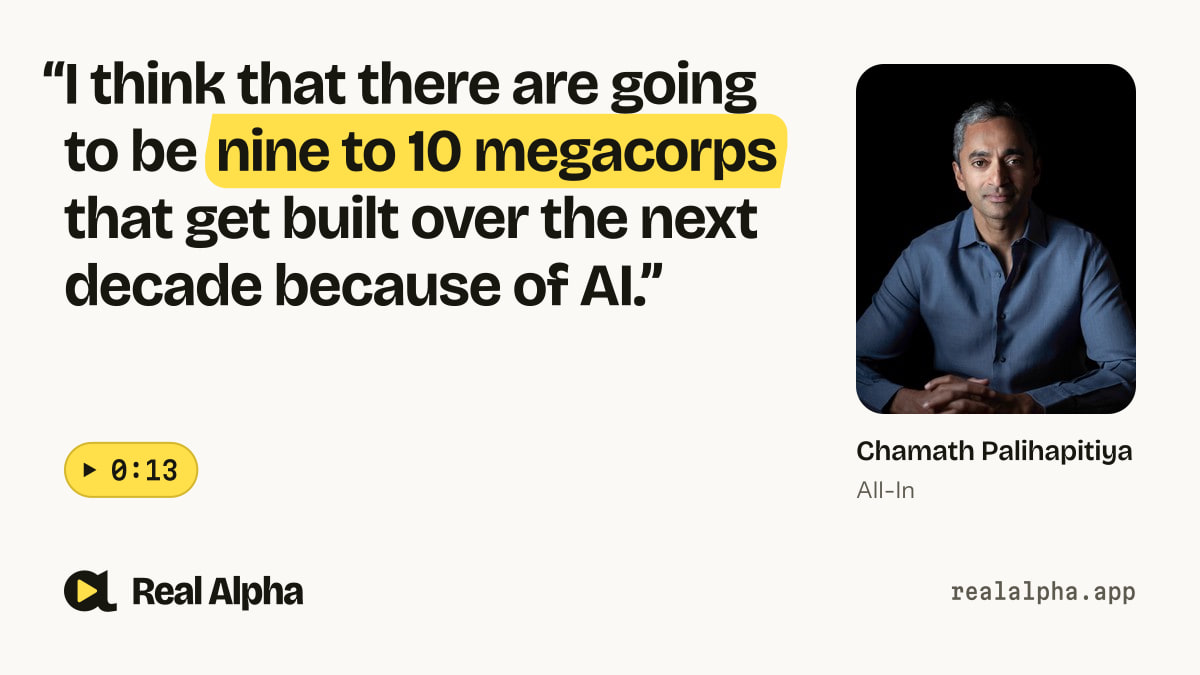
“I think that there are going to be nine to 10 megacorps that get built over the next decade because of AI.”
 Chamath Palihapitiyaat 0:13 · All-In
Takeaways
- AI megacorps will control assets from land and power to applications.
- Nvidia may face pressure as computing diversifies across chips and formats.
- Companies that avoid ambitious investment risk losing market favor.
About this segment
Chamath Palihapitiya argues that a small group of AI companies will build vertically integrated businesses. He expects markets to favor companies willing to invest across the stack.

Chamath Palihapitiya, Host
Founder & CEO, Social Capital
Led Facebook's growth team; his firm backed Slack and AI chipmaker Groq.
From “Anthropic Goes Public, Nvidia in Crisis, Markets Tank, Open Source Crackdown?”, Nov 20, 2026. Watch the full episode
Answers “What will AI look like in the next few years?” See all 395 answers
Answers “Can anyone compete with Nvidia?” See all 43 answers
Thanks. We'll look at and fix what's off.
Transcript
Transcribed by machine (Whisper) from the episode’s audio, so a word may be off here and there.
- 0:20
I think that there are going to be nine to 10 megacorps that get built over the next decade because of AI. And I think that each megacorp is going to go from the application layer all the way down to the dirt. Now, why do I say this? I think the deal that Palo Alto Networks said yesterday rips the Band-Aid off and I think was very smart. What did they buy? They bought these brilliant guys that made open source models. And you would say, well, why is a security company, which should narrowly only be allowed to be in the security lane. Why were they rewarded yesterday?
- 0:57
The stock was up 8% or 9% at one point for buying an AI company. And Nikesh said it in the press release. He's like, this is us venturing outside of security, our first big venture. And the market was like, thank God. And so what's happening? He's going to own the model, right? Then he's going to eventually own the dirt and the land and have the data centers vertically integrated. Then he's going to go up the stack applications. What does Anthropic do it? Ant with all their money, they're already going down to the dirt and they're going up to the application stack.
- 1:26
OpenAI doing the same thing. SpaceX doing the same thing. They own one of the best apps in the game, Cursor. They own all the way down to the dirt. So what do you see taking shape? Meta. Meta owns all the way down to the dirt, all the way up to the app stack. So I think what AI is creating essentially is haves and have-nots. The haves are the folks that have these critical assets that can be very tightly vertically integrated.
- 1:51
And I think that there's going to be 10 of these folks. And so you're going to have this really rich app ecosystem, a lot of open source models and some closed source models. And then you're going to use a lot of distributed silicon. This I think is why NVIDIA is trading down, is this realization that the over-earning era of NVIDIA may be over. This is independent of Jensen, where you just have a multitude of formats and ways in which you can actually compute what you need, and then you're going to need this really important constraint, which is the land and the power. So I think if you view it that way, Jason, you're going to see these eight, nine, 10 conglomerates, and now the market is betting who is a conglomerate and who is not. And that more than anything, I think, explains the flows
- 2:37
over the last few weeks and probably like the last year even. Interesting. So who's on the back heel that has to figure it out? If you are an established company with large amounts of free cash flow and you're not going to go and enter the model game or the data center game, I think the market's going to punish you not by saying your stock is not good, but essentially by trading out of your stock to trade into those companies that are willing to take the risk.
- 3:04
You need something that's more ambitious and Microsoft clearly is going to need to have a frontier model.