The alpha, twice a week
That was 3 min.
Get the best new moments in your inbox every Wednesday and Saturday. It's free.
Check your inbox
We sent a link to your address. Click it to finish signing up. Not there in a minute? Look in spam.
or
Bloomberg Surveillance · 3 min · Nov 9, 2026
AI is not a bubble, but expectations need to adjust
Paul Christopher argues that AI differs from the dot-com bubble because companies are already earning money, but buildout costs and supply constraints will weigh on expectations.
The episode’s best minutes
Full analysis- 14:21Wait for better entry points in tech and data centersPro pick 3 min
- 7:26AI investment accounts for about a quarter of expected growth3 min
- 19:19AI is not a bubble, but expectations need to adjust3 min
- 4 more moments in the full episode
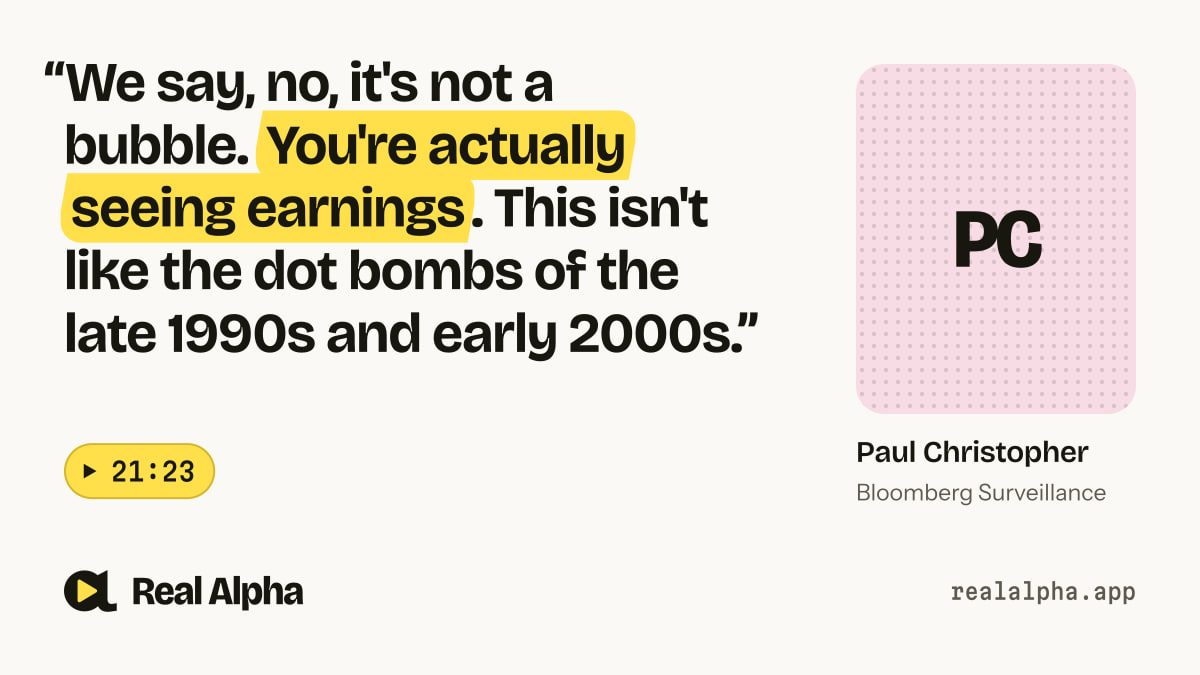
“We say, no, it's not a bubble. You're actually seeing earnings. This isn't like the dot bombs of the late 1990s and early 2000s.”
Takeaways
- He says AI has real earnings behind it, unlike the dot-com bust.
- Data center construction requires time and scarce industrial components.
- He expects four Fed rate hikes between now and end-2027.
About this segment
Paul Christopher argues that AI differs from the dot-com bubble because companies are already earning money, but buildout costs and supply constraints will weigh on expectations. He expects four Fed hikes by the end of 2027.
Head of Global Investment Strategy, Wells Fargo Investment Institute
Leads Wells Fargo Investment Institute’s market guidance teams and focuses on the global investment environment.
- TK
Tom Keene, Host
- PS
Paul Sweeney, Host
From “Stocks Rise as Dip-Buyers Shrug Off Nvidia Woes | Bloomberg Surveillance”, Nov 9, 2026. Watch the full episode
Answers “Is AI a bubble?” See all 99 answers
Thanks. We'll look at and fix what's off.
Transcript
From the transcript Bloomberg Surveillance publishes with the episode.
- 19:22
NVIDIA is supposed to report results on November 17th. So the highest implied move for the S & P 500 over the next month would be the following session since it reports after the closing bell on the 17th.
- 19:32
So I'm curious, what are your thoughts on how. The S & P 500's earning per share risk is currently when you're thinking about that AI CapEx?
- 19:42
The earnings picture does look good to us through 2027. The problem is the expectations for earnings have to come down a little bit more. Again, those headwinds that I mentioned earlier, the war in energy costs, interest rates, the cost of industrial equipment.
- 19:59
For AI, anything related to AI is going to be higher. Some of those order books are for chips and other industrial components are full all the way into 2028. So you're just going to be facing more headwinds. And so a longer term investor can say, well, all right, I'll play this trend. I'm not going to overpay for it, but I'm not going to expect too much in the short term either. Those supply chains really need to ease.
- 20:23
And we are seeing. Activity on the industrial side to expand capacity, but that can't happen overnight.
- 20:29
Paul, you mentioned four rate hikes. I would suggest that's out of consensus. Consensus might be closer to two, maybe three rate hikes. Well, what gets you to four? What do you think in there?
- 20:40
So, yeah, the thing about the consensus is that it's fickle. It's changeable. You hit close to four rate hikes in September, and now you're down to two, according to the consensus. We really don't see any way that the Fed can do just two and maintain credibility. We think you're going to have enough inflation going into next year, especially in the first half of next year. before energy prices can really ease.
- 21:05
And you're going to have more inflation. And that really leaves the Fed with little choice in those early meetings in 2027.
- 21:12
That's where we think you're going to get those rate hikes. After the S & P 500 had its worst week
- 21:15
since April 2025, what's the top question that you're getting from your clients right now?
- 21:21
So the top question is really how do we play the AI trend? Is this a bubble? We say, no, it's not a bubble. You're actually seeing earnings. This isn't like the dot bombs of the late 1990s and early 2000s. You're seeing earnings. It's just that all of a sudden people are waking up to the fact that if you're going to build that much stuff, and there's a data center now in every state and in D.C. too, you're going to build that much stuff. It's going to take quite a lot of components involved. Quite a lot of equipment, a.
- 21:50
Lot of cement, and a lot of wiring. And then you're going to see that trend play out. But it's going to take time to get there. So expectations need to be adjusted. And that's the biggest question that we get from clients.
- 22:03
All right, Paul, thank you so much. We really appreciate it. Paul Christopher, he's head of Global Investment Strategy at the Wells Fargo Investment Institute. He's based in St. Louis.