The alpha, twice a week
That was 5 min.
Get the best new moments in your inbox every Wednesday and Saturday. It's free.
Check your inbox
We sent a link to your address. Click it to finish signing up. Not there in a minute? Look in spam.
or
Bloomberg Daybreak: US Edition · 5 min · Nov 20, 2026
AI is reshaping jobs as its financing tilts toward debt
 Kristalina Georgieva
 cites AI’s effects on jobs and a roughly $1 trillion financing circle increasingly funded by debt.
The episode’s best minutes
Full analysis- 33:49AI is reshaping jobs as its financing tilts toward debtPro pick 5 min
- 16:01Europe is tying Ukraine funding to its next long-term budget8 min
- 26:26The BOJ has room for two more quarter-point hikes7 min
- 2 more moments in the full episode
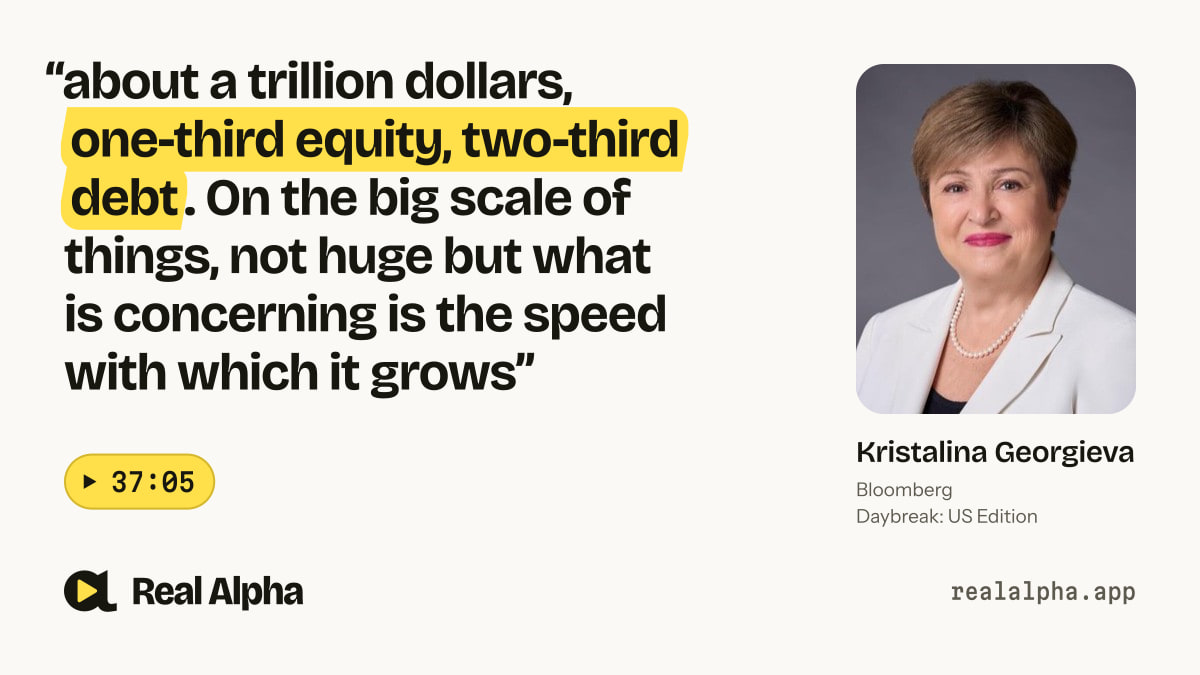
“about a trillion dollars, one-third equity, two-third debt. On the big scale of things, not huge but what is concerning is the speed with which it grows”
 Kristalina Georgievaat 37:05 · Bloomberg Daybreak: US Edition
Takeaways Pro pick
- One in 10 US jobs already requires AI skills, Georgieva says.
- She estimates 60% of advanced-economy jobs will be affected.
- AI financing is about one-third equity and two-thirds debt.
One of Pro's picks, open to you here. Try Pro free for 7 days
One of Pro's picks. The rest of the summary and the 3 takeaways are in Real Alpha Pro; the video, the quote and the transcript stay free.
Read it with Pro, 7 days freeAbout this segment
Kristalina Georgieva cites AI’s effects on jobs and a roughly $1 trillion financing circle increasingly funded by debt. She says the shift could pose a financial-stability risk if left unchecked.

Managing director, IMF
Led IMF crisis responses and expanded financing and debt relief for member countries worldwide.
- NH
Nathan Hager, Host · Host, Bloomberg
From “Daybreak Weekend: US PCE, EU Meetings, Tokyo CPI | Bloomberg Daybreak: US Edition”, Nov 20, 2026. Watch the full episode
Thanks. We'll look at and fix what's off.
Transcript
From the transcript Bloomberg Daybreak: US Edition publishes with the episode.
- 33:52
How real is the demand? Because we're still in the infancy, and those who are building the frontier models say, well, demand is off the charts. And the order books of the Taiwan component makers say, our order books are full till 2030. But there's a circular nature to this investment, as evidenced what Jensen Huang, formerly of NVIDIA, created in his ecosystem, circular demand. How much of that circular demand is not necessarily real?
- 34:20
We see a lot of demands associated with AI in many, many areas. You start from the very basic, bricks and mortars. You have construction for data centers going very rapidly. Then you look at education, healthcare, agriculture. the demand for AI services to increase productivity is there. Then you look at professions that are most easiest to put into an AI world, like data-related activities, accountants, junior lawyers. It is happening there.
- 34:58
We did an assessment of what is actually happening in the labor market. Very interesting result. One, one, in 10 jobs in the US already requires AI skills. And it gets enhanced, pays more. Two, the jobs in the middle that are routine, they get either eliminated or bungled into smaller number of jobs. Many of those are entry-level jobs for young people. Three, and three surprised us. increasing demand for services. Why? Because people with more money in their pockets, the markets are so enthusiastic that everybody feels richer.
- 35:43
You look at. Your 401k in the United States, you have more people spend restaurants, spas, travel, entertainment. So more jobs are created on a net basis and We know how people say, oh, AI is going to destroy all jobs. No, some jobs increase. We have a really kind of a ticking bomb on the labor market. In advanced economies, 60% of jobs over the next years will be impacted. Yes, it will take time.
- 36:15
I call it a slow-moving tsunami, but tsunami nonetheless. So we want everybody to wake up and get to work in policymakers, in the business community. And I want to give a positive story here, which is Singapore. You look at how Singapore is bringing the private sector, the public sector, the trade unions, all into AI ready stage.
- 36:44
I want to come back to the circular nature of finance because a lot of that is debt fueled. And you know a lot about debt burdens in developing countries. So how concerning is that?
- 36:57
It is not yet at the stage when we worry. When we look at the circle of financing, it is about a trillion dollars, one-third equity, two-third debt. On the big scale of things, not huge but what is concerning is the speed with which it grows one and two that there is a gradual shift away from equity towards that so we monitor this very closely and we do signal that this is potentially a financial stability risk if it is not attended.
- 37:39
How close to a shock are we maybe in the developed nations that are building ai and throwing lots tens of billions of, if not trillions of dollars at data centers and the like. We've already seen a rationalization a little bit in the stock market on AI plays. China has a lot of, you know, interest obviously in AI, but very few of them are even remotely close to profitability. How much of a concern is this going to be a year, two years down the road or even closer to that time?
- 38:05
So even before the small correction that we have seen over the last weeks, we were predicting some correction because indeed the enthusiasm was way too high. We don't see yet a risk. Why? Because of this diffusion, the penetration of AI. And you see it is happening and productivity may not be jumping up, but it is moving.