The alpha, twice a week
That was 9 min.
Get the best new moments in your inbox every Wednesday and Saturday. It's free.
Check your inbox
We sent a link to your address. Click it to finish signing up. Not there in a minute? Look in spam.
or
The Diary Of A CEO · 9 min · May 4, 2026
AI may create value without enriching a few dominant firms
 Scott Galloway
 compares AI with past infrastructure booms and argues that important technology does not guarantee strong returns for its makers.
The episode’s best minutes
Full analysis- 1:20:18AI may create value without enriching a few dominant firms9 min
- 24:09AI can cut routine work while expanding what skilled workers doPro pick 6 min
- 15:51Industrial robots may matter more than robots in the home3 min
- 3 more moments in the full episode
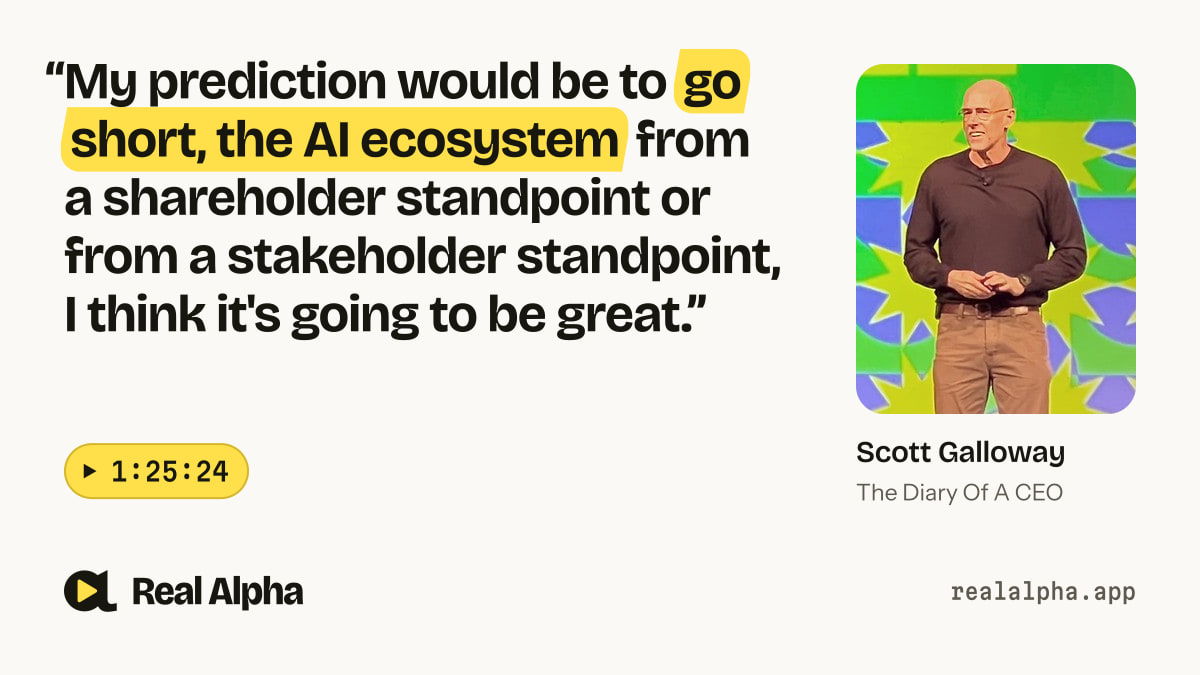
“My prediction would be to go short, the AI ecosystem from a shareholder standpoint or from a stakeholder standpoint, I think it's going to be great.”
 Scott Gallowayat 1:25:24 · The Diary Of A CEO
Takeaways
- Infrastructure booms often end in deep corrections after spending surges.
- AI's value may accrue to users rather than a few listed companies.
- Cheap Chinese open-weight models could pressure US AI valuations.
About this segment
Scott Galloway compares AI with past infrastructure booms and argues that important technology does not guarantee strong returns for its makers. He says cheap open-weight models could pressure US AI valuations.

Scott Galloway is an NYU Stern professor of marketing, entrepreneur, and host of The Prof G Pod and Pivot.

Steven Bartlett, Host · Host, The Diary Of A CEO
From “Scott Galloway: The Rich Are Quietly Preparing For The AI Collapse”, May 4, 2026. Watch the full episode
Answers “Is AI a bubble?” See all 30 answers
Thanks. We'll look at and fix what's off.
Transcript
From the transcript The Diary Of A CEO publishes with the episode.
- 1:20:31
And if you want the link, the link is in the description below. On this point of stocks, the average person, and telling it back into what we're saying about AI, because there's been this over investment in artificial intelligence technology companies. You said earlier, a kid in Stanford right now or anybody could raise $10, $20 million for some AI idea they have. And I'm seeing it everywhere. The companies are over investing in infrastructure.
- 1:20:54
I mean, it was crazy. I think opening ID, the biggest to have a fundraise was it almost $200 billion to build data centers on revenues of, I don't know, is it $30 billion or something? Yeah. Crazyness is going on in the markets. At some point, things correct. Oh, 100%. If you look at the greatest spends on infrastructure, when they get about two or three percent of GDP, there's almost always a crash afterwards. It happened in the railroads.
- 1:21:15
It happened in electrification. It happened in the internet. It happened in the huge telco build out of global crossing. Now, having said that, that doesn't mean those companies don't come back at some point. But there's almost always a deeper correction afterwards. I incurred or I absolutely was on the wrong end of that dip in 2000, again in 2008. But if you look at the most valuable companies in the world, they have in a single year, all of them have had a 40 to 97 percent correction.
- 1:21:44
Amazon went down 94 and 97 percent from 1990 to 2001. Facebook was off 72 percent in 2022. The difference now is if those companies go down, they're such a big part of the market. If they sneeze, the global economy could catch a cold. So I think the technology will absolutely survive. I do think it's seminal. It's breakthrough. But that doesn't mean that we're not going to incur a pretty massive correction from the stock market perspective. Also, let me catastrophize for a moment. Your generation and the majority of investors right now are under the impression that any breakthrough in technology results in a small number of companies over time that are able to use IP distribution, ability risk capital to sequester and capture trillions of dollars in market cap. E-commerce, that's Amazon, eBay, Shopify, social media, whether it's obviously meta or SNAP or YouTube or AI.
- 1:22:47
The problem is, is that what we forget is there have been seminal technologies that have not necessarily resulted in any small number of companies been able to capture shareholder value. Let me give you some examples. If someone said to you right now, for the next 36 months, you either have to go without AI or jet transportation. What would you pick? Without jet transportation or without AI. Prop plans for the next three years.
- 1:23:13
Or AI. Okay. Hands down. Jet transportation. I use AI every day. I invest in AI. Jet transportation is much more important to me. I think that's skirting along the surface of the atmosphere at A-Tense Speed of Sound is unlocked, emotional and financial well-being across the world. It's an unbelievable innovation. If you added up all the shareholder value, the losses and the gains, the profits and the losses, right now, as we say it here now, the entire airline and jet manufacturing industry is a break even. It still hasn't made money.
- 1:23:44
If you look at all the airlines that have gone out of business, if you look at the government subsidies of all the jet plane manufacturers, it has been a shitty business. It's a zero. PCs. I was on the board of Gateway Computer. I realized that's the weakest flex in the world. You don't know what Gateway is? I feel so old. It was this company Ted Wade who was sort of the Michael Delva generation figured out a way to assemble computers and I think South Dakota and it became this hugely valuable company. When I was on the board, it was the second largest computer manufacturer by volume in the world. We were ahead of Apple. We got sold for $600 million or maybe $760, which is what Alphabet will lose in about three trading seconds or gain today.
- 1:24:21
No one's been able to capture a lot of money around PCs. People say Apple. Not wasn't PCs. It was the iPhone. Vaccines. I think vaccines are the second greatest innovation in history, only best by the American middle class. Millions of lives saved through vaccines. Modern is down 90%. There's no one company that's been able to capture sequester shareholder values. My thesis is that there's a one and three chance that AI becomes as important as vaccines, as important as jet transportation, as important as PCs. But there's no one or small group of companies that are able to capture shareholder value. Why is that? AI puts AI out of business. If you look at the convergence of the technologies, all the models are converging. The AI reverse engineers any feature, and basically they're all started with
- 1:25:10
this delta. They're all converging towards the same thing. I wonder if the big winner or the stakeholder that wins an AI is us. We have amazing vaccines, PCs, transportation, but a small number of companies haven't become. We're trillions of dollars. I wonder if the same thing might not happen with AI, with open weight models out of China, with basically great models that are for free. My prediction would be to go short, the AI ecosystem from a shareholder standpoint or from a stakeholder standpoint, I think it's going to be great. Let me back up.
- 1:25:47
I think a more important technology in terms of how it's going to change the world is not AI. Every year, I say this is my technology year. In 24, I said it was AI. 25 and 26. I've had the same technology that said this is more important than AI. Any guesses? Talk about this a lot. You would not know this technology or use it. That's a hint. Okay. Testosterone. Replace me. That hurts because you know I'm on it. That hurts. Okay. Okay. A Zem pack.
- 1:26:19
Okay. GLP1. GLP1. Talk to somebody who's on GLP1 and uses AI every day and ask them which one they would give up. Yeah. I think GLP1, if you look at what's really going to have an impact on people's lives and what will create more shareholder value, I think it's GLP1 than AI. A lot of people much smarter than me say, you're full of shit AI. AI is going to change everything. I think GLP1 is more important technology than AI. My thesis is there's a one and three chance that AI ends up being more like vaccines than e-commerce or social and that is going to be impossible for a small number of companies to capture all the shareholder value they're raising money at. The other kind of what I'll put, you know, fun to speculate or catastrophize. If someone were to say the US economy crashed in the next 24 months or or valuations came down not 30%, but the
- 1:27:07
market dropped 40 or 50%, which has happened before. I wouldn't think it's because if it's misadventures in the Middle East, I think there's a decent chance. If I were advising she and China and I saw America as a real adversary and said, we are sick of these guys messing with us, treating us so poorly, these ridiculous tariffs, very difficult to understand what they're thinking or how we deal with them. I would do what I think they're doing and that I would engage in modern-day steel dumping. So back, I think it was in the 80s or the 90s, China wanted to ramp up.
- 1:27:39
They wanted to consolidate the global steel market so they began dumping cheap steel into the US and US steel manufacturers could not compete. And the idea was price of below market, consolidate the market and then get margin power. That's basically what Amazon and Netflix have done. They've sold you a dollar with a goods for 80 cents until they wrapped up the market then they started raising prices. I think China is beginning to engage in what I'll call AI dumping and that is they're going to have a series of open-weight models. About a third of corporations now are supposedly using Chinese lightweight open-weight models that are cheaper. If I were Xi, I would just dump cheap AI into the US market. In the moment, large corporations start announcing they're not engaging these multi-million dollar site licenses with anthropic or OpenAI. They're using these inexpensive Chinese
- 1:28:22
models and the market realizes that there's no way they can justify these incredible valuations. I think the US market crashes because 40% of the S&P now is directly or tangentially related to this giant bet America is making on AI. The majority of GDP growth over the last two years