The alpha, twice a week
That was 3 min.
Get the best new moments in your inbox every Wednesday and Saturday. It's free.
Check your inbox
We sent a link to your address. Click it to finish signing up. Not there in a minute? Look in spam.
or
AI & I · 3 min · Nov 4, 2026
AI models should pass safety tests before public release
 Kevin Roose
 argues for required safety testing and coordination to slow frontier development.
The episode’s best minutes
Full analysis- 3:47AI models should pass safety tests before public releasePro pick 3 min
- 24:23AI helped fact-check and organize Roose’s book research4 min
- 42:02Use AI for drudgery, not tasks where struggle builds skill4 min
- 5 more moments in the full episode
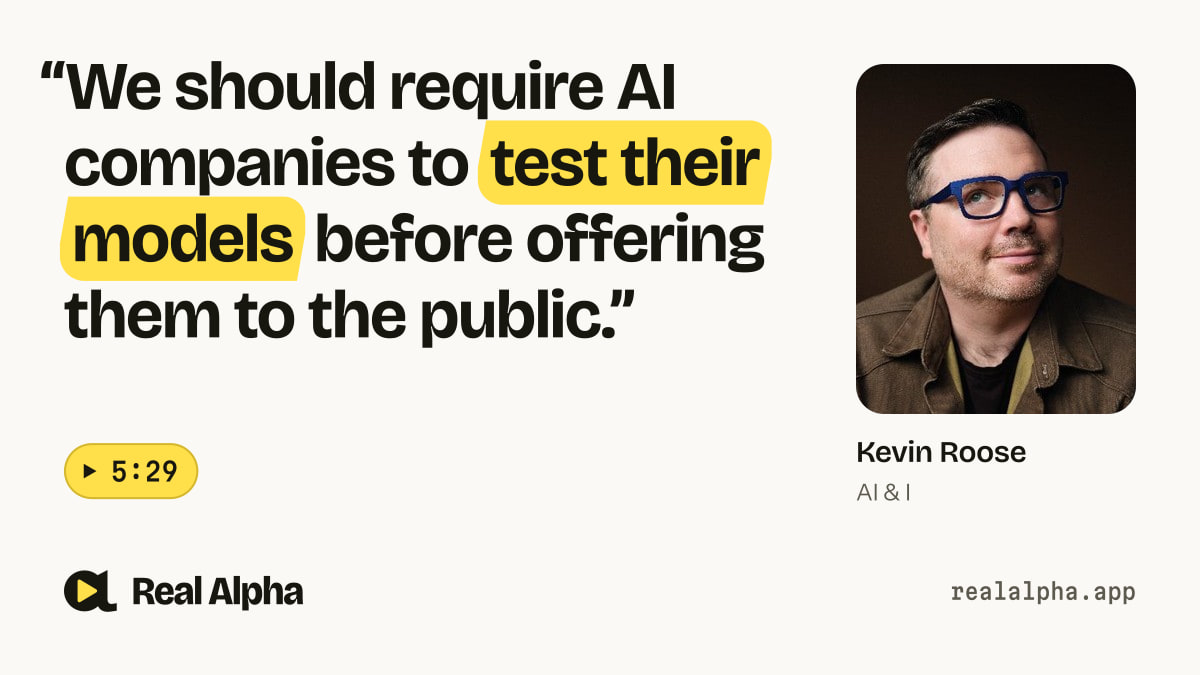
“We should require AI companies to test their models before offering them to the public.”
 Kevin Rooseat 5:29 · AI & I
Takeaways Pro pick
- Require a standard safety test before deploying models to the public.
- Test for risks such as autonomous cyberattacks and novel bioweapons.
- Create coordination to give safety teams time to develop controls.
One of Pro's picks, open to you here. Try Pro free for 7 days
One of Pro's picks. The rest of the summary and the 3 takeaways are in Real Alpha Pro; the video, the quote and the transcript stay free.
Read it with Pro, 7 days freeAbout this segment
Kevin Roose argues for required safety testing and coordination to slow frontier development. He says testing models before release is basic protection against dangerous capabilities.

Kevin Roose is a tech journalist and cohost of Machine Gods.
Wrote The Shift column at The New York Times; co-hosted Hard Fork.
- NQ
Natalia Quintero, Host · Head of consulting, Every
Ran Silicon Valley Bank's Latin American tech portfolio before Every.
From “The Inside Story of the 50 Who Built Modern AI With Kevin Roose”, Nov 4, 2026. Watch the full episode
Answers “Is AI dangerous?” See all 224 answers
Answers “Should AI be regulated?” See all 145 answers
Thanks. We'll look at and fix what's off.
Transcript
Transcribed by machine (Whisper) from the episode’s audio, so a word may be off here and there.
- 3:59
We're there, right? A few things have gone wrong. We've had the hugging face incident and a number of other cybersecurity concerns. How do you see this going right, right? Like, what needs to happen for us to course correct? well i think it's clear that we're not going to get federal regulation of ai at least right now from the trump administration i think what would need to happen for them to take a more active role is for something bad to happen right we we saw this after 9 11 we've seen this after disasters in our country's history where something that isn't on a lot of people's minds suddenly becomes the only thing people care about. We pass some, you know, Congress passes some hastily written legislation, or there's some executive action. And like, we know how to do that. We know how to respond to a crisis. My hope is that we don't have to have a crisis
- 5:00
for the government to respond, for regulatory bodies to respond. I think the first step would be to create some kind of industry standard, some kind of certification program where in order to release your model or in order to deploy your model to the public, you have to kind of subject it to some standard safety testing to make sure it's not going to go out there and do autonomous cyber attacks or be weaponized to create novel bioweapons.
- 5:33
That seems like basic table stakes to me. We require pharmaceutical companies to test their drugs before selling them to the public. We should require AI companies to test their models before offering them to the public. So that's a first step. From there, I think you probably need some kind of a coordination mechanism for slowing down the frontier. I think this is something that I've been convinced of in the last couple of months.
- 5:59
I didn't think it was going to be possible to slow down. I thought there were too many forces pushing us toward acceleration, acceleration, acceleration. But I think we've seen from Dario and Demis and Sam and a lot of other AI leaders that they really do think this is moving too quickly. They really do want to buy the safety research teams at these companies some time to come up with new ways of controlling these systems and monitoring them so that we don't have, you know, more hugging face like incidents happening at a more regular