The alpha, twice a week
That was 5 min.
Get the best new moments in your inbox every Wednesday and Saturday. It's free.
Check your inbox
We sent a link to your address. Click it to finish signing up. Not there in a minute? Look in spam.
or
The Diary Of A CEO · 5 min · Nov 23, 2026
AI now underpins much of the market and US growth
 Steve Eisman
 estimates that AI touches roughly 65% of the market and drives much of US growth.
The episode’s best minutes
Full analysis- 4:26Volume incentives drove the subprime mortgage collapse5 min
- 25:02AI now underpins much of the market and US growthPro pick 5 min
- 1:09:09Eisman says renting can beat buying at today's pricesPro pick 3 min
- 5 more moments in the full episode
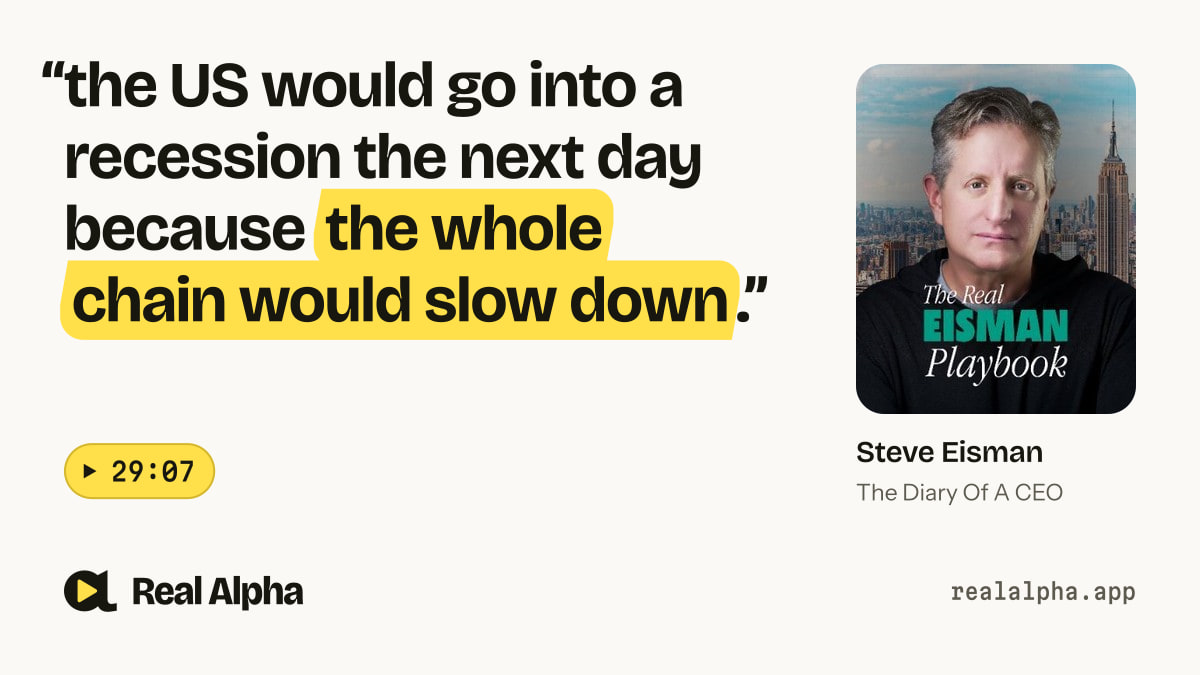
“the US would go into a recession the next day because the whole chain would slow down.”
 Steve Eismanat 29:07 · The Diary Of A CEO
Takeaways Pro pick
- He estimates AI exposure reaches about 65% of the market.
- AI infrastructure spending contributes substantially to GDP growth.
- A recession would hurt, but he distinguishes it from a banking crisis.
One of Pro's picks, open to you here. Try Pro free for 7 days
One of Pro's picks. The rest of the summary and the 3 takeaways are in Real Alpha Pro; the video, the quote and the transcript stay free.
Read it with Pro, 7 days freeAbout this segment
Steve Eisman estimates that AI touches roughly 65% of the market and drives much of US growth. If OpenAI and Anthropic failed, he says, the spending chain could trigger a recession.

Steve Eisman is a professional investor and financial educator.

Steven Bartlett, Host · Host, The Diary Of A CEO
From “Financial Crash Expert: Biggest Money Mistake You'll Make, Everyone Gets This Wrong! | Steve Eisman”, Nov 23, 2026. Watch the full episode
Answers “Will AI boost economic growth?” See all 34 answers
Thanks. We'll look at and fix what's off.
Transcript
From the transcript The Diary Of A CEO publishes with the episode.
- 25:05
And you know what else is? So is the U.S. economy. So if this thing fails, if this whole AI story, and we'll talk about what could happen, but under an assumption that the AI story does this, I believe in AI as a technology, but I also believed in the internet as a technology. That didn't stop the dot-com bubble. We could have a situation where one of these two guys fails. everybody stops ordering all the chips, we go into a recession, eventually we work our way out, and then we grow at a better pace.
- 25:39
That could happen. I think that's the more likely event. I was going to ask you on a sort of balance of probability, you know, If you had to bet your net worth on one outcome, which outcome would you be betting on? Well, I was thinking about betting it on that until the midterm elections. So you've changed it? And I've changed since last week. You know, as Senator Patrick Moynihan once said, facts change, I change.
- 26:01
Just before we go into that, because I feel like that's quite a punchline as to why you've changed your mind. You were going to mention, I believe, how much of the market is AI. Yes. So the S&P 500, which is the 500 largest companies in the United States, is divided up into 11 sectors. Infotech, financial services, industrials, real estate, healthcare, consumer staples, consumer discretionary, on and on and on.
- 26:28
Today, Infotech, just Infotech, is 40% of the S&P. Now, in the history of the United States, no sector has ever been this big. ever. I think the biggest anybody ever got was like 25%. And what's infotech by definition? Technology, which would include NVIDIA, hardware companies like Dell, software companies like Salesforce. It's basically the whole tech world, with some exceptions, which we'll talk about in a second.
- 26:58
So that's 40% of the S&P. Starting about 10 years ago, SMB rejiggered the sectors. And so Amazon, which had been in tech, I think, got moved to consumer discretionary. Google, which had been in tech, got moved to communication services. Meta, which had been in tech, got also moved to communication services. So if you take out... Google, Amazon, Meta, you know, a whole bunch of other companies that call them techie and add that to the 40%, you're at 50.
- 27:36
Now add the utility sector, which is 3% of the S&P, small. but is gonna provide most of the power to the AI data centers. Then add the investment banks and the alternative asset managers that are funding this stuff. And then add industrial companies, GE, Vinova, that provide the power. or in Eaton, which provides the electrification stuff that goes into the AI data center, you're at, I think what he wanted to show was this, you're basically at 65% of the market.
- 28:13
So the blue is basically the AI exposed companies. The only two sectors that you could say have really no role whatsoever in AI would be healthcare and consumer staples. That's kind of ironic. In other words, drugs and toilet paper have nothing to do with AI. But the market is very, very, very, very heavily dependent upon the whole AI story. Now, the economy is also very heavily dependent upon the AI story because U.S. GDP will probably grow two-ish percent this year.
- 28:50
Over half of that, I would say, is all this AI capex. All the money people are spending on the infrastructure. On all the infrastructure, the chips, the equipment, the construction, et cetera. So if it's obviously, if it slows down all of a sudden, look, put it this way, I have a very simple thing. If Anthropic, if, and it's a big if, I'm not making that prediction right now, but if Anthropic and OpenAI went bankrupt tomorrow, the US would go into a recession the next day because the whole chain would slow down.
- 29:15
That means Anthropic has 895 billion commitments. OpenAI has similar levels of commitments. They won't be able to honor those commitments if they're bankrupt. They're out of business. One might say that means the US won't let it happen and therefore they're safe. Now, how are they going to do that? Bail them out. Please, God, not again. I couldn't take it again if we did that. I don't think that's going to happen.
- 29:41
I could be wrong. But if the U.S. would go into recession, you'd think the government might intervene? I don't know how they would intervene. I mean, I could be wrong about this. You know, there's a big difference between a great financial crisis versus a bubble. You know, in the great financial crisis, the banks were all at risk of going under. When you can't get your money out of the bank, that's on another level of disaster.
- 30:08
When companies go bankrupt, it's a recession. The banks will be fine, by the way, because they're much better regulated. They have much less leverage. So I'm not worried about the banks at all. But you'll have a recession. We've had recessions before. It's painful. It's not pleasant. People lose their jobs. But if the U.S. is the most dynamic economy in the world, we'll come out of it.