The alpha, twice a week
That was 2 min.
Get the best new moments in your inbox every Wednesday and Saturday. It's free.
Check your inbox
We sent a link to your address. Click it to finish signing up. Not there in a minute? Look in spam.
or
Founders · 2 min · Jun 28, 2026
AI progress calls for first-principles thinking
 Scott Wu
 argues that AI task horizons are extending from seconds to hours, and asks why they could not reach days or months.
The episode’s best minutes
Full analysis- 37:12Cognition found its first enterprise fit in repetitive migrations5 min
- 20:30AI progress calls for first-principles thinking2 min
- 52:14Focused startups can beat companies with far more resourcesPro pick 5 min
- 5 more moments in the full episode
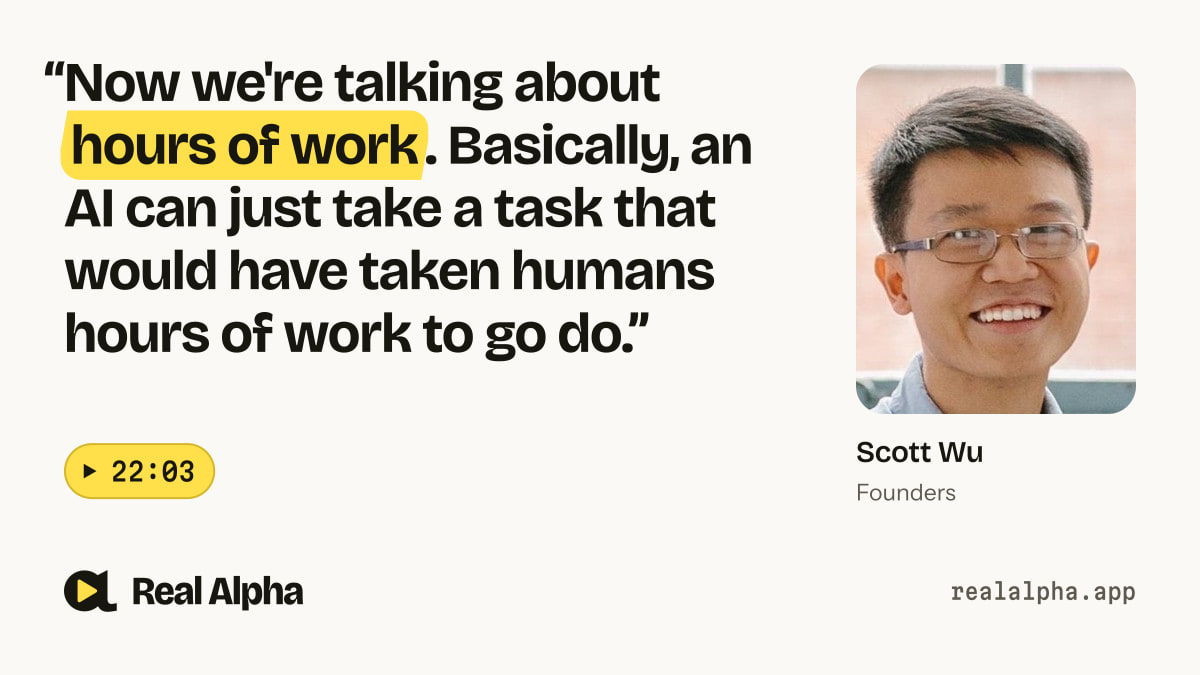
“Now we're talking about hours of work. Basically, an AI can just take a task that would have taken humans hours of work to go do.”
 Scott Wuat 22:03 · Founders
Takeaways
- AI’s ability to work without interruption has grown quickly.
- Wu says pattern matching can fail during periods of real change.
- He uses task duration to imagine what longer-horizon agents could do.
About this segment
Scott Wu argues that AI task horizons are extending from seconds to hours, and asks why they could not reach days or months. That shift can make forecasts based on past patterns misleading.

Scott Wu is co-founder and CEO of Cognition.
Co-founded Cognition, the company behind Devin, an autonomous software engineer; three-time IOI gold medalist.

David Senra, Host · Host, Founders
Has read an entrepreneur's biography every week for Founders since 2016.
From “The Future of Software & AI | Cognition’s Scott Wu”, Jun 28, 2026. Watch the full episode
Thanks. We'll look at and fix what's off.
Transcript
Transcribed by machine (Whisper) from the episode’s audio, so a word may be off here and there.
- 20:35
Ten years from now, we're going to have forgotten that we ever lived without them, honestly. What do you think you understand about AI that other people don't? The reason I ask the question is because we have some mutual friends. I would describe our mutual friends as some of the most AGI-pilled people that I know. Yeah. And I feel every time I have a conversation with them, I'm like, oh, even though I pay attention to this stuff, I feel like a toddler compared to somebody like you.
- 20:57
And so I'm very curious, like, what do you understand about AI that most people do? Yeah. And even people within the tech industry. No, you're way too generous. I don't know that there's, I don't know that I have that, anything that interesting or that deep of an insight. I mean, I think it's, it's. You say that because you're used to it. Here's what I'd say, is the way that folks typically kind of predict the future or think about what happens next is they pattern match based on what they've seen historically.
- 21:24
And they say, okay, well, for a hundred years, it's always been like this. and it's probably safe to assume that it will be. And 99% of the time that works great, right? And in these particular periods where things that actually move and they're real things that are different, those are the 1% of times where it truly is different. Now you just kind of, you know, rather than any kind of pattern matching, like what really matters is just thinking about things from first principles.
- 21:47
Like AI, you know, there's the famous like METR report, which was saying, you know, a couple of years ago, AI would do about 10 to 20 seconds worth of human work without interruption. Then you'd have to guide it or direct it or it would make a mistake or something like that. 10 seconds, 20 seconds, and that's just doubled every couple of months, basically. Now we're talking about hours of work. Basically, an AI can just take a task that would have taken humans hours of work to go do. If you go and describe that task well enough to the AI, it will just go and do the whole thing and come back to you with the result. And then you give it the next thing, the next thing, right?
- 22:24
And if you just ask from a first principles question, well, why can't that be days? Or why That'd be weeks or months of work. And then what does the world look like if everybody has an agent that can just do months of work for them at a time? Then you get to a pretty different conclusion from what we've all seen and what we've all lived for the last several years. And I think that that kind of first principles thinking is as different as it sounds and as crazy as it sounds, you know, this is one of those times where it's actually more correct than the simple pattern match.