The alpha, twice a week
That was 4 min.
Get the best new moments in your inbox every Wednesday and Saturday. It's free.
Check your inbox
We sent a link to your address. Click it to finish signing up. Not there in a minute? Look in spam.
or
Training Data · 4 min · Nov 24, 2026
AI progress is a recursive loop, and students should join labs
 Noam Brown
 sees AI-assisted research as part of a long-running cycle of technological self-improvement, though compute and human bottlenecks remain.
The episode’s best minutes
Full analysis- 6:57Diplomacy bots work better when they model real people3 min
- 10:05Brown left game theory to work on general reasoningPro pick 3 min
- 23:37AI progress is a recursive loop, and students should join labs4 min
- 3 more moments in the full episode
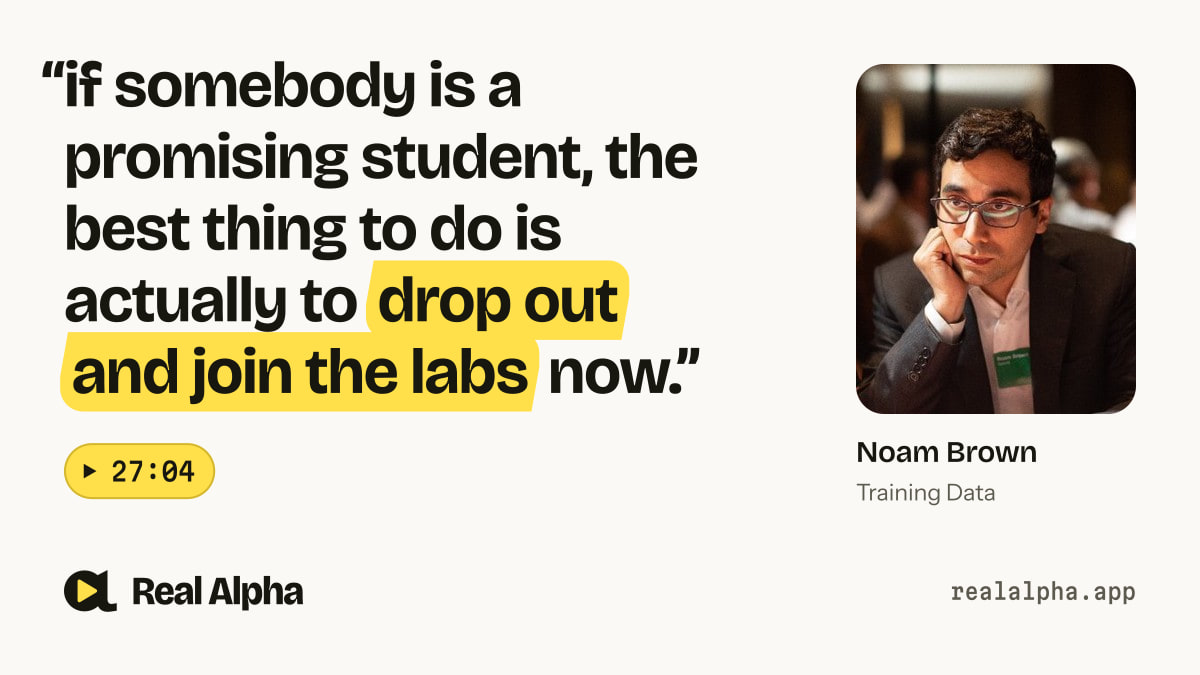
“if somebody is a promising student, the best thing to do is actually to drop out and join the labs now.”
 Noam Brownat 27:04 · Training Data
Takeaways
- Technology has long helped people create better technology.
- AI could accelerate research despite remaining bottlenecks.
- Brown says promising students should consider joining labs now.
About this segment
Noam Brown sees AI-assisted research as part of a long-running cycle of technological self-improvement, though compute and human bottlenecks remain. He argues promising students should consider joining AI labs now.

Noam Brown is an OpenAI researcher.
Foundational contributor to OpenAI's o1 reasoning models; earlier built Libratus and Pluribus, superhuman poker AIs.
- AL
Alfred Lin, Host · Sequoia Capital
From “OpenAI’s Noam Brown: Why Game Theory Didn’t Lead to General Intelligence (Live at No Limit Finals)”, Nov 24, 2026. Watch the full episode
Thanks. We'll look at and fix what's off.
Transcript
Transcribed by machine (Whisper) from the episode’s audio, so a word may be off here and there.
- 23:42
Hey, this is Jasper from Hyperbolic. Thanks for your talk. And a lot of people talking about RSI and just wondering, like, how soon do you think RSI going to happen and can you apply it for being the best poker player in the in the world um sorry what was the last part Do you think you can apply RSI to PokerBot so that you can become the best player? Could you apply RSI to a property? You mean making PokerBots or playing Poker?
- 24:11
They're the same, right? Like RSI, basically, you can self-improve yourself to become a bet. I mean, like I said, I asked all the latest models to make PokerBots, and I think they are getting pretty good at iterating and running experiments and recognizing when they could do better. As far as RSI, it is a real thing. In some ways, it's not a novel concept. If you think about all of human technological progress, it really is just one giant RSI loop where we use technology to advance our ability to do technology, to make technology or to make scientific discoveries.
- 24:45
We make the telescope so we can explore deeper into space. We make computers, and then we start off using punch cards, and then we progress to compilers. And this accelerates our ability to do research and make new technology, and what humans end up doing then shifts to what the models are bad at. This goes back to my point that the models are jagged right now. So when we go from punch cards to compilers, a lot of what people end up doing becomes focused on what the models are still bad at, what the computers cannot do.
- 25:22
And when we go from compilers to things like LLMs, again like the work that a person does shifts. Now I think what's different today is two things. One the generality of the technology and two the speed at which it's happening but fundamentally it's not different from what's happened in the past and even for the creation of LLMs we have used the LLMs themselves to aid us in making the next generation of LLMs for years. I remember back Back in 2022, 2023, people would use LLMs to, for example, do data quality, so they would look through the pre-training data to see is this actually high-quality data or is there anything concerning in it.
- 26:03
That's basically a form of RSI. Now, the way the technology is developing, I think we're lucky that it is jagged and that there are things that the models are quite bad at. But in the same way that these models can now do superhuman math research, I do think there is a case that even if they are spiky and jagged, they can be directed towards being really good at RSI. And in that case, yeah, you might see very rapid progress.
- 26:34
Now, I still think you can get bottlenecked on certain things. I think you can get bottlenecked by compute. I think you can get bottlenecked by the long tail of things that the models are bad at and humans are necessary for. But I do think that things go much faster. So we have seen a lot of rapid progress over the past few years when it comes to AI. I think even in the past six months, that progress has, if anything, accelerated, I think.
- 26:58
And I think that we're going to continue to see a very steep rate of progress over the next year or two. And so perhaps my most controversial take is that if somebody is a promising student, the best thing to do is actually to drop out and join the labs now. Recruitments are ready. Spinal work. Because things are going fast and it's an exciting time. So it's not a great time to sit on the sidelines.
- 27:27
And I will say also, I've hired a few people that have just dropped out and, you know, skipped their senior year of college. And they do exceptionally well. They've had a lot of success with these kinds of people. No, but I was in grad school. I wasn't in the middle of the AI boom.