The alpha, twice a week
That was 4 min.
Get the best new moments in your inbox every Wednesday and Saturday. It's free.
Check your inbox
We sent a link to your address. Click it to finish signing up. Not there in a minute? Look in spam.
or
Lex Fridman Podcast · 4 min · Oct 26, 2026
AI proofs don't replace the human value of understanding
 Alex Kontorovich
 separates producing a solution from understanding why it works.
In this episode
Full analysis- 1:11:29AI formalized Fermat’s Last Theorem in 13 million lines8 min
- 1:41:57Viscosity may not prevent every fluid blow-up6 min
- 2:56:09Fine-tuning can transmit behaviors hidden in random data4 min
- 11:03AI proofs don't replace the human value of understanding4 min
- 49:28Mathematical verification depends on slow community review6 min
- 3:04:07Practical instances can make worst-case hard problems easy4 min
- 1:50:30AI may help find simpler coordinates for turbulent flows5 min
- 1:59:02Insects correct for gusts with sensors in their wings5 min
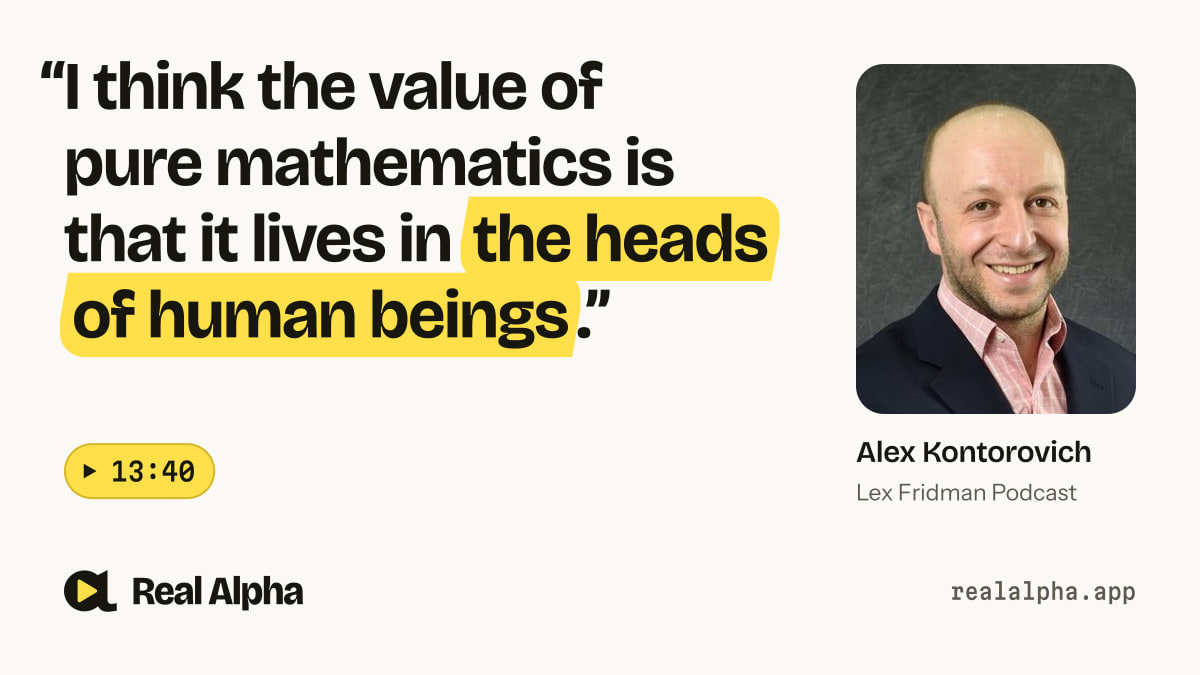
“I think the value of pure mathematics is that it lives in the heads of human beings.”
 Alex Kontorovichat 13:40 · Lex Fridman Podcast
Takeaways
- Solving a theorem and understanding its proof are different outputs.
- Human limits can encourage more generalizable explanations.
- Pure math can matter for what it teaches people, not just what it proves.
About this segment
Alex Kontorovich separates producing a solution from understanding why it works. Moitra argues that human limits can push mathematicians toward more general explanations.

Mathematician, Rutgers
Advances analytic number theory through research on automorphic forms, homogeneous dynamics and representation theory.

Lex Fridman, Host · Host, Lex Fridman Podcast
Robotics and AI researcher at MIT; started the show in 2018.
From “AI Crisis in Math: Navier-Stokes, Riemann Hypothesis & Complexity Theory | Lex Fridman Podcast #503”, Oct 26, 2026. Watch the full episode
Thanks. We'll look at and fix what's off.
Transcript
Transcribed by machine (Whisper) from the episode’s audio, so a word may be off here and there.
- 11:08
What does solved math mean? if you think back to when chess engines first came out and people were like oh this is going to be amazing we'll play centaur games so this is a human being plus a computer system against another human being and a computer system and that lasted like 10 seconds and then the computers got so good that if you did anything but choose the top move that the computer recommended you would lose and so the human being's role in that game became yes accept the first move yes accept the first move, that's no longer fun. And we don't see many games of centaur chess anymore. Right.
- 11:44
And so, uh, in fact, I just had a conversation with a colleague named Thomas Goberta, where we axiomatized our argument for what the future might look like. And one of the axioms that I'm willing to even accept for the sake of argument is what I call the solved axiom and the solved axioms. says, let's assume at some future point, we're nowhere near there now, and I don't expect us to be there necessarily. We'll see where the capabilities taper off if they do. But let's assume the solved axiom, which says any mathematical problem that can be solved with human interacting with AI could also have been solved by AI alone. That's the solved axiom. So that would mean that really there's nothing new for a human being to you know you can say to an ai system okay i have problem x i want to think about problem x but the only way that i will make progress any progress
- 12:38
that i'll make on problem x will just be press a button the ai thinks about it doesn't necessarily solve it doesn't mean that it'll solve every problem the reman hypothesis is not solved okay that's what i really want the solution to i just didn't think in my lifetime i would see any kind of progress towards it that we saw a few days ago. So it's not that AI systems are solving every problem. They're solving every problem that could be solved by humans interacting with AI. That's what that axiom would be. So I'm saying, if we are ever in that world, does that necessarily destroy mathematics? And my strong argument is no, I don't think it destroys mathematics.
- 13:17
If that axiom is true, what's the role of humans? So I don't think that mathematics, pure mathematics, not engineering mathematics, not things that will cure cancer and solve, you know, everybody has a jetpack or whatever other technological advancement you might imagine. Pure mathematics. You know, we know that we're proving theorems just because we're curious about them. I don't think the solution to theorems living in ones and zeros and data centers is valuable to human beings.
- 13:46
I think the value of pure mathematics is that it lives in the heads of human beings. So just to, you know, add to this, I mean, I'm glad you came right out with the question that's on everyone's mind. So thank you for that. I would caution against overfitting to one objective function for this, right? Because, you know, we used to think of ourselves as just the smartest things around, you know, human mathematicians can solve, you know, reach the highest treetops. But now we're faced with the fact that many of the problems that we thought were, you know, quite a ways out have been solved by AI. But maybe one of the consolations we can take is actually the fact that we're very computationally limited compared to the way that AI is solving it. You know, given the same finish line of proving the same theorem,
- 14:29
I can't really hold that many papers or ideas in my head at one time. So in order for me to reach that same finish line, maybe I have to develop more generalizable and abstractable ways of getting there that then help you not just solve that one problem, but, you know, explain connections or other directions you want to get into. Right. So it's always amazing when you look back on papers you've written and you can see these threads invisible sometimes that connect different areas of work because developing systems of ways of understanding problems helps you for surrounding problems, not just to get a lean formalized, you know, one theorem down.
- 15:09
But the interesting thing here is those threads, what you're saying is sometimes invisible, are quite visible to the AI systems now. It seems like that's perhaps the actual very reason why they're able to make so much progress is they can extract the threads and pull on them because they have the view of the so many papers.