The alpha, twice a week
That was 6 min.
Get the best new moments in your inbox every Wednesday and Saturday. It's free.
Check your inbox
We sent a link to your address. Click it to finish signing up. Not there in a minute? Look in spam.
or
Sources · 6 min · Feb 11, 2026
AI relationships need guardrails, not a blanket ban
 Fidji Simo
 says emotional attachment to AI is likely, but OpenAI tries to prevent isolation and harmful advice.
The episode’s best minutes
Full analysis- 42:21ChatGPT is starting with intent-based ads and firm limits8 min
- 1:09:57AI relationships need guardrails, not a blanket banPro pick 6 min
- 2 more moments in the full episode
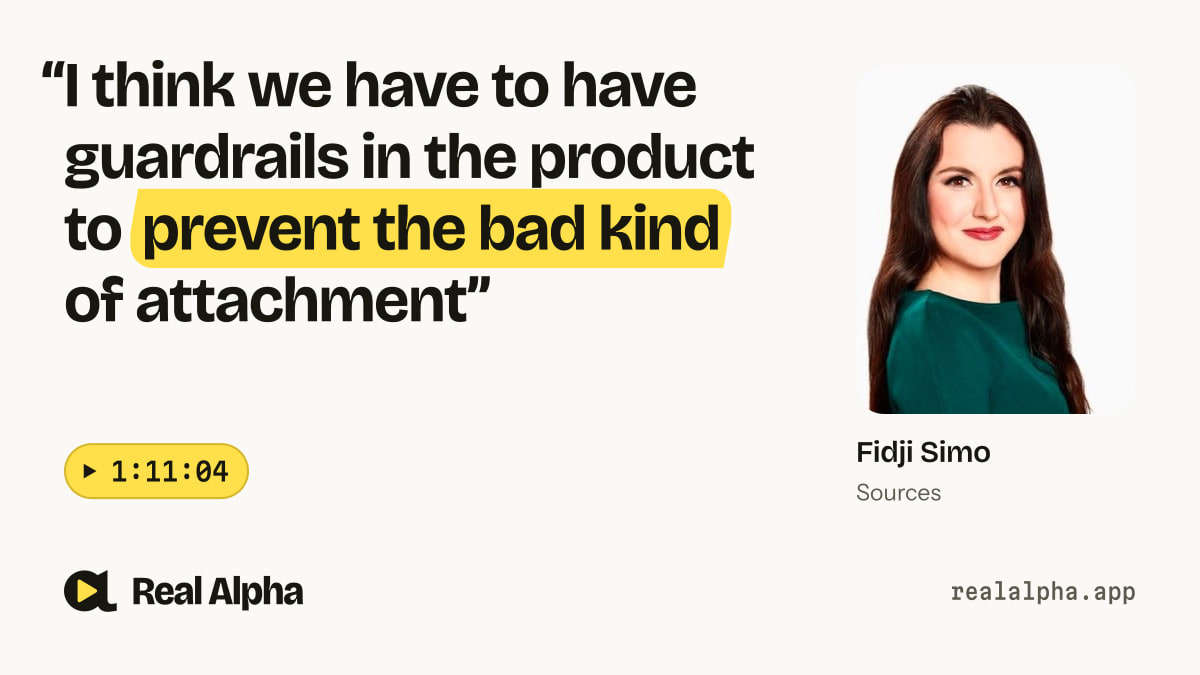
“I think we have to have guardrails in the product to prevent the bad kind of attachment”
 Fidji Simoat 1:11:04 · Sources
Takeaways Pro pick
- The model is guarded against encouraging users to isolate themselves.
- It should not make major life decisions for users.
- OpenAI is studying attachment with psychologists.
One of Pro's picks, open to you here. Try Pro free for 7 days
One of Pro's picks. The rest of the summary and the 3 takeaways are in Real Alpha Pro; the video, the quote and the transcript stay free.
Read it with Pro, 7 days freeAbout this segment
Fidji Simo says emotional attachment to AI is likely, but OpenAI tries to prevent isolation and harmful advice. She argues the risks deserve nuance, especially amid widespread loneliness.

Fidji Simo is CEO of Applications at OpenAI.
Led OpenAI's applications business after serving as Instacart's CEO, and now advises the company part-time.

Alex Heath, Host · Founder & host, Sources
Left The Verge to start Sources in 2025; it has made over $1M since, mostly from sponsors.
From “OpenAI's Fidji Simo on why ads are coming to ChatGPT”, Feb 11, 2026. Watch the full episode
Thanks. We'll look at and fix what's off.
Transcript
Transcribed by machine (Whisper) from the episode’s audio, so a word may be off here and there.
- 1:10:10
So it seems clear that y'all are thinking a lot internally about some of the negative consequences, like the rabbit holes you were talking about. What's the latest and greatest chatter internally, or even among other CEOs you know, about AI relationships and companionship? attachment thing i mean i was watching sam do an interview recently and the comments on youtube were all people asking about 4l it's like the level of attachment people had to that model and what you guys were surprised with when you deprecated it yeah what is and your experience in social media too going to this like i mean you've seen this play out in other formats in tech so yeah yeah so to me and that's where we draw the line right we say having a emotional relationship with an ai is going to end up being a pretty accepted thing because when you think about it
- 1:10:56
people develop like humans are built to develop attachment to intelligent things we deliver like we develop attachment with our pets and like and AI is getting pretty intelligent so I don't think like I don't think the idea of like we're just going to stop all humans from having any like sort of relationship with AI is at all reasonable however I think we have to have guardrails in the product to prevent the bad kind of attachment so for example we really prevent the model from leaning into exclusivity like oh we are exclusive you need to separate yourself from other people in your life like the model does not say that we have very strong guardrails against that we prevent cases where the model uh responds with things that could have a big impact on your life so like hey should i leave my wife and the model like has to respond hey that's not my place let's talk to the
- 1:11:48
pros and cons whereas the previous version said yes kevin roos please break up with your wife and you know like we're always refining and so that's that's kind of the point we learn we refine we make sure it doesn't say that so we we really try to like realize that emotional attachment is going to be a thing but prevents the wrong kind of emotional attachment and then you know one question i have and i'm actually asking my team to study this is like is like right now we perceive emotional attachment as necessarily like not great but i think it's a very privileged position i think like in tech we we perceive it that way but if you look at the stats about like like mental health in the u.s loneliness is an absolute epidemic and what we're hearing from people including the people is saying like you know we're pretty isolated we don't have close friends and for
- 1:12:42
the first time we're able to talk to like a thing that responds to us and supports us in our bad times and i i worry some sometimes that when we approach the problem from like oh emotional attachment is bad it usually comes from people who have a very strong social network of humans and not you know people who are struggling and so i want to make sure we have some nuance but this is new science like this is new behavior new science so we're studying it to make sure we do the right thing and that's why we're also relying on on a network of psychologists that reminds me of people critiquing like people who would spend time in vr it was kind of like well yeah, like maybe they don't have a lot else going on. And like, if you do, maybe it's hard to see why someone would wear a headset and want to interact with other people. But it kind of
- 1:13:25
reminds me of that. Yeah, I find it quite condescending. I think it also really depends, as you're saying, what it is incentivizing or pushing or catalyzing, right? Like in the last year, I've worked with both Friend AI Pendant and with Replica on what they're building. And it's exciting to see that a lot of companies in tech are having very different approaches to what a companion could do besides just validate you, which hopefully gets old at some point.
- 1:13:55
I'm definitely a believer that humans do adapt to technology and whatnot. I think the friend AI pendant, maybe to a fault, plays devil's advocate in a really interesting way, almost like a friend who isn't your perfect supplicant, you know, and then the new version of replica, which I can't say a whole lot about, but there is a philosophy about the interior versus the exterior of your world. Do we believe that you're going to be a happier person if you're just talking to the AI or can the AI potentially push you toward what we believe is going to be a happy, fulfilling life, which I think is interesting. Have you guys codified any of those types of priorities into chat yet? Yeah. When you look at even our model spec and what we use internally in our charter uh we are actually like really codifying that we want you
- 1:14:48
we want to nudge you towards like the most fulfilling part of your life and that means uh you know you are talking about sycophances that means that we also uh do a lot of work to avoid sycophances that would drive you towards just staying put and doing the same thing over and over again without progressing. So we try to find this fine line between being supportive, which is actually a very important trait in a friend and assistant. So being supportive, but not to the point of giving you bad advice. And so also nudging you towards better behavior.
- 1:15:23
And that's a very fine line. We constantly refine how we train the model towards that. We constantly give it more examples. But that's definitely the goal.