The alpha, twice a week
That was 5 min.
Get the best new moments in your inbox every Wednesday and Saturday. It's free.
Check your inbox
We sent a link to your address. Click it to finish signing up. Not there in a minute? Look in spam.
or
Bloomberg Surveillance · 5 min · Nov 9, 2026
AI remains a theme, but the market cycle is repricing it
 Liz Thomas
 sees AI innovation continuing while investors reassess valuations and future capex.
The episode’s best minutes
Full analysis- 2:33AI remains a theme, but the market cycle is repricing itPro pick 5 min
- 8:23AI financing needs more transparency to spot systemic risks6 min
- 15:39Chip export controls need enforcement, not corporate assurances3 min
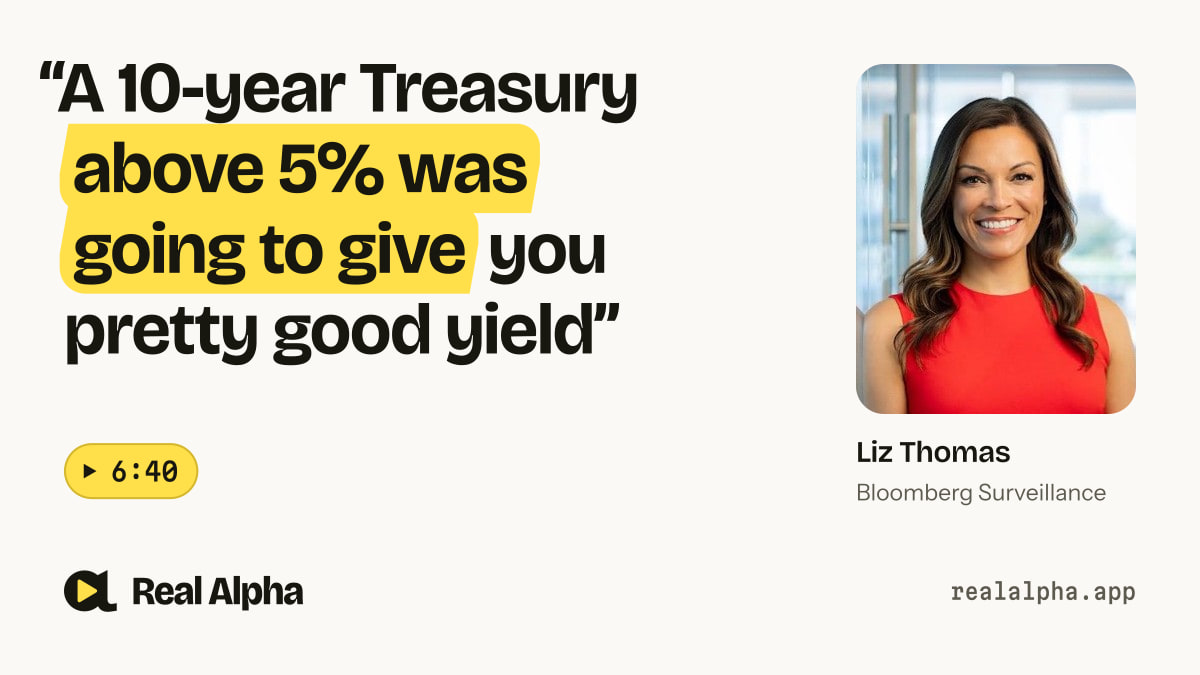
“A 10-year Treasury above 5% was going to give you pretty good yield”
 Liz Thomasat 6:40 · Bloomberg Surveillance
Takeaways Pro pick
- AI's long-term promise doesn't guarantee near-term stock gains.
- Investors were becoming more selective about valuations and capex.
- Treasuries above 5% offered income and protection from a stock selloff.
One of Pro's picks, open to you here. Try Pro free for 7 days
One of Pro's picks. The rest of the summary and the 3 takeaways are in Real Alpha Pro; the video, the quote and the transcript stay free.
Read it with Pro, 7 days freeAbout this segment
Liz Thomas sees AI innovation continuing while investors reassess valuations and future capex. She explains why Treasuries above 5% offered both yield and a hedge.

Chief Market Strategist, Social Finance
Provides economic and market insights to help people take an active role in investing.
- TK
Tom Keene, Host
- PS
Paul Sweeney, Host
- LM
Lisa Mateo, Host
- MB
Michael Barr, Host
From “Bloomberg Surveillance TV: November 9th, 2026 | Bloomberg Surveillance”, Nov 9, 2026. Watch the full episode
Thanks. We'll look at and fix what's off.
Transcript
From the transcript Bloomberg Surveillance publishes with the episode.
- 2:35
And I don't think that this completely puts the build out under threat. I think there's a re-rating going on. And I think there's maybe a coming back down to earth going on where for a long time we were just sort of hand over fist piling money into a lot of the stocks that were levered up to the AI infrastructure build-out. And I don't think that that's necessarily a bad thing still. I still think that that theme lives on. AI absolutely lives on. But there's a difference between the theme itself of innovation and what happens in the market and where we are in that market cycle.
- 3:08
So I think right now, that market cycle, especially for the AI build-out, is looking like it's under threat and maybe we got a little ahead of our skis. Now, there have been some things that happened. Obviously, last week, the huge down day on Thursday brought valuations down again. There, yes, was a recovery on Friday. It's looking like things are going to be a little bit green today. But those recoveries were not all that impressive, right? We still had an advanced decline on the S & P. That was negative on Friday. Today, yes, up, but nothing to really write home about. So, I don't think that there's a bounce back up to all-time highs. I think that we have to level out somewhere, and we will, but this adds another layer of complexity. And the CapEx numbers in 2027 are perhaps some of the ones that are now
- 3:53
in question the most. The Jensen Wong crisis, do you think it's idiosyncratic to NVIDIA? Or do you think this is broader for the AI trade, given how much of a champion he's been? I mean, he's been lobbying this White House for policies that help the entire ecosystem.
- 4:09
I mean, I certainly hope that we don't hear about more similar types of personal crises that come out of it. I think what will likely start to heat up, and it already has today, The chatter around regulations, the fact that we had a blue sweep in Congress last week, and the likelihood of regulations picking up in 2027, I think this probably only fuels that fire further. So idiosyncratic to NVIDIA today, this story, obviously, I hope it stays that way. But the entire complex is going to deal with the idea of possibly more regulations and this investigation being what I'll call a wet sock on the whole thing.
- 4:50
Uphill battle. There's going to be a ton of noise coming out of Washington, D.C. regarding him and other tech executives. Is this a moment where investors, you think, will want to step in and buy the dip? Or potentially, is this just a falling knife that's going to keep falling?
- 5:03
I think we're already seeing some buy the dip behavior. And as I mentioned earlier, I think the AI theme is still well intact. And in the innovation cycle, we're probably still pretty early in the innovation cycle. So the buy the dip mentality, I don't think is quite there without discernment. And I don't think that it comes in and takes us back up to where we were. But I do think that investors are going to use this as somewhat of an opportunity. But this is really only the first trading day after this news came out over the weekend. Usually it takes a few days for the market to really figure out what it thinks about the entire thing. So I would be waiting a few days to let some of the dust settle and see how semis shake out for the rest of this week.
- 5:44
You said bonds are starting to look good again, and yet we got a hotter-than-expected labor market report on Friday. CPI is expected to come in below where we got it in September at the same time, still running above the 2% target. What's the argument here? Is it that the economy is going. To slow, or just that people are seeing another alternative in a way that they hadn't before? I think it's more the latter.
- 6:09
And when I started thinking about this, the first time the 10-year Treasury hit 5%, is when I started to really think about it as, you know what, that looks like an attractive opportunity. And if our job in markets is to help people make money, generate income, perhaps, depending on what your goals are, it started to look like an opportunity. And I was honestly having trouble finding a reason not to buy it.
- 6:31
So there's this long-term. Thread about the deficit and the debt, and everybody is concerned about that, which I totally understand. That remains a large problem without an easy solution. But in the near term. A 10-year Treasury above 5% was going to give you pretty good yield, and I couldn't imagine a world where the Fed or the Treasury was going to let it stay at 525 or even get up to 6 for a very long time, right?
- 6:57
It could still crawl back. In that direction, but I couldn't imagine a world where the market left it there for a long time. So that alone, it was a good trade-off, as we talked about before. The other thing is, if you want hedging against some sort of outside shock that could happen and really take stocks down, take market sentiment down pretty far if we had some cracks that started to show up in the economy, getting a 10-year and even a two-year Treasury at those high yields when if the Fed— if there's a risk that the Fed actually has to turn dovish at some point in the next six months— Those were good entry points. So that was my thesis. And again, I was having trouble finding a reason not to buy them at the time.